
Emissions regulations are tightening globally – Euro 7, EPA 2027, China 7, IMO Tier III, and beyond. No single technology solves every challenge. Diesel, gasoline, hybrid, industrial, marine, and non-road applications each demand tailored aftertreatment architectures. Our **Technical Solutions Overview** provides a comprehensive roadmap of our emissions control capabilities – from catalyst substrates and coatings to fully integrated systems with remote monitoring. Whether you need a high-flow TWC for a sports car, a DOC+DPF+SCR system for a mining haul truck, or a catalytic baghouse for a waste incinerator, we deliver engineered solutions that balance performance, durability, and cost.
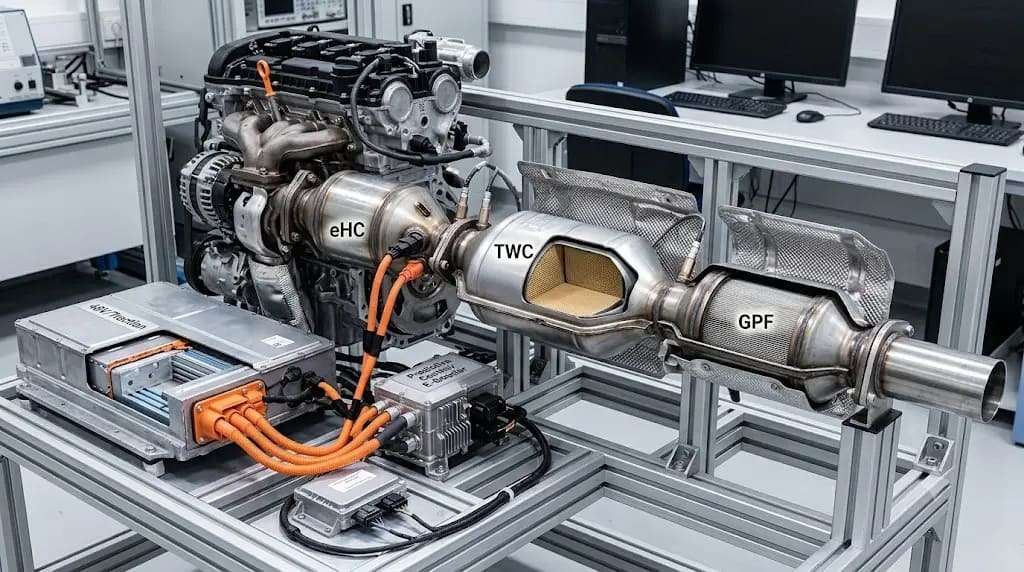
Complete HEV/PHEV system architecture:
Engine → Electrically Heated Catalyst (eHC) → Close-coupled TWC → Underfloor GPF (GDI) → Tailpipe
Component integration with hybrid powertrain: eHC powered by high-voltage battery (48V or traction battery). Thermal management integrated with battery cooling system. Predictive controls connected to navigation and driver behavior.

How it works: The eHC is a resistive heating element integrated into or upstream of the TWC substrate. When the engine is off, the eHC maintains catalyst temperature above light-off. When the engine restarts, the eHC rapidly reheats the catalyst – 300°C in <10 seconds.
Construction: Metallic foil substrate (FeCrAlloy) with printed resistive heating tracks. Ceramic substrate with embedded conductive grid (emerging). 48V power supply (from hybrid battery). Heater power: 1-4 kW depending on catalyst volume and target temperature. Integrated temperature sensors for closed-loop control.
Operating modes:
Energy consumption: Standby heating: 50-100 Wh per hour of electric driving. Rapid reheat: 5-10 Wh per restart. Cold-start assist: 15-30 Wh (once per trip). Total energy <3% of battery capacity for typical PHEV duty cycle.
How it works: Active and passive strategies maintain catalyst temperature during engine-off periods, extending the time before eHC activation is needed and reducing battery drain.
Passive thermal retention: Insulation: ceramic fiber wrap or aerogel blanket around catalyst housing (reduces heat loss by 50-70%). Heat storage materials: phase-change materials (PCM) or high-specific-heat ceramics embedded in catalyst housing. PCM stores heat during engine operation (melting at 300°C) and releases heat during engine-off periods (solidifying at 280°C). Extends cool-down time from 15 minutes to 45+ minutes with zero battery drain.
Active thermal management: Coolant-based heating: engine coolant (or separate electric heater) circulates through catalyst housing. Integrated with battery thermal management system. Redundant heating paths: eHC + coolant + PCM ensure catalyst readiness in all conditions. ECU-controlled based on predicted engine restart.
How it works: The TWC substrate is designed for rapid heating and cooling – minimizing the energy required to reach and maintain light-off temperature.
Thin-wall metallic substrate: Preferred for eHC integration (heater printed directly on substrate). Lower thermal mass than ceramic: 300°C reached in 5-10 seconds vs. 15-20 seconds for ceramic. Cell density: 400-600 cpsi. Wall thickness: 2-3 mil (0.05-0.08 mm). FeCrAlloy foil construction. Open frontal area >90%. Withstands 950°C+ peak temperatures.
Volume optimization: Smaller volume than conventional TWC (eHC compensates for reduced thermal mass). Engine displacement × 0.8-1.0. Faster light-off from lower thermal inertia. Reduced backpressure.
How it works: Formulated for high oxygen storage capacity (OSC) to buffer air-fuel ratio fluctuations during engine restarts.
Composition: Ceria-zirconia content: 40-50% of washcoat. Pd:Rh ratio optimized for fast light-off. Stabilizers (La, Ba) maintain surface area and OSC after thermal cycling. Base metal promoters (Ni, Co) for low-temperature activity.
Performance: OSC: 600-1,000 µmol O₂/g. Light-off (T50): 180-220°C. Maintains >95% conversion during lambda transients.
How it works: ECU predicts engine restart events using navigation, traffic, and driver behavior data – enabling pre-heating before engine start.
Predictive algorithms: GPS and navigation data predict electric-only range and engine restart points. Machine learning model learns driver behavior. Cloud-based route optimization maintains catalyst temperature. Pre-heating triggered by approaching highway on-ramp.
Vehicle-to-grid (V2G) integration: Catalyst pre-heating scheduled during charging (uses grid power, not battery).
Parameter | Conventional TWC | HEV/PHEV System with eHC | Improvement |
Cold-start light-off time | 30-45 seconds | 5-10 seconds (eHC) / 15-25 seconds (PCM) | -50-80% |
Cold-start CO/HC/NOx | 60-80% of trip emissions | <10% of trip emissions | -80-90% |
Temperature drop (10 min EV driving) | 400°C → 100°C | 400°C → 250°C (PCM) / 400°C → 200°C (insulation) | Minimized |
NOx conversion (after engine restart) | 60-70% (cold catalyst) | 90-95% (pre-heated) | +25-35% |
Fuel penalty (catalyst heating) | N/A | <1% (eHC energy from battery) | N/A |
Hybrid Type | Battery Size | Electric Range | Recommended System | Key Considerations |
Mild hybrid (48V) | 0.5-1 kWh | <1 km (assist only) | Thin-wall TWC + insulation | Frequent engine starts, low battery capacity |
Full hybrid (HEV) | 1-2 kWh | 2-5 km | eHC (1-2 kW) + PCM + insulation | Moderate EV periods, regen braking recovery |
Plug-in hybrid (PHEV) | 10-20 kWh | 30-80 km | eHC (2-4 kW) + PCM + insulation + predictive controls | Extended EV periods, charging station pre-heat |
Range-extended EV (REEV) | 20-40 kWh | 150-300 km | eHC (1-2 kW) + PCM + predictive OBD | Engine may not run for days, must maintain OBD readiness |
eHC maintains catalyst at light-off temperature continuously. PCM and insulation extend EV driving without battery drain. Predictive controls ensure catalyst ready before engine restart. Compliant with Euro 7 RDE.
Maximizes electric-only driving. Engine operates only when optimal for emissions. Preserves hybrid fuel economy benefit.
Catalyst monitor active during engine operation. eHC electrical circuit monitored. PCM temperature and thermal cycle counted. Predictive OBD model estimates catalyst aging.
HEV (48V, small battery): lower eHC power, PCM critical. PHEV (large battery): higher eHC power, predictive controls essential. REEV (very large battery): minimal battery drain, OBD-focused.
We engineer complete HEV/PHEV aftertreatment systems for any electrified platform. Our team tailors eHC power rating, substrate material, TWC formulation, PCM selection, insulation strategy, and predictive control algorithm to your hybrid architecture, battery capacity, and regulatory target.
Partner with us to define your path to compliance – hybrid efficiency, catalyst readiness.