
Exploring the engineering behind Diesel Exhaust Fluid (DEF) dosing systems and their role as the precision delivery mechanism enabling Selective Catalytic Reduction (SCR) for diesel engines.
Selective Catalytic Reduction (SCR) requires a controlled amount of ammonia (NH₃) to reduce NOx into N₂ and H₂O. Transporting pure ammonia is hazardous, so systems inject Diesel Exhaust Fluid (DEF) – a 32.5% high-purity urea solution. The urea decomposes into NH₃ before entering the SCR catalyst. Urea injection systems precisely meter DEF into the exhaust stream based on engine operating conditions. A well-calibrated system delivers 90–99% NOx conversion while minimizing ammonia slip. These systems are mandatory for modern diesel vehicles (Euro 4/5/6, EPA 2010+, China 4/5/6) and increasingly for stationary engines, marine diesels, and off-highway equipment.
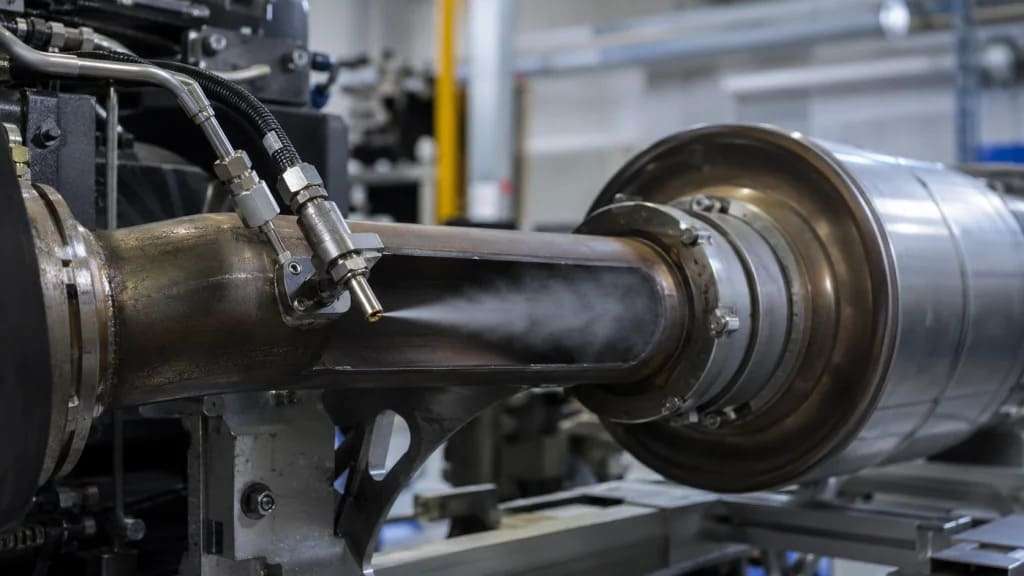
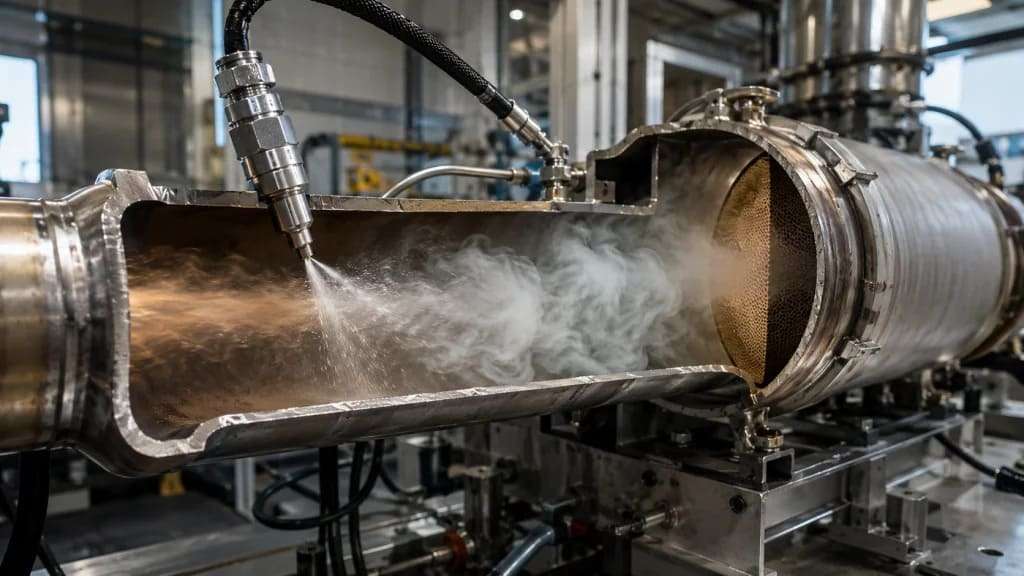
The system transforms liquid DEF into gaseous ammonia, mixes it uniformly with exhaust, and delivers it to the SCR catalyst – all while surviving harsh exhaust conditions (thermal cycles, vibration, freezing).

DEF is 32.5% automotive-grade urea (NH₂)₂CO, 67.5% deionized water. Key properties: freezes at -11°C (12°F), decomposes above 130°C (266°F), pH 9–10 (mildly alkaline). ISO 22241 standard defines purity: <0.3% biuret, <10 ppm insoluble matter, <5 ppm phosphates, <2 ppm calcium/magnesium/sodium. Low-quality DEF (contaminated with water, oils, or particulates) clogs injectors, poisons SCR catalysts, and triggers OBD faults.
DEF quality sensor: Monitors urea concentration (32.5% ± 0.5%) via ultrasonic velocity or refractive index. Triggers warnings if adulterated or diluted.
DEF tank: Polyethylene or stainless steel, 5–50+ liters. Includes filler neck (blue cap, standardized), vent, suction port, return port, level sensor, quality sensor, and heating elements (for cold climates).
DEF pump module: Immersed or inline. Delivers 2–10 bar (29–145 psi) pressure. Direction control valves enable forward (injection) and reverse (purge) flow – critical for preventing freezing by draining the line after engine shutdown.
DEF injector (doser): Precision solenoid injector mounted in the exhaust pipe upstream of SCR. Flow rates 0.1–10 kg/hour depending on engine size. Internal or external cooling protects against exhaust temperatures (300–600°C / 572–1,112°F). Stainless steel body with fine mesh filter (10–30 µm) prevents nozzle clogging.
Mixing element: Static mixer (twisted vanes) or perforated plate ensures uniform NH₃ distribution across the SCR face. Poor mixing causes localized NH₃ slip or incomplete NOx reduction.
Control unit (DCU): Standalone or integrated into engine ECU. Receives signals from NOx sensors (pre/post SCR), temperature sensors (pre SCR), exhaust mass flow, and engine operating parameters. Calculates required DEF dose and commands injector pulses.
Heating system (cold climates): Electric (PTC resistance heaters) or engine coolant circulation thaws frozen DEF, heats the tank, pump, and supply line. Required for vehicles operating below -11°C.
Base dose calculation: ECU determines engine-out NOx (modeled or measured by upstream NOx sensor) and multiplies by exhaust mass flow (from air meter or map) to calculate NOx mass flow (g/sec). Required NH₃ mass = NOx mass × 2 (stoichiometric ratio for standard SCR: 4NO + 4NH₃ + O₂ → 4N₂ + 6H₂O). Required DEF mass = NH₃ mass × (60.06/34.08) × (1/0.325) – the factor accounts for urea molecular weight (60.06 g/mol), NH₃ molecular weight (34.08 g/mol), and DEF concentration (32.5%).
Simplified factor: 1 g NOx requires approximately 1.2 g DEF.
NH₃ storage control (closed-loop): Cu-zeolite SCR catalysts store NH₃ in zeolite pores at lower temperatures (150–250°C). The ECU models NH₃ storage level based on dosing history, temperature, and exhaust flow. It doses extra DEF during low-load operation to “fill the tank,” then reduces or stops dosing while stored NH₃ continues reducing NOx. After regeneration or high-temperature events, stored NH₃ desorbs – the ECU compensates.
Post-injection & active regeneration: During DPF regeneration, high exhaust temperatures (>600°C) convert NH₃ to NOx instead of reducing it. The ECU stops dosing until temperatures fall below 500°C or uses a bypass strategy.
Injected DEF droplets undergo two reactions before reaching the SCR catalyst:
Spray atomization & evaporation (50–150°C / 122–302°F): High-pressure injection (2–10 bar) shears DEF into droplets (Sauter mean diameter 30–80 µm). Droplets evaporate as they absorb exhaust heat, leaving solid urea particles.
Thermolysis (133–200°C / 271–392°F): (NH₂)₂CO (solid) → NH₃ (gas) + HNCO (isocyanic acid gas). Requires >133°C; incomplete below 160°C.
Hydrolysis (180–350°C / 356–662°F): HNCO + H₂O → NH₃ + CO₂. Requires water vapor (abundant in diesel exhaust) and is catalyzed by the SCR catalyst surface or a dedicated hydrolysis coating. Rate-limited below 200°C.
Complete conversion requires: Sufficient exhaust temperature (>180°C), adequate mixing distance (200–500 mm from injector to SCR face), and uniform flow distribution. At low temperatures (<180°C), DEF crystallizes as solid deposits (urea, biuret, cyanuric acid, ammelide) – these clog the mixer, increase backpressure, and block NH₃ delivery. Many systems include a crystallization detection strategy (pressure sensor or temperature differential) and perform “de-crystallization” by raising exhaust temperature.
The NH₃-laden exhaust enters the SCR catalyst:
Standard SCR (dominant, 70–90%): 4NO + 4NH₃ + O₂ → 4N₂ + 6H₂O
Fast SCR (preferred, requires 50:50 NO:NO₂ from upstream DOC): 2NO + 2NO₂ + 4NH₃ → 4N₂ + 6H₂O
NO₂ SCR (minor, slower): 4NO₂ + 4NH₃ + O₂ → 4N₂ + 2N₂O + 6H₂O (N₂O is an undesirable greenhouse gas).
NH₃ oxidation (undesirable, reduces efficiency): 4NH₃ + 3O₂ → 2N₂ + 6H₂O (above 450°C).
Conversion efficiency: 90–99% in optimal window (250–450°C / 482–842°F). Below 200°C, efficiency drops sharply (slow kinetics, poor NH₃ storage). Above 500°C, NH₃ oxidizes before reducing NOx.
A downstream ASC (typically Pt on alumina) oxidizes unreacted NH₃: 4NH₃ + 3O₂ → 2N₂ + 6H₂O. Target tailpipe NH₃ <10–50 ppm (regulated). Modern ASCs are selective – they minimize N₂O formation and avoid oxidizing NH₃ to NOx.
NOx sensors (2 required): Upstream (engine-out) and downstream (tailpipe, post-SCR/ASC). Cross-sensitivity to NH₃ (reads as false NOx) is managed by algorithm. The ECU calculates SCR conversion efficiency. If efficiency falls below threshold (typically 75–85%), OBD fault sets.
Temperature sensors (2–3): Pre-DOC, pre-SCR, post-SCR. Ensure SCR is active (>175°C) and prevent overheating (>550°C).
DEF quality sensor: Detects water, low urea concentration (<30%), or contamination.
DEF level sensor: Alerts driver when low (<10% remaining).
Inducement strategy (heavy-duty vehicles): Progressive warnings (visual, audible) as DEF depletes: Level 1 (<20% remaining, warning); Level 2 (<10%, warning + engine power derate 25%); Level 3 (<2.5%, derate 75% or speed limit 5 mph / 8 km/h). Prevents operation without DEF.
We don’t just supply urea injectors – we engineer complete dosing systems. Whether you require a 0.5 kg/hour injector for a 2.0L passenger diesel or a 10 kg/hour system for a 15L heavy-duty truck, our team tailors nozzle design, flow characteristics, heating strategy, and control algorithms to your engine’s NOx output, exhaust temperature profile, and packaging constraints.
Partner with us to define your path to compliance.
Solid ammonia storage (AdAmmine): Strontium chloride (SrCl₂) or magnesium chloride (MgCl₂) salts store ammonia reversibly. Heated salt releases NH₃ directly – no DEF, no freezing, no crystallization. Downside: higher cost, limited refueling infrastructure.
Ultrasonic & air-assisted dosing: High-frequency vibration or compressed air atomizes DEF into finer droplets (10–30 µm SMD), reducing crystallization risk and improving low-temperature performance (<150°C). Emerging for Euro 7 and cold-climate applications.
Electrically heated injectors: Resistive heating elements inside the injector nozzle prevent freezing at shutdown and enable instant dosing after cold start. Integrated temperature sensor provides closed-loop control.
Digital twin & predictive dosing: ECU learns driving patterns (route topography, ambient temperature, historical load) and pre-conditions the SCR system (pre-heating, NH₃ pre-storage) to optimize cold-start NOx reduction. Enabled by connected vehicle data.
The urea injection system is not a simple pump – it is a precision chemical metering system operating in one of the harshest environments on a vehicle. A well-engineered system delivers 90–99% NOx conversion, survives 700,000+ km of real-world operation, and ensures regulatory compliance across temperature extremes from -40°C to +60°C. Whether you are developing a passenger car diesel, a long-haul truck, a city bus, or a stationary genset, urea injection will define your NOx compliance – and we are ready to engineer the solution.