
Exploring the engineering behind the Diesel Particulate Filter (DPF) and its role as the essential filtration and regeneration solution for capturing particulate matter from lean-burn diesel engines.
Diesel combustion in the engine generates exhaust containing not only gases but also solid carbonaceous particles (soot), soluble organic fraction (SOF), and ash. A Diesel Particulate Filter (DPF) then traps these particulates physically while allowing exhaust gases to pass through. Over time, the accumulated soot is removed through controlled regeneration (oxidation), converting it into CO₂. Finally, the cleaned exhaust—now nearly free of visible smoke and fine particulates—continues downstream to other aftertreatment devices or the tailpipe. This filtration-regeneration cycle ensures that modern diesel engines meet stringent particulate number (PN) and particulate mass (PM) limits.
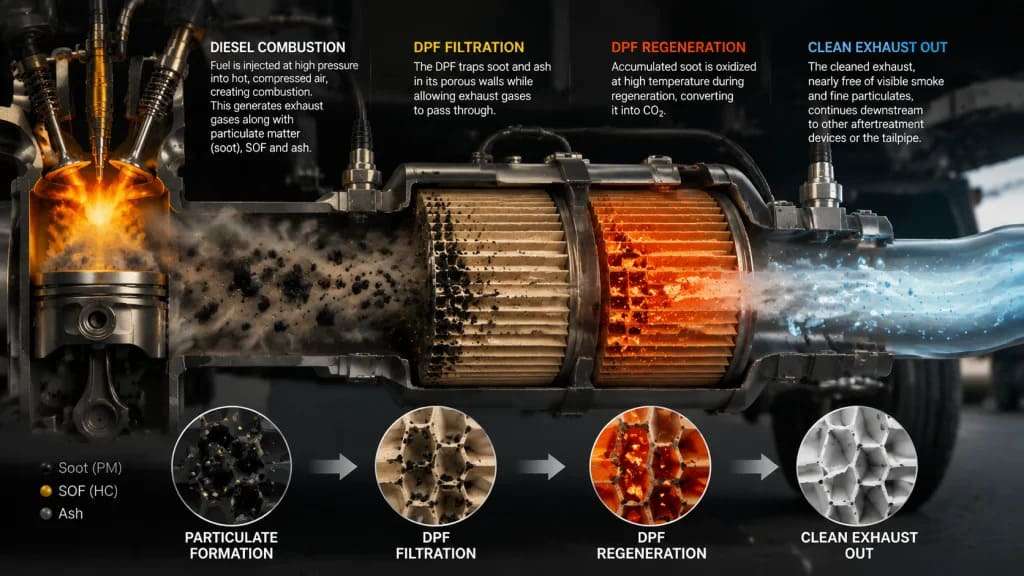
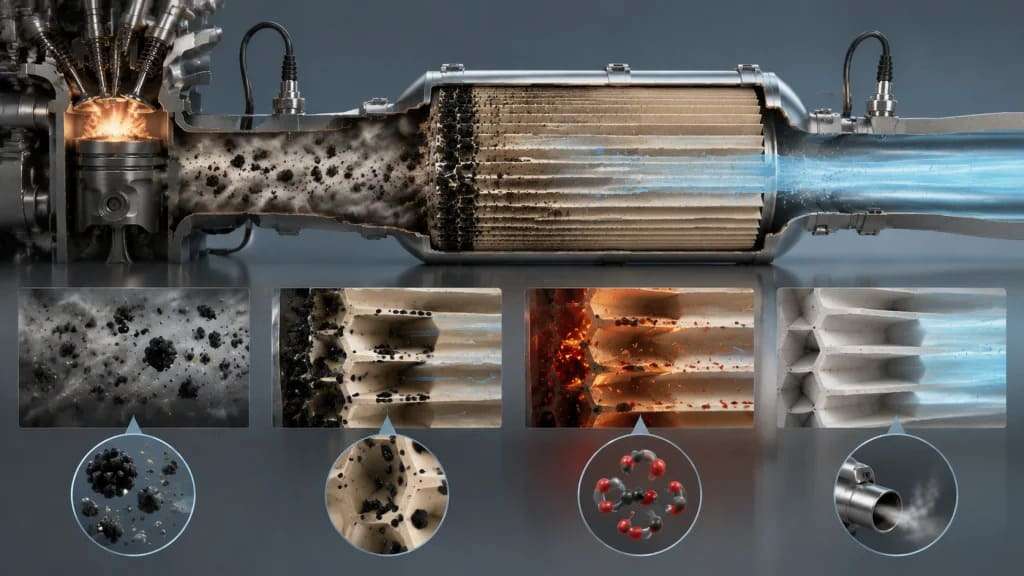
Unlike flow-through catalysts (DOC, SCR), which rely on chemical reactions, the DPF uses physical wall-flow filtration. Diesel exhaust contains a wide distribution of particulate sizes, from coarse soot agglomerates down to nanoparticles (<23 nm) that are most harmful to human health.
The DPF is the only device capable of capturing >99% of these particles while maintaining acceptable backpressure. Its wall-flow design forces exhaust to pass through porous ceramic walls, trapping soot on the inlet channels while cleaned gas exits through the outlet channels.
Why the DPF is mandatory:
Modern diesel engines (especially with high-pressure common-rail injection) produce very low PM mass but high numbers of nanoparticles—invisible but dangerous.
– Without a DPF, even “clean” diesel engines would fail Euro 5/6 and EPA 2007+ PN limits by orders of magnitude.
– The DPF also traps metallic ash from engine oil (Ca, Zn, Mg, P), which accumulates permanently and determines filter service life.

The journey of particulate-laden exhaust through the DPF system follows a precise technical path of filtration, monitoring, and regeneration.
The process begins in the combustion chamber. High-pressure direct injection, multiple pilot injections, and optimized swirl create a more homogeneous air-fuel mixture, reducing soot formation at the source. However, some soot is inevitable—especially under high-load or transient conditions. The Engine Control Unit (ECU) manages EGR rate, boost pressure, and injection timing to balance NOx vs. soot (the classic diesel trade-off). The DPF handles whatever soot remains.
As exhaust exits the DOC (where some HC and CO have been oxidized, and NO has been partially converted to NO₂), it enters the DPF. The filter is typically made of Cordierite or Silicon Carbide (SiC) both ceramic materials with high thermal shock resistance and filtration efficiency.
Location: Downstream of the DOC (and often upstream or integrated with SCR).
Filter structure:
Inlet channels: Open at the front, plugged at the rear.
Outlet channels: Plugged at the front, open at the rear.
Porous walls: Typically 10–20 µm thick with 10–30 µm pore size.
Filtration mechanism: Exhaust enters the inlet channels, passes through the porous walls (soot particles are too large to fit through the pores), and exits via the outlet channels. Cleaned exhaust then flows to downstream components (SCR, tailpipe).
Efficiency: >99% of all solid particles—down to 5–10 nm—are captured.
As soot accumulates, backpressure rises, reducing engine efficiency and increasing fuel consumption. The DPF must be cleaned (regenerated) periodically. There are three regeneration modes:
Passive Regeneration (Continuous)
Occurs automatically at normal operating temperatures (250–350°C / 482–662°F).
Requires NO₂ from the upstream DOC: **C + 2NO₂ → CO₂ + 2NO**.
Effective only with sufficient NOx/soot ratio (typical in highway driving).
Active Regeneration (Periodic)
– Triggered when soot load exceeds a calibrated limit (typically 4–6 g/L).
– The ECU raises exhaust temperature to 550–650°C (1022–1202°F) by:
– Late post-injection(s) of fuel into cylinders.
– Burning that fuel on the DOC to generate exotherm.
– At high temperature, soot oxidizes with O₂: **C + O₂ → CO₂**.
Service Regeneration (Stationary)
– Performed in a workshop when passive/active regeneration cannot complete (e.g., frequent short trips).
– Forced regeneration using diagnostic tools at higher temperatures and longer durations.
Failure to regenerate: Leads to excessive backpressure, engine derate, and eventual DPF cracking or melting.
A Differential Pressure Sensor measures pressure drop across the DPF (P1 upstream – P2 downstream). The ECU calculates soot load using:
– Delta-P (pressure difference)
– Exhaust mass flow rate
– Temperature
– Modeled soot generation rate
When calculated soot load reaches a threshold, the ECU commands active regeneration. If regeneration fails repeatedly, the OBD system illuminates the malfunction indicator light (MIL) and may require service regeneration or DPF replacement.
A temperature sensor before and after the DPF monitors regeneration exotherm to prevent thermal damage (max substrate temperature typically <800°C / 1472°F for cordierite, <900°C / 1652°F for SiC).
We don’t just manufacture DPFs; we engineer them to meet the precise demands of your specific diesel technical route. Whether you require a high-porosity, low-backpressure SiC DPF for a high-horsepower heavy-duty truck, or a compact, fast-light-off cordierite DPF for a passenger car diesel, our team can tailor the substrate material, pore size distribution, wall thickness, and channel density to your exact engine characteristics and driving cycles.
Partner with us to define your path to compliance.
With Euro 7, EPA 2027, and China 7 tightening PN limits for all driving conditions (including cold start and short trips), the DPF remains non-negotiable. However, the hardware is evolving.The modern high-efficiency diesel route now looks like this:
Engine → DOC → DPF → SCR → Tailpipe (or DOC + DPF + SCR + ASC)
SCR catalyst coated directly onto the DPF substrate.
Benefit: Saves space, reduces backpressure compared to separate DPF+SCR cans, and enables passive NOx reduction simultaneously with filtration.
Challenge: Thermal management for regeneration must protect the SCR coating.
Combines all three functions in a single brick.
Benefit: Ultra-compact for hybrid vehicles and tight engine bays.
Challenge: Complex washcoat layering (oxidation + storage + reduction functions on one substrate).
– Small, high-cell-density TWC close-coupled (for fast light-off of gases), followed by a larger, high-porosity cGPF underfloor (for particulate filtration and polishing gas conversion).
Benefit: Optimizes each brick for its specific function—gas conversion for the close-coupled TWC, filtration for the underfloor GPF.
Application: High-performance vehicles and large SUVs with high exhaust flow rates.
Hydrotreated Vegetable Oil (HVO) and other paraffinic fuels produce near-zero soot, dramatically extending DPF regeneration intervals.
However, engine oil ash remains the lifetime limiter—low-ash oils (CJ-4, CK-4, E9) are essential.
The DPF is not just a filter—it is a thermal and chemical reactor in its own right. It must capture, store, and oxidize particles across a wide range of engine loads, temperatures, and driving behaviors. A well-engineered DPF balances high filtration efficiency (>99%), low backpressure (<10 kPa at rated power), durability (>500,000 km for heavy-duty), and regeneration reliability