
|

HENTEK CAT Catalyst & Catalytic Converter Solutions

Technical Route – Motorcycles Mini TWC + Muffler

The Integrated Exhaust Solution for Two-Wheelers

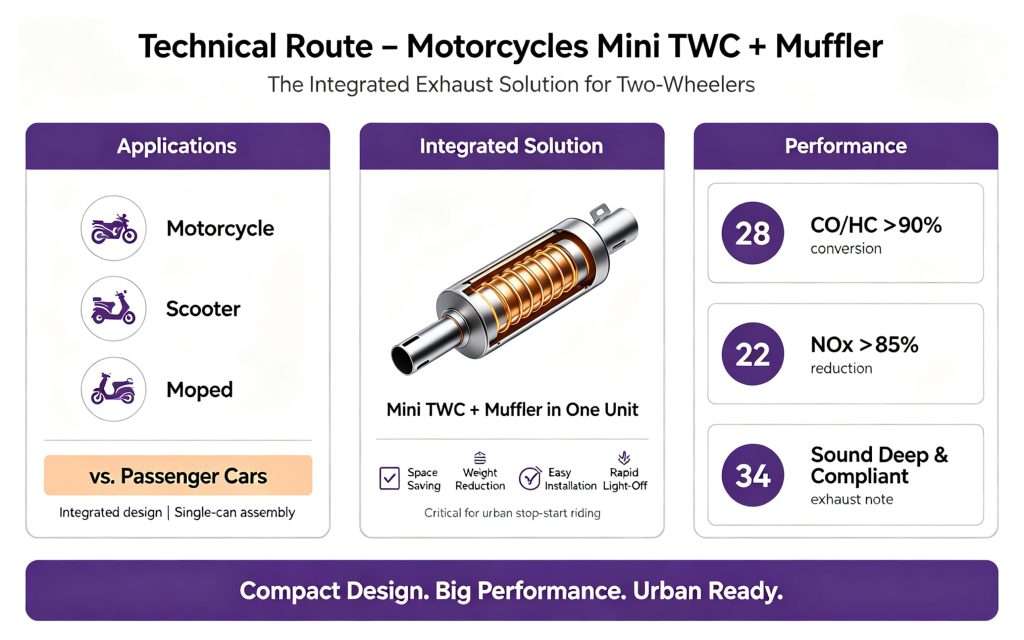
Motorcycles, scooters, and mopeds face unique emissions challenges: compact packaging, extreme vibration, frequent cold starts, and cost sensitivity. Unlike passenger vehicles with separate catalytic converter and muffler assemblies, the mini TWC + muffler technical route integrates the Three-Way Catalyst (TWC) directly into the exhaust silencer. This single-can solution saves space, reduces weight, simplifies installation, and ensures rapid light-off – critical for urban stop-start riding. Meeting Euro 5, Bharat Stage VI, China 4, and EPA standards, this integrated approach delivers >90% CO/HC conversion and >85% NOx reduction while producing the deep, compliant exhaust note riders expect.
The Mini TWC + Muffler Pathway

Complete system architecture:
Engine → Exhaust header → Integrated mini TWC + muffler → Tailpipe

Step 1: Metallic Substrate – The Motorcycle Advantage

Unlike automotive ceramic substrates, motorcycles require metallic honeycomb substrates (FeCrAlloy foil) due to extreme vibration from single-cylinder and twin-cylinder engines.

Construction:

  • Corrugated and flat foil layers wound into a spiral or stacked
  • Cell density: 200-600 cpsi (cells per square inch)
  • Wall thickness: 2-3 mil (0.05-0.08 mm) – much thinner than ceramic
  • Open frontal area >90% minimizes backpressure

Vibration resistance:

  • All-welded construction prevents substrate fracture (ceramic substrates crack under vibration)
  • Withstands 5-10g at 50-200 Hz
  • No fragile bonding agents

Fast light-off:

  • Low thermal mass reaches 250°C in 15-30 seconds from cold start (ceramic: 45-60 seconds)

Critical for short urban trips (2-5 km) where most cold-start emissions occur

Step 2: TWC Washcoat – Three-Way Conversion

The metallic substrate is coated with palladium-rhodium (Pd/Rh) washcoat – same precious metal chemistry as automotive TWC but optimized for motorcycle conditions.

Composition:

  • Pd loading: 1-3 g/L (primary HC/CO oxidation)
  • Rh loading: 0.1-0.2 g/L (primary NOx reduction)
  • Ceria-zirconia (CZ) for oxygen storage capacity (OSC) – buffers air-fuel ratio fluctuations

Reactions under stoichiometric operation (lambda = 1.00):

  • CO + ½O₂ → CO₂ (oxidation)
  • HC + O₂ → CO₂ + H₂O (oxidation)
  • NO + CO → ½N₂ + CO₂ (reduction – requires CO as reductant)

OSC mechanism:

  • Lean spikes (excess O₂): Ce₂O₃ + O₂ → 2CeO₂ (ceria stores oxygen)
  • Rich spikes (O₂ deficit): 2CeO₂ + CO → Ce₂O₃ + CO₂ (ceria releases oxygen)
  • Maintains conversion for 1-2 seconds during lambda transients

Performance:

  • CO/HC conversion: >90% at operating temperature
  • NOx conversion: 80-90% at operating temperature
  • Light-off (T50): 200-250°C

Step 3: Muffler Integration – Sound and Spark Arresting

The TWC is housed within the muffler can – either as a pre-silencer or as a mid-bed within the main silencing chamber.

Chamber design:

  • Inlet chamber: exhaust gas enters from header
  • Catalyst chamber: mini TWC substrate (50-150mm length) – gas passes through for conversion
  • Perforated tube + packing chamber: acoustic fiberglass or stainless steel wool absorbs high-frequency noise
  • Outlet chamber: final expansion before tailpipe

Spark arresting:

  • Screen or perforated plate after catalyst captures glowing carbon particles
  • Required for off-road and some street-legal applications

Sound tuning:

  • Backpressure targets: 2-5 kPa at peak power (minimal power loss)
  • Exhaust note: deep, mellow tone (no harsh rasp)
  • Volume: 75-85 dB at idle, 85-95 dB at WOT
  • Drone elimination at cruising speeds (2,500-4,000 rpm)

Step 4: Packaging and Sizing

Volume rule:

  • Mini TWC volume (cm³) = engine displacement (cc) × 0.5 to 1.0
  • Example: 150cc scooter → 75-150 cm³ TWC (≈50mm diameter × 40-75mm length)
  • Muffler can diameter: 80-120mm (matches chassis clearance)
  • Overall length: 250-450mm (compact enough for under-belly or side-mount)

Mounting:

  • Rubber-isolated hangers absorb vibration
  • Spring-loaded joints allow thermal expansion
  • Heat shields prevent rider leg burns (<180°C surface temperature)

Lambda sensor integration (EFI models):

  • Bung for M18×1.5 oxygen sensor (pre-catalyst, closed-loop fueling)

Bung for post-catalyst sensor (OBD catalyst monitor, optional)

Step 5: Oxygen Sensor Feedback (Closed-Loop EFI)

For Euro 5, BS VI, and China 4 EFI models, a lambda sensor upstream of the mini TWC provides real-time feedback.

Operation:

  • UEGO (wideband) sensor measures lambda 0.7–1.3
  • ECU targets lambda = 1.00 ± 0.01
  • Fuel injection adjusted every 100-200 ms
  • Maintains TWC at peak efficiency window

Carbureted engines (no closed-loop):

  • Richer calibration (0.9-0.95 lambda) to prevent lean misfire
  • Higher OSC washcoat (40-50% CZ) buffers wider AFR swings
  • Slightly lower conversion efficiency (75-85%) but acceptable for Euro 3/4

Step 6: GPF Integration (GDI Motorcycles)

Emerging GDI scooters and motorcycles require particulate filtration – added without increasing system length.

Catalyzed GPF (cGPF):

  • TWC washcoat applied to wall-flow filter substrate
  • One brick replaces TWC + GPF – same package size
  • Filtration efficiency >99% for particles >23 nm
  • Passive regeneration during normal riding (exhaust 500-700°C)

Suitable for Euro 5+ and China 4 GDI models

Performance Benchmarks

Parameter

Carbureted + Mini TWC

EFI + Mini TWC

EFI + cGPF (GDI)

CO conversion

75-85%

90-95%

90-95%

HC conversion

75-85%

90-95%

85-90%

NOx conversion

70-80%

85-90%

85-90%

PN filtration

N/A (PFI)

N/A (PFI)

>99%

Light-off time

20-30 sec

15-25 sec

20-30 sec

Backpressure (kPa)

2-4

2-4

3-5

Key Advantages of the Mini TWC + Muffler Route

Integrated packaging: One can replaces two (catalytic converter + muffler). Saves 30-50% under-belly space. Reduces part count and assembly time. Lighter weight (2-4 kg vs. 3-6 kg for separate components).

Rapid light-off: Metallic substrate reaches light-off in 15-30 seconds (ceramic: 45-60 seconds). Captures 60-80% of cold-start emissions. Meets Euro 5 cold-start requirements without electric heating.

Vibration durability: Welded metallic substrate withstands single/twin-cylinder vibration. No ceramic cracking. Service life: 30,000-50,000 km.

Cost-effective PGM: Pd/Rh only (no Pt – higher cost). Loading: 1-2 g/L (vs. 2-4 g/L automotive). Optimized for motorcycle duty cycle.

Sound compliance: Meets ECE R41 (Europe), 40 CFR Part 205 (US EPA), and local noise ordinances. Deep tone without drone. Spark arrestor for fire safety (off-road models).
Our Engineering Expertise

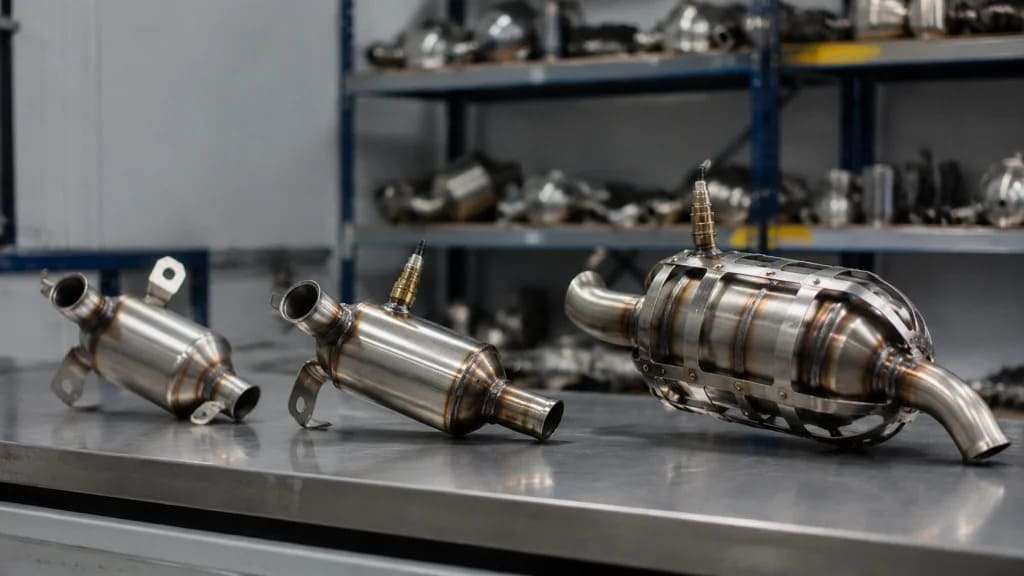
We engineer complete mini TWC + muffler solutions for any two-wheel platform. Whether you require:

  • 50cc scooter system (metallic 200 cpsi, 0.5L volume)
  • 200cc commuter motorcycle (400 cpsi, 100 cm³ TWC, EFI with lambda sensor)
  • 600cc adventure bike (cGPF for GDI, 150 cm³, spark arrestor)

Our team tailors substrate cell density, precious metal loading, muffler chamber design, and lambda sensor integration to your engine type, displacement, and regulatory target.

Partner with us to define your path to compliance – compact, durable, euro-ready motorcycle exhaust.