
Exploring the engineering behind NOx sensing technology—the critical feedback device that enables closed-loop control of Selective Catalytic Reduction (SCR) systems and on-board diagnostics (OBD) for diesel, lean-burn gasoline, and emerging hydrogen engines.
NOx sensors measure nitrogen oxide (NO + NO₂) concentration in exhaust gas, providing real-time feedback to the engine control unit (ECU). Unlike laboratory analyzers (chemiluminescence detectors), production NOx sensors must survive extreme conditions: 100–900°C exhaust temperatures, high vibration, condensation (acidic, corrosive), soot and ash fouling, and 10,000+ hour operating life. The sensor enables two critical functions: closed-loop SCR control – upstream sensor measures engine-out NOx for precise DEF dosing; OBD compliance – downstream sensor monitors SCR conversion efficiency, triggering faults if NOx exceeds regulatory limits. Without reliable NOx sensors, modern diesel engines cannot meet Euro 6/7, EPA 2010/2027, or China 6/7 standards.
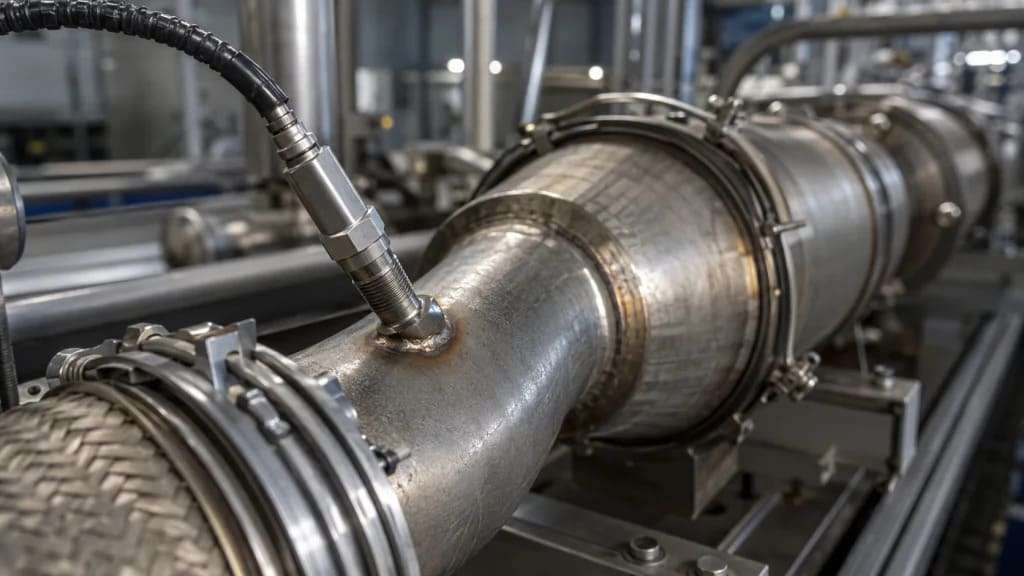
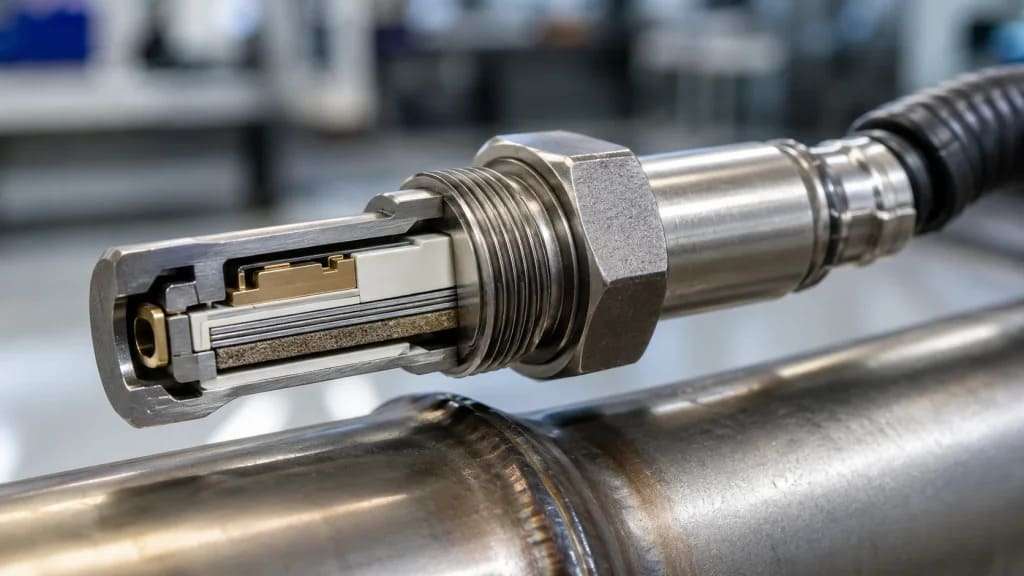
Production NOx sensors use amperometric (current-measuring) planar ceramic technology – a multi-layer zirconia (ZrO₂) device with integrated heater, pumping cells, and measurement cavity.

A modern NOx sensor is a miniature ceramic electrochemical device:
Substrate: Yttria-stabilized zirconia (YSZ) – oxygen-ion conducting ceramic at high temperatures (>400°C / 752°F). Multi-layer tape-cast structure (6–12 layers).
Heater layer: Platinum (Pt) resistive heating element embedded in the ceramic. Brings sensor to operating temperature (650–850°C) within 10–30 seconds of power-on. Heater resistance typically 4–10 ohms.
Oxygen reference channel: Sealed cavity exposed to ambient air (20.95% O₂) or pumped to a known reference partial pressure. Provides stable O₂ reference for Nernst equation calculations.
First pumping cell (oxygen removal): Electrodes (Pt or Pt/Au) on inner and outer surfaces. Applies voltage (typically 200–400 mV) to pump O₂ out of the measurement cavity. Control circuit maintains cavity O₂ at a constant low level (<10⁻⁶ atm) by measuring oxygen concentration via the Nernst cell (electromotive force between reference and cavity).
Second pumping cell (NOx decomposition): After O₂ is removed, NOx molecules enter a second cavity. A higher voltage (400–600 mV) dissociates NOx into N₂ and O₂: 2NO → N₂ + O₂; 2NO₂ → N₂ + 2O₂. The released O₂ is pumped out, and the resulting pumping current is proportional to NOx concentration.
Oxygen pumping electrodes: Porous Pt cermet (Pt + ceramic) – allows gas diffusion while maintaining electrical contact. Typically coated with spinel or alumina protective layer to prevent poisoning.
Diffusion barrier: Porous ceramic layer (alumina or spinel) limits gas flow into the sensor, creating a linear response independent of exhaust mass flow (within limits).
Protective coatings: Zeolite or alumina overcoat absorbs siloxanes, phosphates, and sulfates – common poisons that would otherwise deactivate Pt electrodes.
The sensor operates at 650–850°C (heater regulated):
Step A: Oxygen removal (first cavity). Exhaust gas (containing O₂, NOx, CO, HC, H₂O, CO₂) diffuses into first cavity. Pumping cell removes O₂ until cavity O₂ concentration is reduced to <10⁻⁶ atm. The current required to maintain this low O₂ level (I_pump1) is proportional to exhaust O₂ concentration.
Step B: NOx decomposition (second cavity). Gas from first cavity (now O₂-depleted) enters second cavity. Higher voltage dissociates NOx. The resulting oxygen is pumped out; the pumping current (I_pump2) is proportional to NOx concentration.
Step C: Signal processing. The ECU measures I_pump2 (typically 0–500 microamps for 0–2,000 ppm NOx). The sensor’s internal microprocessor linearizes and temperature-compensates the signal. Output is transmitted to ECU via CAN bus (J1939 or proprietary protocol) or analog voltage (0–5V). Update rate: 10–100 Hz (depending on application).
Cross-sensitivity management: NH₃ (ammonia) dissociates at similar voltages to NOx – causing false high NOx readings (critical for downstream sensors where NH₃ slip occurs). Solutions include: NH₃ compensation algorithm – the ECU models expected NH₃ slip (based on SCR temperature, NH₃ storage level, DEF dosing rate) and subtracts from sensor reading; dual-chamber selective electrodes – some sensors use electrodes that discriminate between NOx and NH₃; downstream NH₃ sensor (additional sensor) for direct measurement.
Other interferences: H₂O (water vapor) – negligible above 600°C; CO and HC – oxidized before reaching measurement cavity; SO₂ (sulfur dioxide) – no direct interference but poisons sensor over time.
Upstream NOx sensor (engine-out, pre-SCR): Measures raw NOx (typically 300–1,200 ppm for diesel, 50–500 ppm for lean-burn gasoline). Requirements: wide range (0–2,000+ ppm), fast response (for transient control), robust against soot and oil ash (high exposure). PGM electrodes: Pt/Rh or Pt/Au for poison resistance. Response time (T90): 0.5–2 seconds.
Downstream NOx sensor (tailpipe, post-SCR/ASC): Measures treated NOx (typically 0–200 ppm for compliant systems). Requirements: high sensitivity at low concentrations (<20 ppm critical for Euro 7), NH₃ cross-sensitivity compensation (critical due to possible slip), long-term stability over 10,000+ hours. PGM electrodes: optimized for low-concentration linearity. NH₃ compensation algorithm mandatory.
Dual-cell vs. single-cell: Dual-cell (separate O₂ removal and NOx measurement cavities) – higher accuracy, better NH₃ discrimination, higher cost. Standard for heavy-duty and Euro 7 applications. Single-cell (combined cavities) – lower cost, simpler electronics, lower accuracy. Limited to light-duty, pre-Euro 6 applications.
Analog vs. digital: Analog output (0–5V or PWM) – simple interface, no on-sensor intelligence, requires ECU linearization. Older designs. Digital (CAN, SENT) – sensor includes microprocessor for linearization, temperature compensation, diagnostics; outputs calibrated NOx value. Modern standard.
Mounting location: Upstream sensor – between turbocharger outlet and DOC/SCR inlet (or pre-DOC for NO₂ measurement). Downstream sensor – post-SCR/post-ASC, typically 150–500mm after catalyst exit. Temperature at sensor tip must remain within 100–900°C (preferred 200–800°C).
Bung (weld boss): M20×1.5 or M18×1.5 thread (industry standard). Stainless steel (304 or 409). Positioned vertically (top of pipe) or 10–30° above horizontal – prevents moisture/condensate pooling on sensor tip (thermal shock risk). No downstream-facing angle (condensate runs into sensor).
Installation torque: 40–50 Nm (30–37 lb-ft). Overtorque cracks ceramic, undertorque leaks exhaust. Copper or stainless compression gasket seals against pipe.
Harness & connector: High-temperature wires (PTFE or silicone insulation, 250–350°C rating). Shielded cable (EMI protection – sensor signals are microamp-level). Sealed connector (IP67/IP69K for non-road/marine). Wire length matched to vehicle harness (sensor calibrated for specific wire resistance – extending changes signal).
Anti-fouling measures: Soot accumulation blocks diffusion path – causes slow response and low readings. Solutions: protective shield (metal cap with small holes) prevents direct soot impingement; vertical mounting allows soot to fall away; burn-off cycle (ECU briefly heats sensor to 900°C during regeneration to clean soot). Oil ash and sulfur deposits – irreversible, reduces sensor life; low-ash oil and ultra-low-sulfur fuel (ULSD) required.
Power-up sequence (cold start): 12V/24V supply to heater (regulated by ECU). Heater duty cycle (PWM) controls temperature. Sensor reaches 650–850°C in 10–30 seconds (depending on ambient temperature). During warm-up, sensor outputs “not ready” or last valid value. No dosing allowed until sensor ready.
Normal operation: Upstream sensor outputs NOx concentration (ppm or mg/kWh). ECU uses this value (or modeled NOx if sensor fails) for DEF dosing. Downstream sensor outputs post-SCR NOx. ECU calculates conversion efficiency: Efficiency = (Upstream_NOx – Downstream_NOx) / Upstream_NOx. If efficiency < threshold (typically 75–85% depending on regulation) for a calibrated duration, OBD fault triggers.
NH₃ compensation (downstream sensor): When SCR dosing is active and temperature is high (>350°C) or NH₃ storage model shows desorption, ECU predicts NH₃ slip. Compensated NOx = Raw_NOx – (Predicted_NH₃ × Cross_sensitivity_factor). Cross-sensitivity factor is sensor-specific (typically 0.5–1.0 – meaning 100 ppm NH₃ reads as 50–100 ppm NOx).
Rationality checks: Compare upstream and downstream NOx – downstream cannot exceed upstream (impossible – indicates sensor fault). Compare NOx with engine operating conditions – if reported NOx is implausible for given speed/load, sensor flagged as “stuck” or “out of range.” Heater current monitoring – open circuit or short circuit detected.
Failure modes (OBD diagnostics): Heater circuit failure (open/short) – DTC sets, sensor inoperative. Element degradation (increased pumping current at zero NOx) – DTC for “signal stuck low.” Response time degradation (T90 > 3 seconds) – DTC for “slow response.” Cross-sensitivity out of range – excessive NH₃ effect indicates contamination. Sensor missing or disconnected – “circuit open” DTC.
NOx sensors degrade over time – typically 5,000–10,000 hours (on-highway) or 3,000–8,000 hours (non-road/harsh environments).
Degradation mechanisms:
End-of-life indicators: Slower response (T90 increases from 1 second to 5+ seconds); zero offset (sensor reads >20 ppm when NOx known to be zero – e.g., during regeneration); excessive NH₃ cross-sensitivity (false high readings); heater current out of specification (increased resistance indicates degradation).
Service interval: Not routinely replaced – only when fault codes indicate failure or performance degradation. Typical life: 10,000–15,000 hours on-highway; 5,000–8,000 hours non-road/off-highway.
We don’t just supply NOx sensors – we engineer sensing solutions integrated with your SCR control strategy. Whether you require a fast-response (<0.5 sec T90) upstream sensor for a transient-heavy urban delivery diesel, or a high-sensitivity (<10 ppm accurate) downstream sensor with advanced NH₃ compensation for Euro 7 certification, our team tailors the ceramic architecture, electrode formulation, protective coatings, and calibration algorithms to your engine’s NOx profile, exhaust chemistry, and regulatory target.
Partner with us to define your path to compliance – measure, control, and verify.
Solid-state NOx sensors (non-zirconia): Gallium nitride (GaN) or silicon carbide (SiC) based sensors – operate at lower temperatures (300–500°C vs. 650–850°C), lower power consumption, potentially longer life. Still in development – not yet production-ready.
NH₃/NOx dual sensor: Single sensor measuring both NH₃ and NOx simultaneously – eliminates cross-sensitivity ambiguity, enables direct closed-loop NH₃ slip control. Two independent measurement cavities or impedance spectroscopy. Emerging for Euro 7 (2027+).
Virtual sensing (software replacement): Machine learning model predicts NOx from engine parameters (speed, load, boost, EGR rate, temperature, humidity). No physical sensor – reduces cost, eliminates failure modes. Accuracy currently insufficient for regulatory compliance (requires correlation >95% vs. physical sensor). Used as backup for OBD (when sensor fails) or for non-regulated markets.
Low-cost sensors for emerging markets: China VII, India BS-VII, Brazil L8 require NOx sensing but cost sensitivity is extreme. Simplified single-cell designs, reduced PGM loading, shorter life (3,000–5,000 hours) – trade-offs acceptable for price-sensitive applications.
Connected sensor with onboard diagnostics: Sensor includes microprocessor with predictive algorithms – self-diagnoses degradation (sintering, poisoning, response time). Communicates remaining useful life (RUL) to ECU or cloud – enables predictive maintenance, reduces unplanned downtime.
The NOx sensor is the eyes and ears of the SCR system – without it, DEF dosing is blind. A well-engineered NOx sensor provides accurate, fast, and stable measurement across 10,000+ hours of the harshest exhaust environment. Whether you are certifying a Euro 7 heavy-duty truck, a Tier 5 non-road excavator, or a China 7 lean-burn gasoline vehicle, the NOx sensor will define your control authority and your compliance confidence – and we are ready to engineer the solution.