
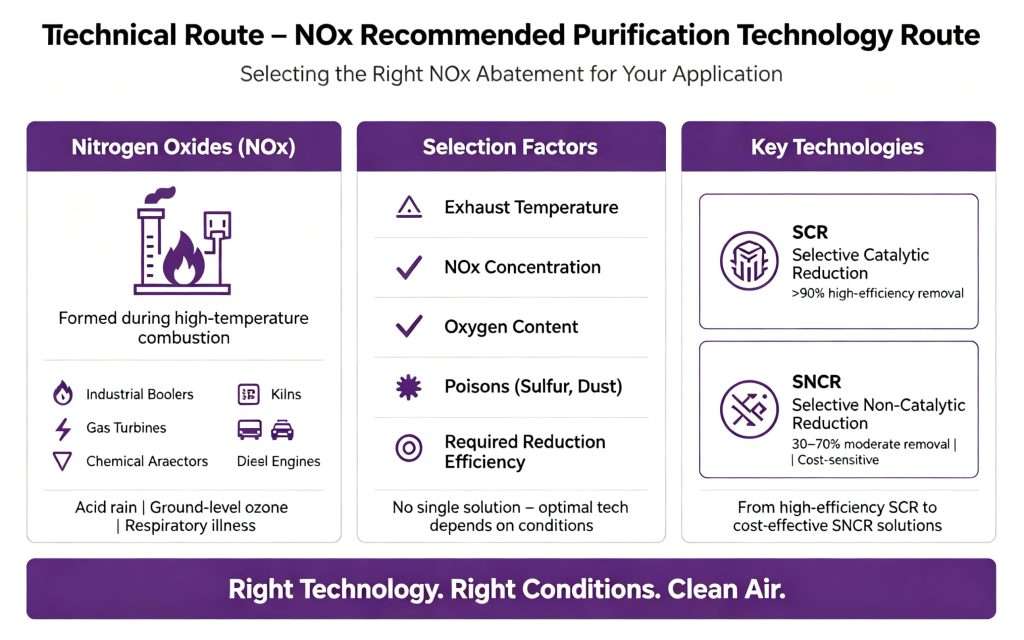
Nitrogen oxides (NOx) are formed during high-temperature combustion in industrial boilers, gas turbines, kilns, chemical reactors, and diesel engines. NOx contributes to acid rain, ground-level ozone (smog), and respiratory illness. There is no single solution for NOx removal – the optimal technology depends on exhaust temperature, NOx concentration, oxygen content, presence of poisons (sulfur, dust), and required reduction efficiency. This technical route guides you through the recommended NOx purification technologies for each application scenario, from selective catalytic reduction (SCR) for high-efficiency removal (>90%) to selective non-catalytic reduction (SNCR) for cost-sensitive moderate removal (30-70%).

Application Scenario | Recommended Technology | Expected Efficiency | Key Advantage |
High dust, high SO₂ (coal boiler, cement kiln) | High-dust SCR (plate catalyst) | 85-90% | Poison-resistant, durable |
Clean gas, moderate temperature (gas turbine, natural gas boiler) | Honeycomb SCR (vanadia) | 90-95% | Low pressure drop, high efficiency |
Low temperature, post-FGD (waste incinerator, post-desulfurization) | Low-temperature SCR (zeolite or precious metal) | 80-90% | Operates at 150-250°C |
Moderate efficiency, low capital (small boiler, furnace) | SNCR (urea injection at 850-1,100°C) | 30-70% | Low cost, no catalyst |
High efficiency, space constrained (marine, retrofit) | Compact SCR (high cell density) | 85-95% | Small footprint |
Ultra-low NOx (sub-9 ppm, gas turbine) | Dual-layer SCR + oxidation catalyst | 95-98% | Meets stringent permits |
How it works – Ammonia (NH₃) or urea (decomposes to NH₃) is injected into flue gas upstream of a catalyst bed. On the catalyst surface, NOx reacts with NH₃ to form N₂ and H₂O. Standard SCR (250-450°C): 4NO + 4NH₃ + O₂ → 4N₂ + 6H₂O. Fast SCR (with NO₂ from upstream DOC): 2NO + 2NO₂ + 4NH₃ → 4N₂ + 6H₂O (10× faster).
Catalyst types – Vanadia (V₂O₅/WO₃/TiO₂): industry standard, sulfur-tolerant (up to 1,000+ ppm SO₂), operates 250-450°C, lowest cost. Cu-zeolite: higher low-temperature activity (175-500°C), preferred for diesel engines, sulfur-sensitive (<10 ppm SO₂). Fe-zeolite: high-temperature durability (250-550°C), long service life. Precious metal (Pt, Pd): low-temperature (150-250°C) for post-FGD applications, highest cost.
Applications – Coal-fired power plants (high dust + SO₂ → high-dust plate catalyst). Cement kilns (high dust, high alkali → alkali-resistant vanadia). Waste incinerators (post-FGD, low temperature → low-temperature SCR). Gas turbines (clean gas, 300-500°C → honeycomb vanadia). Diesel engines (175-500°C → Cu-zeolite).
How it works – Urea or ammonia injected directly into the furnace or boiler at 850-1,100°C. NOx reduces thermally without catalyst. 4NO + 4NH₃ + O₂ → 4N₂ + 6H₂O (same chemistry as SCR – no catalyst).
Advantages – Lower capital cost (no catalyst, smaller reactor). Simpler operation (fewer components). No catalyst replacement cost. Suitable for retrofit (minimal ductwork modification).
Limitations – Lower efficiency (30-70% vs. 90%+ for SCR). Requires precise temperature window (850-1,100°C) – narrow operating range. Higher ammonia slip (10-30 ppm vs. <5-10 ppm for SCR). Not suitable for low-temperature exhaust (<800°C).
Applications – Small to medium industrial boilers (10-100 MW). Cement pre-calciners (850-1,100°C zone). Waste incinerators (first pass of secondary combustion chamber). Marine engines (some applications). Best available efficiency can reach >90% under optimized conditions with computational fluid dynamics (CFD) modeling for injection placement.
How it works – SNCR upstream (partial NOx reduction, 40-60%) followed by compact SCR (polishing, 50-70% of remaining). Combined efficiency: 70-90%. Lower catalyst volume than full SCR (30-50% reduction). Lower ammonia slip than SNCR alone (<10 ppm). Less sensitivity to temperature window (SNCR removes peak load, SCR polishes).
Applications – Medium-sized boilers (50-200 MW). Retrofit projects (space constrained). Cement kilns (preheater + precalciner). Applications where 90%+ efficiency not required.
How it works – Traditional vanadia SCR requires 250-450°C. Low-temperature SCR uses specialized catalysts (Mn-based, Cu-zeolite, or precious metal) that operate below 250°C.
Catalyst options – MnOₓ/CNT (carbon nanotube) with 1.5 wt% Mn loading achieves 99% NOx conversion at 150°C. Cu-zeolite operates down to 175°C. Pt-Pd on TiO₂ for 150-200°C.
Applications – Waste incinerators (after wet FGD – flue gas at 150-200°C). Industrial boilers with heat recovery (exhaust cooled below 250°C). Glass furnaces (post-filtration). Steel sintering plants.
How it works – Fast SCR requires 50:50 NO:NO₂ ratio. Diesel and lean-burn gas engines produce 80-95% NO, 5-20% NO₂. Upstream Diesel Oxidation Catalyst (DOC) or simple oxidation catalyst converts NO to NO₂: 2NO + O₂ → 2NO₂. Achieves 50:50 NO:NO₂ ratio. Increases SCR rate by 5-10×.
Applications – Diesel engines (stationary, non-road, marine). Lean-burn natural gas engines. Gas turbines with low NO₂ fraction.
Technology | Efficiency | Temperature Window | NH₃ Slip | Relative Cost | Best For |
Vanadia SCR (high-dust) | 85-90% | 250-450°C | <10 ppm | Medium | Coal, cement |
Honeycomb SCR (clean gas) | 90-95% | 250-450°C | <5 ppm | Medium | Gas turbines, boilers |
Cu-zeolite SCR | 90-99% | 175-500°C | <10 ppm | Medium-high | Diesel engines |
Low-T SCR (150-250°C) | 80-90% | 150-250°C | <10 ppm | High | Post-FGD, waste |
SNCR | 30-70% | 850-1,100°C | 10-30 ppm | Low | Small boilers, cement |
Hybrid SNCR+SCR | 70-90% | 850-1,100°C (SNCR) + 250-450°C (SCR) | <10 ppm | Medium | Medium boilers, retrofit |
Temperature (continuous, minimum, maximum). NOx concentration (ppm or mg/m³). Oxygen content (affects SCR rate). SO₂ concentration (affects catalyst choice). Dust loading (affects catalyst type – plate vs. honeycomb). Moisture content.
Required outlet NOx (regulation limit). Required reduction efficiency (%). NH₃ slip limit (if applicable). Operating hours per year (affects ROI).
High efficiency (>90%) + clean gas → honeycomb SCR. High efficiency + high dust → plate SCR. High efficiency + low temperature (<250°C) → low-T SCR. Moderate efficiency (50-70%) + low capital → SNCR. Retrofit + space constraint → hybrid SNCR+SCR. Ultra-low NOx (<9 ppm) → dual-layer SCR + oxidation catalyst.
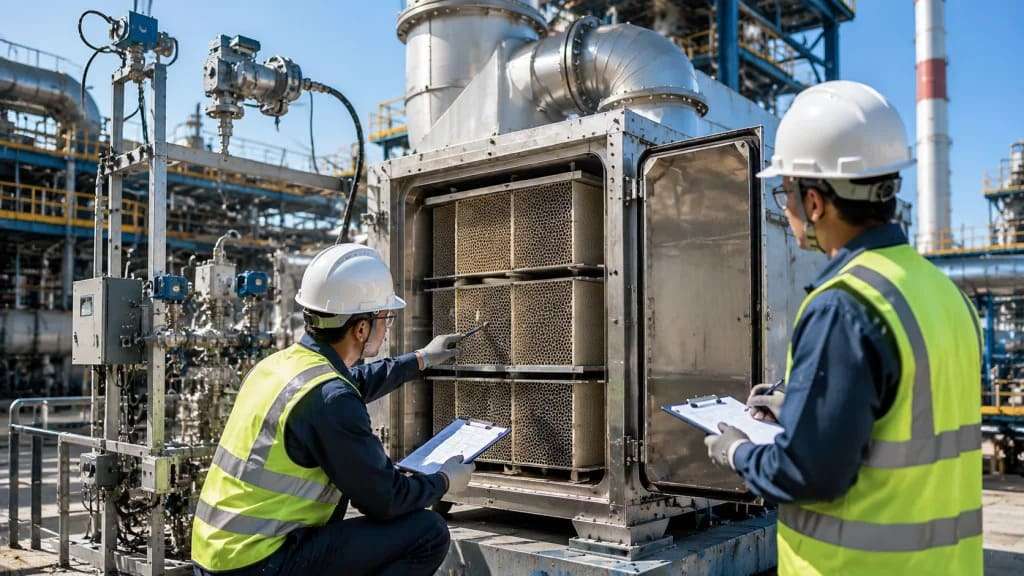
We engineer recommended NOx purification routes for any industrial application. Whether you require a high-dust vanadia SCR plate catalyst for a coal-fired boiler (85-90% reduction), a Cu-zeolite honeycomb SCR for a diesel genset (95%+ reduction, 175-500°C), or a low-temperature MnOₓ/CNT SCR for a waste incinerator post-FGD (99% at 150°C), our team tailors the catalyst formulation, substrate geometry, ammonia injection design, and control strategy to your specific flue gas composition, temperature window, and regulatory target.
Partner with us to define your path to compliance – recommended NOx route, optimized for your application.