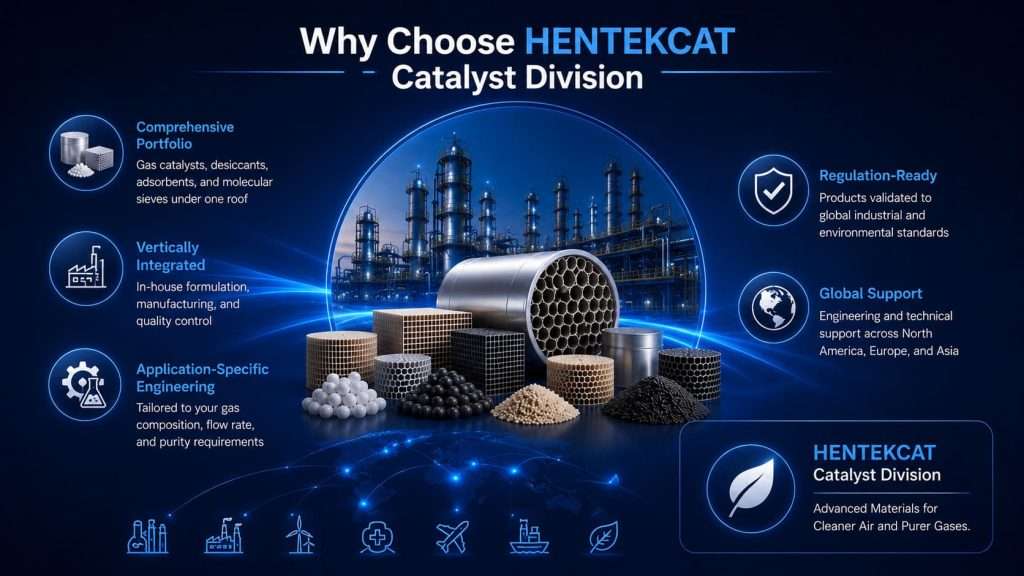
HENTEKCAT’s Catalyst Division is a specialized manufacturer of advanced catalytic materials, adsorbents, and molecular sieves for industrial gas purification, emission control, and specialty chemical applications. With over two decades of industry experience, we combine deep expertise in catalyst chemistry with precision manufacturing capabilities to deliver high-performance solutions for ozone abatement, carbon monoxide oxidation, hydrogen peroxide decomposition, oxygen removal, gas drying, and nitrogen generation.
Our product portfolio spans three core categories: Gas Catalysts, Desiccants & Adsorbents, and Carbon Molecular Sieves – each engineered to meet the most demanding industrial requirements with reliability, efficiency, and cost-effectiveness.
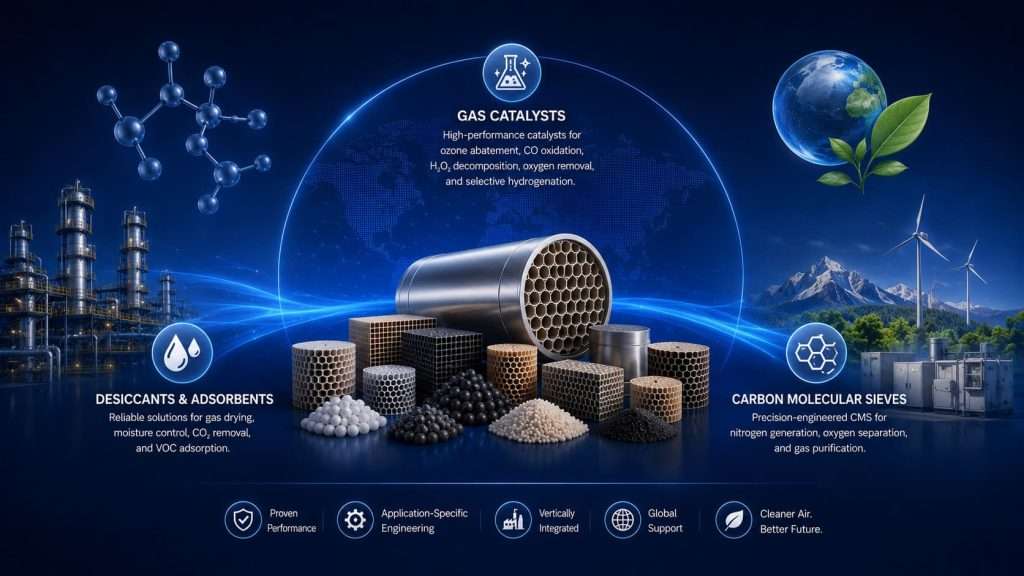

Our gas catalyst portfolio addresses critical air purification and process gas treatment challenges across industrial, aerospace, and environmental applications.
Hydrogen peroxide (H₂O₂) decomposition catalysts accelerate the breakdown of H₂O₂ into water and oxygen, a reaction that occurs naturally but very slowly without catalysis. Our H₂O₂ destruction catalytic converters are used in aerospace propulsion systems, sterilization equipment, and wastewater treatment. Platinum-based nanocatalysts are particularly effective for this decomposition reaction, controlling the energy yield of several energy conversion technologies. Advanced formulations such as mullite oxide YMn₂O₅ enable rapid decomposition at room temperature without excessive energy consumption.
Applications: Rocket propulsion systems, medical sterilization, industrial wastewater treatment, chemical processing.
Ozone is a powerful oxidant used in water treatment and air purification, but residual ozone is a hazardous air pollutant requiring abatement. Manganese dioxide (MnO₂) exhibits the best ozone decomposition performance among all transition metal oxides. Our ozone decomposition catalysts utilize advanced MnO₂ formulations with enhanced oxygen vacancy concentrations for efficient ozone removal, even under extremely low-temperature conditions. Specific crystallographic phases such as α-MnO₂ achieve 80-90% decomposition efficiency for 100 ppm ozone over extended test periods.
Applications: Industrial off-gas treatment, water treatment plant off-gas, HVAC systems, aerospace cabin air purification, office equipment emissions.
Aluminum honeycomb ozone removal filters combine a lightweight, high-open-area aluminum honeycomb substrate with a MnO₂ catalytic coating. The honeycomb structure provides ultra-low pressure drop, excellent mechanical strength, and rapid thermal response. MnO₂ coatings of approximately 50 µm thickness achieve ozone conversion under ambient conditions. The catalyst decomposes ozone to oxygen at room temperature without requiring additional energy.
Applications: Aircraft cabin air systems, HVAC ventilation, air purifiers, office equipment (copiers, printers), wastewater treatment off-gas.
Copper mesh carriers offer exceptional thermal conductivity, mechanical flexibility, and inherent antimicrobial properties. Our copper mesh ozone removal filters support high-efficiency ozone decomposition catalysts that decompose ozone into oxygen at room temperature. Copper catalytic materials demonstrate superior performance with relatively low cost, making them ideal catalyst materials for ozone decomposition. The flexible mesh format allows on-site cutting and fitting to irregular duct geometries.
Applications: Retrofitted HVAC systems, industrial ducts with irregular geometries, precision electronic equipment protection, ozone analysis equipment (zero gas generation).
Hopcalite is a mixed copper-manganese oxide catalyst (CuMnOx) that has served as the industry standard for ambient-temperature carbon monoxide oxidation since its discovery in 1920. The synergy between copper and manganese oxides creates a redox system that enables continuous oxygen transfer and CO adsorption. Hopcalite achieves high CO conversion at room temperature (25°C). Cerium-modified hopcalite formulations increase CO conversion by 50% at room temperature.
Applications: Respiratory protection (firefighter escape masks, mine rescue equipment, military gas masks), compressed breathing air purification, industrial off-gas treatment.
Hopcalite powder is the fine particulate form of copper-manganese mixed oxide catalyst, serving as the precursor or active component for formed catalysts (pellets, granules, honeycomb coatings). Synthesized via co-precipitation from aqueous solutions of copper and manganese nitrates. The presence of mixed copper and manganese oxide phases is essential for catalytic activity. The powder form enables flexible integration into various catalyst bed configurations and coating applications.
Applications: Catalyst bed packing for respiratory canisters, catalytic filter coatings, industrial gas purification systems, chemical synthesis.
Ceramic honeycomb CO removal catalysts utilize cordierite monoliths coated with hopcalite or precious metal active phases. High-performance catalysts achieve CO conversion efficiency exceeding 99% at significantly lower temperatures than alternative thermal oxidation methods. The honeycomb geometry provides high geometric surface area, ultra-low pressure drop, and excellent thermal shock resistance. Honeycomb catalysts with 233 cpsi cell density demonstrate the highest CO conversion rates.
Applications: Industrial flue gas treatment, compressed breathing air systems, office equipment emissions, automotive and engine exhaust.
Platinum and palladium based catalysts represent the gold standard for CO oxidation due to their exceptional activity, thermal stability, and resistance to humid environments. Bimetallic PtPd catalysts supported on alumina exhibit superior catalytic activity compared with their monometallic counterparts. The most active species for CO oxidation are dispersed Ptn⁺ and Pdn⁺ cations and PdOx species decorating alumina crystal defects. These catalysts maintain >99% CO conversion across a wide operating window (-20°C to 300°C) with service lives exceeding 10,000 hours.
Applications: Automotive exhaust (cold-start emissions), industrial flue gas, compressed breathing air, fuel cell feed gas purification (PROX), enclosed space air purification.
Copper(II) oxide (CuO) based catalysts are the industry standard for adsorptive removal of trace oxygen from industrial gas streams. Under reducing conditions, CuO reacts with oxygen to form stable copper-containing compounds, effectively scavenging O₂ from the gas stream. The catalyst operates across a broad temperature range – from ambient conditions up to 230°C. CuO–CeO₂/Al₂O₃ systems achieve oxygen removal capacity of 3000 ml O₂ per gram of catalyst with service lifetimes of 160 hours at 200°C.
Applications: Inert gas purification (N₂, Ar, He, Kr, Xe), hydrogen purification, syngas purification for Fischer-Tropsch synthesis, glove box atmosphere maintenance, semiconductor manufacturing.
Palladium supported on alumina is one of the most versatile heterogeneous catalysts in industrial catalysis. High specific surface area (150-300 m²/g) and thermal stability to 800°C enable excellent Pd dispersion. Bimetallic PtPd/Al₂O₃ catalysts exhibit superior catalytic activity compared with monometallic counterparts. Pd/Al₂O₃ serves as the industry standard for selective hydrogenation (acetylene removal from ethylene streams) and VOC abatement. For methane oxidation in lean-burn natural gas engines, Pd outperforms Pt and maintains high activity in the presence of water vapor.
Applications: Hydrogen purification (deoxygenation), VOC abatement, selective hydrogenation (acetylene, butadiene, nitriles), methane oxidation (natural gas engines), total hydrocarbon oxidation (gas turbine exhaust).
Our desiccant and adsorbent portfolio provides high-performance solutions for gas drying, moisture control, CO₂ removal, and VOC adsorption across industrial, medical, and environmental applications.
Activated alumina balls are white, spherical porous pellets made from high-purity aluminum oxide (Al₂O₃) with a specific surface area of 280-380 m²/g and total pore volume ≥0.38 cm³/g. The uniform microporous structure provides excellent water adsorption capacity (≥50% by weight) and high mechanical strength (≥100 N/pellet for 3-5mm size). The product does not expand, crack, or pulverize upon water adsorption. Adsorption capacity can be restored by heating to 175-315°C, enabling thousands of adsorption-regeneration cycles with a typical service life of 3-5 years.
Applications: Compressed air drying (pressure dew points to -70°C), instrument air drying, natural gas drying, air separation units, drinking water defluoridation and dearsenification, catalyst carrier.
Soda lime is a granular mixture of calcium hydroxide (Ca(OH)₂) and sodium hydroxide (NaOH) that provides efficient CO₂ removal through chemical absorption. Each kilogram provides approximately 10 hours of effective CO₂ absorption in closed anesthesia circuits. USP-NF grade material with CO₂ absorption capacity >140 L/kg and CO₂ activity >35%. Medical-grade formulations are KOH-free, minimizing anesthetic agent degradation. A pH-sensitive indicator dye (ethyl violet) provides clear visual indication of exhaustion – granules change distinctly from white to purple. Spent soda lime should not be reused.
Applications: Closed-circuit anesthesia systems, respiratory therapy equipment, diving rebreathers, mine refuge chambers, laboratory CO₂ absorption, industrial gas purification.
Honeycomb activated carbon is a rigid monolithic structure with a regular array of parallel open channels, manufactured from high-quality activated carbon powder. The honeycomb configuration creates an effective adsorption surface area at least three times that of conventional columnar activated carbon. Specific surface area ≥400-750 m²/g (standard grade) to ≥750-1,000 m²/g (high-performance grade). Iodine values reach ≥800 mg/g for high-performance grades, with CTC adsorption values of 70-80%. Pressure drop is approximately 11 times lower than densely packed 4 mm columnar activated carbon at equivalent linear velocities. The material can be thermally regenerated for hundreds of adsorption-desorption cycles.
Applications: Industrial VOC abatement (coating, printing, painting, pharmaceutical), spray paint booth exhaust, odor control (wastewater treatment, food processing), indoor air purification, catalyst support for catalytic combustion and SCR systems.
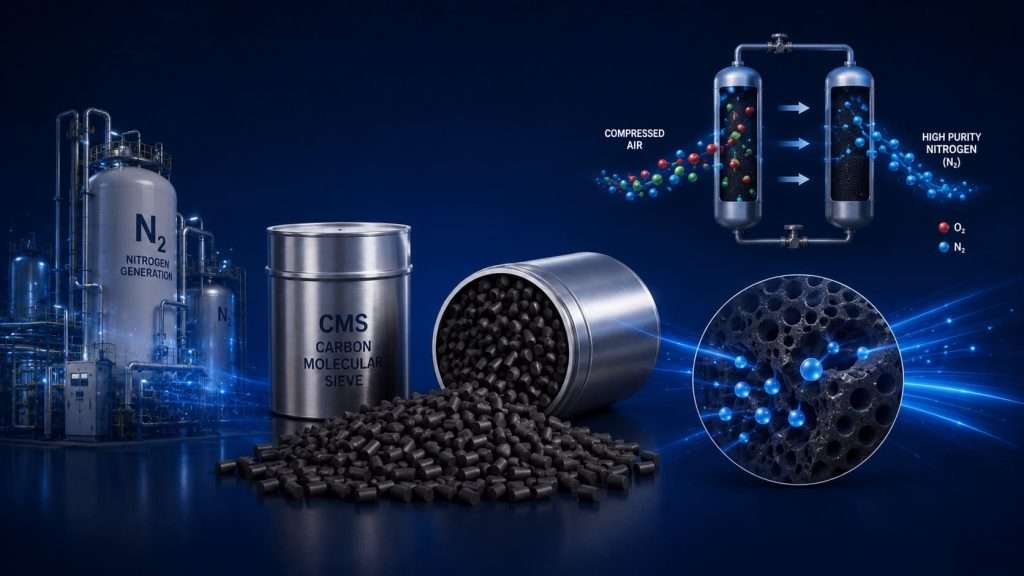
Carbon Molecular Sieves (CMS) are non-polar adsorbents specifically engineered for the separation of nitrogen from air under ambient temperature and pressure swing conditions. The material contains micropores with diameters of approximately 4 angstroms (4Å), which exhibit strong instantaneous affinity for oxygen molecules. This unique pore structure enables CMS to preferentially adsorb oxygen from compressed air, producing a continuous stream of high-purity nitrogen. All CMS grades are manufactured from high-purity elemental carbon, appearing as black cylindrical pellets with uniform particle size distribution and high mechanical strength (≥95-100 N/pellet). Service life typically ranges from 6-10 years under normal operating conditions.
CMS-200 is a premium-grade carbon molecular sieve delivering 200 Nm³ of nitrogen per metric ton of CMS per hour at 99.5% purity. Bulk density: 630-700 g/L. Pellet diameter: 1.1-1.8 mm. Adsorption cycle time: 120 seconds. Compressive strength: ≥95-100 N/pellet. Dust content: ≤100 ppm.
Performance data (at 0.8 MPa adsorption pressure):
| Nitrogen Purity (%) | Nitrogen Production (Nm³/h·t) |
|---|---|
| 99.99 | 70–75 |
| 99.9 | 125–140 |
| 99.5 | 200 |
| 99.0 | 240–260 |
| 98.0 | 325–330 |
CMS-260 delivers higher nitrogen productivity than standard grades, producing 260 Nm³ per metric ton of CMS per hour at 99.5% purity. Pellet diameter: 0.9-1.3 mm. Bulk density: 640-690 g/L. Compressive strength: ≥70-100 N/pellet. Hardness: ≥98 wt%. Dust content: ≤100 ppm. Adsorption cycle time: 2 × 60 seconds.
Performance data (at 0.7-0.8 MPa adsorption pressure):
| Nitrogen Purity (%) | Nitrogen Production (Nm³/h·t) |
|---|---|
| 99.99 | 105–130 |
| 99.9 | 170–200 |
| 99.5 | 220–265 |
| 99.0 | 250–325 |
| 98.0 | 290–390 |
CMS-330 represents the high-capacity tier, delivering 330 Nm³ per metric ton of CMS per hour at 99.5% purity. Pellet diameter: 1.0-1.3 mm. Bulk density: 640-680 kg/m³. Crush strength: ≥65-70 N/pellet. Hardness: ≥98 wt%. Dust content: ≤100 ppm. Adsorption cycle time: 2 × 35-45 seconds. Capable of producing nitrogen with purity up to 99.999% via PSA method.
Performance data (at 0.7 MPa adsorption pressure):
| Nitrogen Purity (%) | Nitrogen Production (Nm³/h·t) |
|---|---|
| 99.999 | 102–105 |
| 99.99 | 158–160 |
| 99.9 | 230–245 |
| 99.5 | 330–340 |
| 99.0 | 410 |
| 98.0 | 520 |
– Comprehensive portfolio – Gas catalysts, desiccants, adsorbents, and molecular sieves under one roof
– Vertically integrated – In-house formulation, manufacturing, and quality control
– Application-specific engineering – Tailored to your gas composition, flow rate, and purity requirements
– Regulation-ready – Products validated to global industrial and environmental standards
– Global support – Engineering and technical support across North America, Europe, and Asia
HENTEKCAT Catalyst Division – Advanced Materials for Cleaner Air and Purer Gases.