
Sports car enthusiasts demand maximum power, rapid throttle response, and an aggressive exhaust note – but must still pass emissions inspections (smog check, MOT, TÜV). The factory exhaust system prioritizes noise reduction and 150,000 km catalyst durability over performance. The modified high-flow TWC + sport exhaust technical route replaces restrictive OEM components with high-performance alternatives: a high-flow three-way catalyst (reduced backpressure, faster light-off) paired with a straight-through sport muffler (enhanced sound, weight reduction). This route achieves 10-25+ horsepower gains, 30-50% backpressure reduction, and a deep, aggressive exhaust tone – while maintaining OBD-II readiness and passing visual emissions inspections (catalyst present, no check engine light). For naturally aspirated and turbocharged sports cars.
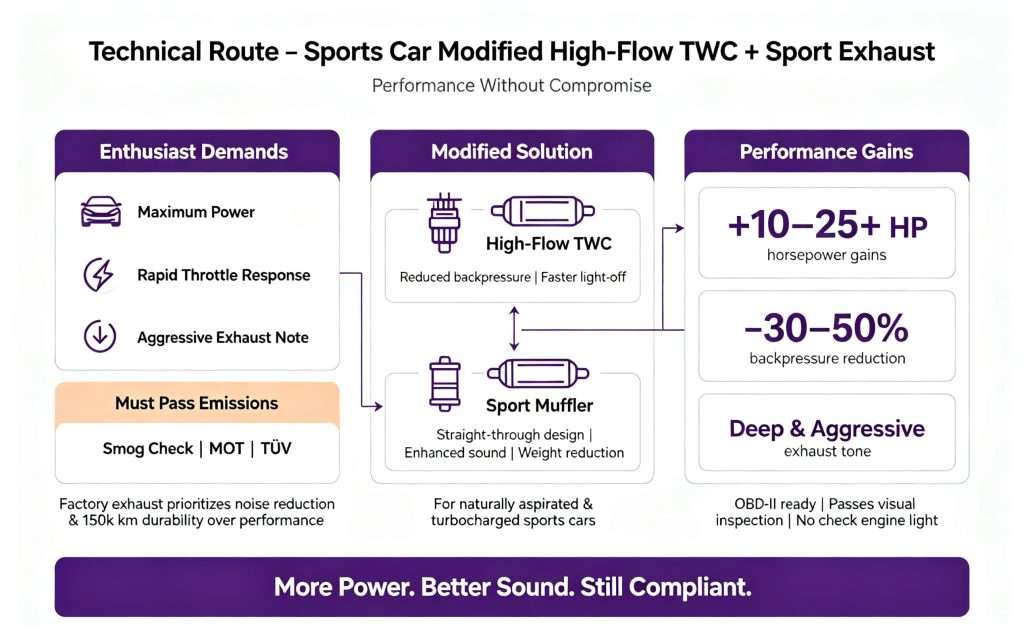

Complete system architecture: Engine → Performance header (optional) → High-flow TWC → Mid-pipe → Sport muffler → Tailpipe
The factory catalytic converter is designed for 150,000 km durability and cold-start compliance – using high cell density (600-900 cpsi), thick walls (4-6 mil), and high precious metal loading (3-5 g/L). This creates significant backpressure (2-4 psi at peak power), robbing horsepower.
High-flow TWC modifications – Cell density reduced: 400 cpsi (vs. 600-900 factory) – lower flow resistance. Wall thickness reduced: 2-3 mil (ultra-thin-wall) – increases open frontal area by 15-25%. Substrate volume reduced: 30-50% smaller than OEM – faster light-off, lower thermal mass, reduced backpressure. Precious metal loading: 1.5-2.5 g/L (vs. 3-5 g/L factory) – sufficient for street use, not 150k mile durability. Ceramic or metallic substrate: metallic preferred for turbo applications (faster spool, higher temp tolerance).
Performance impact – Backpressure reduction: 30-50% (1-2 psi vs. 2-4 psi factory). Horsepower gain: 5-15 hp (naturally aspirated), 10-25+ hp (turbocharged with tune). Throttle response: improved (less exhaust restriction). Turbo spool: 200-500 RPM sooner (turbo applications). Light-off time: 15-25 seconds (vs. 30-45 seconds factory).
The most critical aspect of a street-legal high-flow TWC is maintaining proper oxygen sensor readings. The upstream sensor (pre-catalyst, wideband UEGO) must see the same exhaust composition as factory – no modification. The downstream sensor (post-catalyst, switching) monitors catalyst efficiency – if it sees higher oxygen levels (from reduced catalyst volume or OSC), it triggers P0420/P0430 (catalyst efficiency below threshold).
Solutions – High-quality high-flow TWC with adequate OSC (oxygen storage capacity) – ceria-zirconia content similar to OEM. Proper catalyst volume – too small triggers CEL. O2 sensor spacer (defouler) – moves sensor out of direct exhaust flow, reducing oxygen signal (not legal in all regions). ECU tune (reflash) – disables or desensitizes catalyst monitor (off-road/track only – illegal for street use in most jurisdictions). CARB-legal high-flow TWC systems are available for many platforms – retain full OBD readiness with no tune required.
The factory muffler uses multiple chambers and baffles to cancel sound – creating backpressure and adding weight (25-40 lbs). The sport muffler replaces this with a straight-through perforated core and acoustic packing.
Construction – Straight-through perforated tube (minimal flow restriction). Acoustic packing: stainless steel wool (bass frequencies) + fiberglass (high frequencies). Muffler shell: 304 stainless steel (polished or brushed finish) or titanium (ultra-lightweight, exotic tone). Weight: 15-25 lbs (30-50% lighter than factory). Backpressure: near-zero (0.5-1 psi vs. 2-4 psi factory).
Sound characteristics – Valved muffler: quiet mode (closed valve – street legal, neighbor-friendly), race mode (open valve – aggressive, high-volume). Drone elimination: Helmholtz resonator or quarter-wave tuner cancels resonant frequencies at cruising RPM (2,500-3,500 rpm). Exhaust note: deep and aggressive (European sports car) or raw and thunderous (American V8).
Mid-pipe (downpipe for turbo) – Larger diameter than factory: 2.5-3.0 inches (naturally aspirated), 3.0-4.0 inches (turbo). Eliminates factory crush bends and restrictive flex sections. High-flow TWC integrated (turbo-back system) or separate (cat-back system). Heat shielding for turbo applications (reduces underhood temperature).
Performance header (naturally aspirated) – Equal-length primary runners (improves exhaust scavenging). Merge collector (optimizes flow into TWC). Thermal barrier coating (ceramic or titanium) – reduces underhood heat, maintains exhaust gas velocity. Horsepower gain: 10-20+ hp with high-flow TWC and tune.
For maximum gains, the engine control unit must be recalibrated to take advantage of reduced backpressure.
Naturally aspirated tuning – Adjust fuel maps (leaner at WOT – more power). Adjust ignition timing (more advance). Disables catalyst monitor (off-road only) or retains with high-quality TWC. Horsepower gain: 5-15 hp over bolt-ons alone.
Turbocharged tuning – Increase boost pressure (reduced backpressure lowers turbine drive pressure – more boost safely). Adjust fuel and ignition maps for increased airflow. Wastegate duty cycle adjustment. Horsepower gain: 20-50+ hp over bolt-ons alone.
OBD readiness – CARB-legal systems: retain all monitors (catalyst, O2 sensor, EVAP). No check engine light. Passes plug-in OBD scan. Off-road/track tunes: catalyst monitor disabled (fails visual inspection in some regions).
Parameter | Factory System | High-Flow TWC + Sport Exhaust | Gain |
Backpressure (peak power) | 2-4 psi | 1-2 psi | -30-50% |
Exhaust system weight | 25-40 lbs | 15-25 lbs | -30-40% |
Horsepower (NA) | Baseline | +10-20 hp | 3-6% |
Horsepower (turbo, with tune) | Baseline | +20-50 hp | 5-12% |
Turbo spool (RPM) | Baseline | -200-500 RPM | Faster response |
Sound volume (idle/WOT) | 75-85 dB | 90-105 dB | Enhanced |
Cold-start light-off | 30-45 sec | 15-25 sec | Faster |
Vehicle Type | Recommended Configuration | Expected Gain | CEL Status |
Naturally aspirated (Porsche 911, Corvette, Miata) | High-flow 400 cpsi TWC + performance header + sport muffler | 15-25 hp | No CEL (with quality TWC) |
Turbo (911 Turbo, M3/M4, Golf R) | High-flow downpipe (200-300 cpsi) + cat-back exhaust + tune | 30-60 hp | Tune required (or CEL spacer) |
Supercharged (Mustang, Camaro, Audi) | High-flow 400 cpsi TWC + cat-back exhaust | 20-30 hp | No CEL (with quality TWC) |
Track-only (any) | Cat-less downpipe/header + race exhaust + tune | 20-50+ hp | CEL disabled (not street legal) |
Street-legal performance – Retains catalytic converter (passes visual inspection). OBD-II readiness maintained (with quality high-flow TWC or CARB-legal system). No check engine light. Smog check compliant (depending on region).
Real horsepower gains – 10-25 hp for bolt-on systems (no tune). 20-50+ hp with tune (turbo). Reduced backpressure = engine works less to push exhaust out. Faster turbo spool = more responsive.
Enhanced sound without drone – Deep, aggressive tone at WOT. Quiet at cruise (valved systems or resonated designs). No unpleasant resonance at highway speeds.
Weight reduction – 30-50% lighter than factory. Titanium exhausts offer even greater savings. Improved power-to-weight ratio.
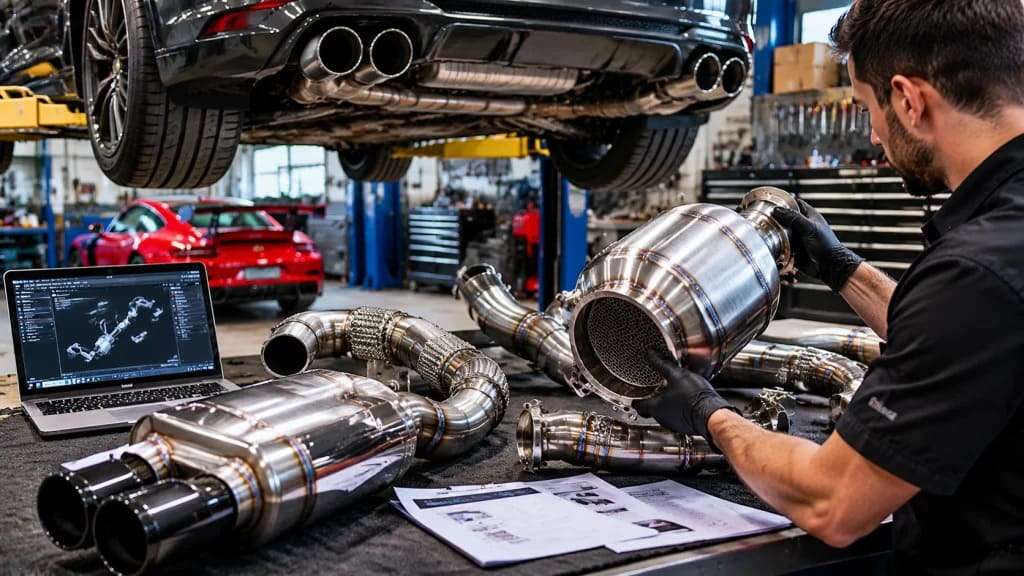
We engineer complete high-flow TWC + sport exhaust systems for any sports car platform. Whether you require a CARB-legal high-flow TWC (400 cpsi, metallic substrate, retains OBD readiness) for a street-driven Porsche 911, a turbo-back system (3.5-inch downpipe with 300 cpsi TWC + valved sport exhaust) for a 700 hp Nissan GT-R, or a cat-less track exhaust (off-road only) for a dedicated track car, our team tailors the catalyst cell density, substrate material, pipe diameter, muffler design (valved or fixed, resonated or non-resonated), and tuning support to your vehicle, power goals, and local emissions requirements.
Partner with us to define your path to performance – high-flow TWC + sport exhaust, power without compromise.