
Exploring the engineering behind the Diesel Oxidation Catalyst (DOC) and its role as the foundational aftertreatment solution for lean-burn diesel engines.
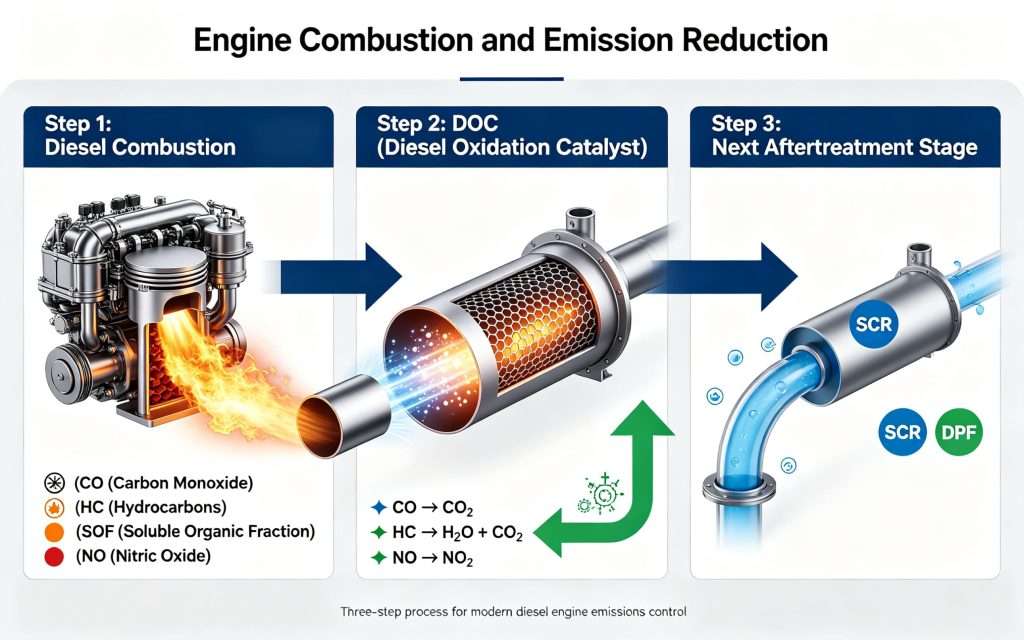
Diesel combustion in the engine generates exhaust containing CO, HC, and soluble organic fraction (SOF) from partially burned fuel and oil. A Diesel Oxidation Catalyst (DOC) then converts these pollutants into CO₂ and H₂O. This reaction significantly reduces harmful organic emissions and, critically, oxidizes nitric oxide (NO) into nitrogen dioxide (NO₂) to support downstream systems. Finally, the transformed exhaust moves to the next stage of aftertreatment. This three-step process ensures that modern diesel engines begin emissions control immediately, converting toxic byproducts into less harmful substances while enabling subsequent SCR or DPF efficiency.
Unlike gasoline engines, which run stoichiometrically (14.7:1), diesel engines operate with a significant excess of air (lean burn, often A/F > 25:1 or lambda > 1.4). This high oxygen content makes a traditional Three-Way Catalyst impossible—there is no “rich” period to reduce NOx. However, the lean condition is ideal for oxidation reactions*
The DOC is the first and essential step in the diesel technical route. It does not reduce NOx; rather, it prepares the exhaust stream by:
– Oxidizing CO and HC into harmless CO₂ and water.
– Generating exothermic heat (through HC combustion) to raise exhaust temperature for DPF regeneration.
– Producing NO₂ to enable passive soot oxidation in the DPF and fast SCR reactions.
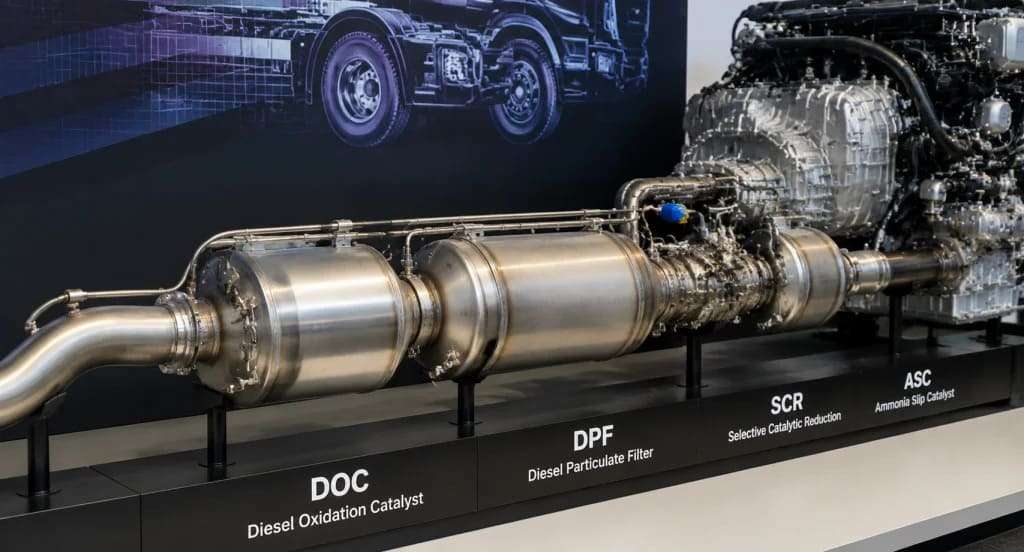
This makes the DOC the enabler for nearly all modern diesel aftertreatment systems—DPF, SCR, and ASC.

The journey of diesel exhaust from the engine cylinder through the aftertreatment system follows a precise technical path, with the DOC acting as the critical first active device.
How it works – SCR catalyst is integrated directly into the baghouse filter media. PM is captured on the filter surface while NOx is catalytically reduced as gas passes through the catalyst layer. NH₃ is injected upstream. The system simultaneously removes PM, NOx, and dioxins/furans (PCDD/F) – the catalyst decomposes dioxins at 180-260°C.
Catalytic filter media – Woven fiberglass or PTFE fabric coated with low-temperature SCR catalyst (MnOₓ/TiO₂ or V₂O₅/TiO₂). Operating temperature: 180-260°C. Air-to-cloth ratio: 0.8-1.2 m³/min•m². Dioxin destruction: >99% (if present).
Key advantages – Single vessel replaces ESP/baghouse + SCR reactor (50% smaller footprint). No reheat required (SCR operates at baghouse temperature). Lower capital cost (one housing, one ductwork set). Lower pressure drop (no separate SCR vessel). Simultaneous dioxin destruction.
Typical applications – Municipal waste incinerators, medical and hazardous waste incinerators, biomass and waste-to-energy boilers, small to medium industrial boilers (<100 MW), iron ore sintering plants (dioxin control).
How it works – SCR reactor placed directly after the boiler/economizer (300-400°C) before particulate removal. High-dust flue gas (10-30 g/m³) passes through plate-type SCR catalyst with wide channels to prevent dust bridging. NOx is reduced by 85-90% with NH₃ injection. ESP downstream removes PM (>99.5%). No reheat is required – flue gas is already at optimal SCR temperature.
Plate SCR catalyst – Metal mesh coated with V₂O₅/WO₃/TiO₂. Wide pitch (6-10 mm) prevents dust bridging and erosion. Erosion-resistant edges. Alkali and arsenic-tolerant formulations available for challenging fuels.
ESP design – Dry ESP with rapping system. Collection efficiency >99.5% (PM outlet <10-20 mg/m³). Operating temperature: 300-350°C. Low pressure drop (0.5-1.0 kPa). Continuous operation with minimal maintenance.
Key advantages – Maximizes SCR temperature (optimal vanadia activity window). No reheat energy penalty. Proven in thousands of coal-fired plants worldwide. ESP unaffected by NH₃ slip.
Typical applications – Coal-fired power plants (baseload, high availability), cement kiln preheaters (high dust, high alkali), steel sintering plants, industrial boilers burning solid fuels.
How it works – Baghouse or ESP removes PM first (to <10-20 mg/m³). Clean gas (150-250°C) then passes through low-temperature SCR (honeycomb or plate). NH₃ is injected upstream. NOx is reduced by 85-95%. If flue gas temperature is below 150-175°C, a reheat system (burner or heat exchanger) is required.
Low-temperature catalyst options – MnOₓ/CNT: 99% NOx conversion at 150°C, Cu-zeolite: 90-95% at 175-250°C, V₂O₅/TiO₂ (low-temp formulation): 85-90% at 200-250°C. Honeycomb substrate preferred (clean gas allows high cell density, lower cost).
Key advantages – Clean gas means no catalyst erosion. Longer catalyst life (5-8 years vs. 3-5 years for high-dust). Smaller catalyst volume (10-30% less than high-dust). Suitable for retrofit projects (SCR added after existing baghouse). Honeycomb catalyst can be used (lower cost than plate).
Typical applications – Waste incinerators (post-FGD, 150-200°C), industrial boilers with heat recovery (exhaust cooled below 250°C), gas turbines (post-HRSG), glass furnaces (post-ESP), retrofit projects where high-dust SCR cannot be accommodated.
How it works – Wet electrostatic precipitator (WESP) removes PM and acid mists from saturated flue gas (50-80°C). Low-temperature SCR downstream requires reheat to 150-250°C. The system provides simultaneous PM, NOx, and acid gas (SO₃, HCl, HF) removal.
Performance – PM outlet: <5 mg/m³ (>95% efficiency). NOx efficiency: 80-90% (with low-T SCR and reheat). Acid gas removal: >90% (with alkaline scrubbing upstream). SO₃ removal: >95% (prevents visible plume and corrosion).
Key advantages – Handles saturated flue gas (after wet FGD) – dry ESP would have dust cake adhesion issues. Removes acid mists (submicron H₂SO₄ aerosol) – prevents blue plume. No dust re-entrainment (unlike dry ESP rapping). Low pressure drop (0.5-1.5 kPa).
Typical applications – Waste incinerators (after wet FGD), biomass boilers (high moisture flue gas), marine exhaust (SO₂ scrubber + WESP + SCR), chemical plants with wet gas streams, power plants burning high-sulfur coal (with wet FGD).
Configuration | PM Outlet | NOx Outlet | Operating Temp | Reheat Required | Relative Cost |
Catalytic Baghouse | <5-10 mg/m³ | <50-100 mg/m³ | 180-260°C | No | Medium |
High-Dust SCR + ESP | <10-20 mg/m³ | <50-100 mg/m³ | 300-400°C | No | Medium-High |
Low-Dust SCR + Baghouse | <5-10 mg/m³ | <30-50 mg/m³ | 150-250°C | Yes (if <175°C) | Medium |
Wet ESP + Low-T SCR | <5 mg/m³ | <50-100 mg/m³ | 50-80°C (WESP) + 150-250°C (SCR) | Yes | High |
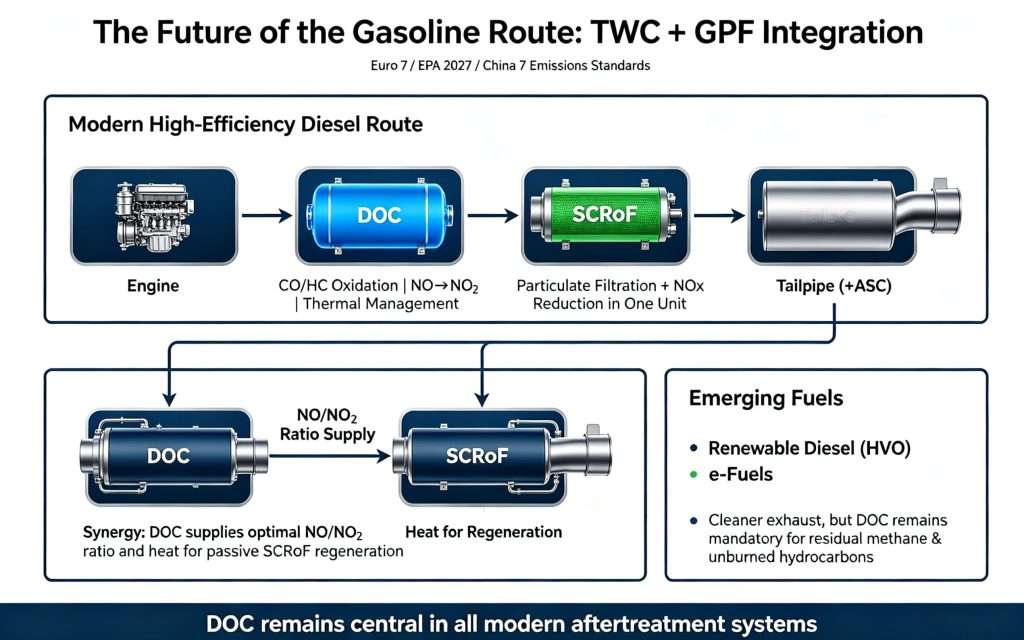
With Euro 7, EPA 2027, and China 7 standards tightening NOx and particulate limits simultaneously, the technical route continues to evolve. However, the DOC remains central.
The modern high-efficiency diesel route now looks like this:
Engine → DOC (CO/HC/NO→NO₂) → SCRoF (SCR coated on DPF) → Tailpipe (or + ASC)
The DOC’s Role: Still handles 100% of CO and HC oxidation, NO₂ generation, and thermal management for regeneration.
The SCRoF’s Role: Combines particulate filtration and NOx reduction in one unit, reducing space and cost.
Synergy: The DOC supplies the optimal NO/NO₂ ratio and the heat needed for both active and passive regeneration of the SCRoF. Emerging fuels like renewable diesel (HVO) and e-fuels produce even cleaner exhaust, but the DOC remains mandatory to oxidize residual methane and other unburned hydrocarbons.
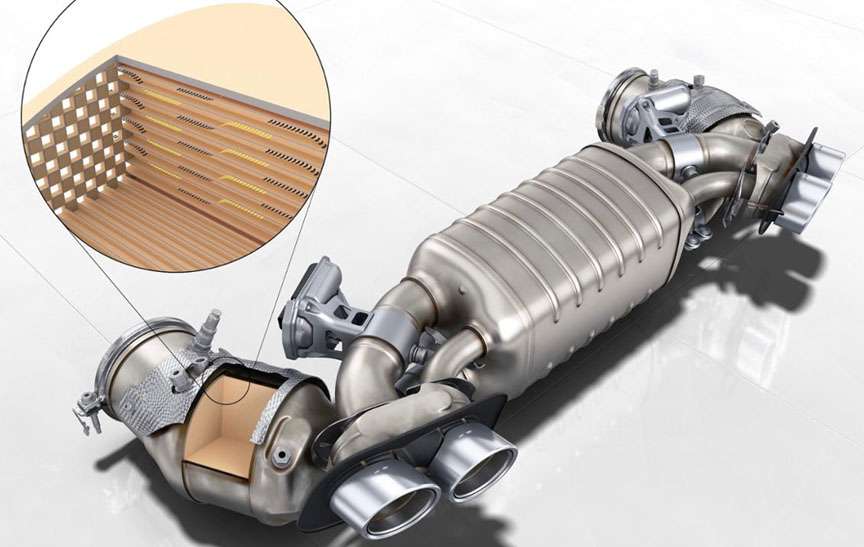
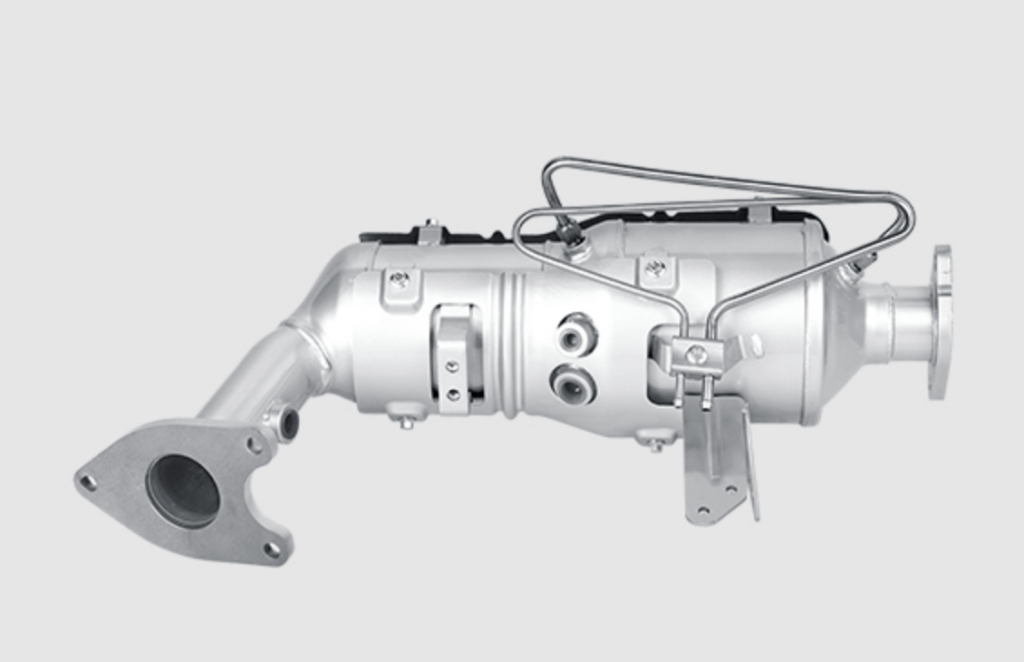
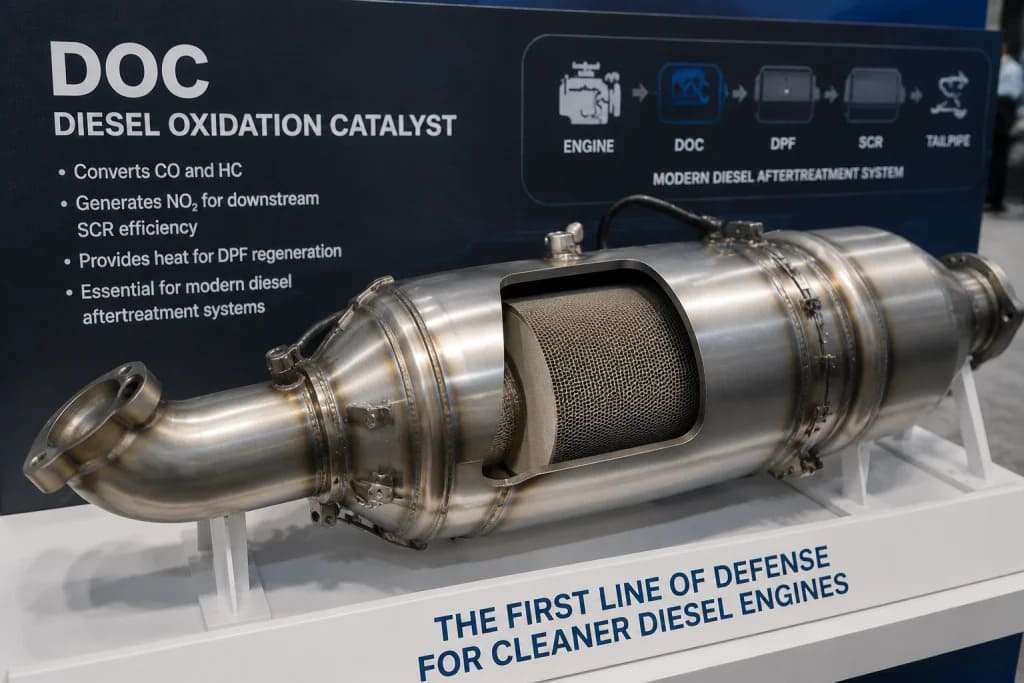
It is the unsung workhorse of diesel emissions control. No DPF regenerates without it. No SCR achieves 95%+ NOx conversion without its NO₂. In a world transitioning away from fossil diesel, the DOC will continue to serve as the first line of defense for compression-ignition engines in heavy-duty, off-road, marine, and generator applications.