
Industrial processes generate significant dust and particulate matter—from cement kilns and power plants to steel mills, chemical reactors, and food processing facilities. Uncontrolled dust emissions harm worker health, damage equipment, violate environmental regulations, and contribute to regional air pollution. We provide complete, validated dust control solutions meeting EPA, EU Industrial Emissions Directive, China GB, and global standards.
Industrial dust varies widely in composition, particle size, concentration, temperature, and moisture content. No single technology fits all applications. Our systems integrate multiple complementary dust collection technologies into a compact, energy-efficient package tailored to your specific process conditions
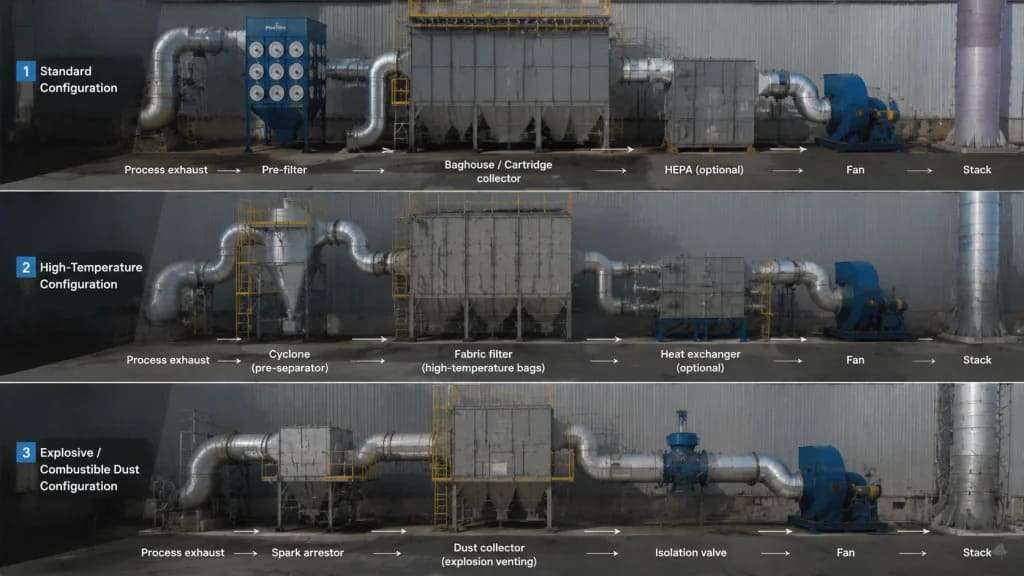
Standard configuration (moderate dust, ambient temperature):
Process exhaust → Pre-filter → Baghouse / Cartridge collector → HEPA (optional) → Fan → Stack
High-temperature configuration (kilns, furnaces, dryers):
Process exhaust → Cyclone (pre-separator) → Fabric filter (high-temperature bags) → Heat exchanger (optional) → Fan → Stack
Explosive / combustible dust configuration (grain, wood, chemicals):
Process exhaust → Spark arrestor → Dust collector (explosion venting) → Isolation valve → Fan → Stack

Most common industrial dust collector. Dust-laden air passes through woven or felted fabric bags (fiberglass, polyester, aramid, PTFE). Dust cakes on the surface; cleaned by pulse jet, reverse air, or mechanical shaking. Efficiency: 99.5–99.9% for particles >0.5 µm. Air-to-cloth ratio: 0.8–1.5 m³/min•m².
Higher efficiency than baghouses in a smaller footprint. Pleated cellulose or synthetic media. Efficiency: 99.9%+ for particles >0.3 µm. Preferred for fine dust (welding fume, pharmaceutical, food). Air-to-cloth ratio: 0.6–1.2 m³/min•m².
Pre-separator for coarse dust. Centrifugal force separates particles >5–10 µm. Efficiency: 70–90% for 10 µm, <20% for 1 µm. Low pressure drop (0.5–1.5 kPa). Reduces load on downstream collectors.
For sticky, hygroscopic, or explosive dust. Dust contacts water spray, packed bed, or venturi throat. Efficiency: 90–99% for particles >1 µm, venturi can reach 0.5 µm. Provides simultaneous gas cooling and absorption. Produces wastewater requiring treatment.
For very high volume, high-temperature applications (up to 400°C). Charged corona wires ionize particles; collection plates attract dust. Efficiency: 99.5–99.9% for particles >0.1 µm. High capital cost, low operating cost. Used in power plants, cement, and steel.
For ultra-fine dust (pharmaceutical, cleanroom, nuclear). HEPA: 99.97% at 0.3 µm. ULPA: 99.999% at 0.12 µm. High pressure drop (0.5–1.5 kPa). Requires upstream pre-filtration.
Pollutant | Raw Emission | After Treatment | Efficiency |
Total particulate matter (PM) | 50–5,000+ mg/m³ | <10 mg/m³ (typical), <1 mg/m³ (HEPA) | 99%+ |
PM10 (≤10 µm) | 20–2,000 mg/m³ | <5 mg/m³ | 99%+ |
PM2.5 (≤2.5 µm) | 5–500 mg/m³ | <1 mg/m³ | 99%+ |
Visible opacity | >20% | <5% (clear stack) | N/A |
Industry | Typical Dust | Technology Selection | Key Requirement |
Cement / Lime | Clinker dust, lime | Baghouse or ESP | High temperature (200°C+), high loading |
Steel / Foundry | Iron oxide, slag fume | Cartridge collector + HEPA | Fine fume (<0.5 µm), high efficiency |
Power (coal) | Fly ash | ESP or baghouse | Very high volume, continuous operation |
Chemical / Pharmaceutical | API, excipient powders | Cartridge + HEPA (containment) | Zero leakage, safe change-out |
Food / Grain | Flour, grain dust, sugar | Cyclone + baghouse | Explosion venting, food-grade construction |
Woodworking | Sawdust, wood flour | Cyclone + cartridge | Spark arrestor, explosion venting |
Welding / Plasma cutting | Metal fume (Fe, Cr, Ni) | Cartridge collector (nanofiber) | Fine fume (<0.1 µm), source capture |
Asphalt / Concrete | Mineral dust | Baghouse | High loading, outdoor installation |
Pharmaceutical (tableting) | Active ingredient dust | Downflow booth + HEPA | Containment (<1 µg/m³ operator exposure) |
Battery manufacturing | Electrode powder (Li, Co, Ni) | HEPA + carbon pre-filter | Toxic dust, strict workplace limits |
Meets EPA 40 CFR Part 60 & 63, EU Industrial Emissions Directive, China GB 16297, and local standards. Compliance documentation included.
Baghouse: 99.5%+ at 0.5 µm. Cartridge with nanofiber: 99.9%+ at 0.3 µm. HEPA: 99.97% at 0.3 µm. ESP: 99.5%+ at 0.1 µm.
Low-pressure-drop designs: baghouse 0.8–1.5 kPa, cartridge 1.0–1.8 kPa. Energy-efficient fans (IE3/IE4) with variable frequency drives. Heat recovery options available.
Carbon steel or stainless steel housings. Corrosion-resistant coatings. High-temperature options: fiberglass bags to 260°C, ceramic filters to 900°C. Explosion venting compliant with NFPA.
Top-access filter change-out. Pulse jet cleaning triggered by differential pressure. Modular designs for capacity expansion. Condition monitoring: ΔP, hopper level, compressed air pressure.
NFPA 652/654 compliant. Explosion venting ducted safely. Isolation valves prevent flame propagation. Spark arrestors upstream. Grounded steel construction.
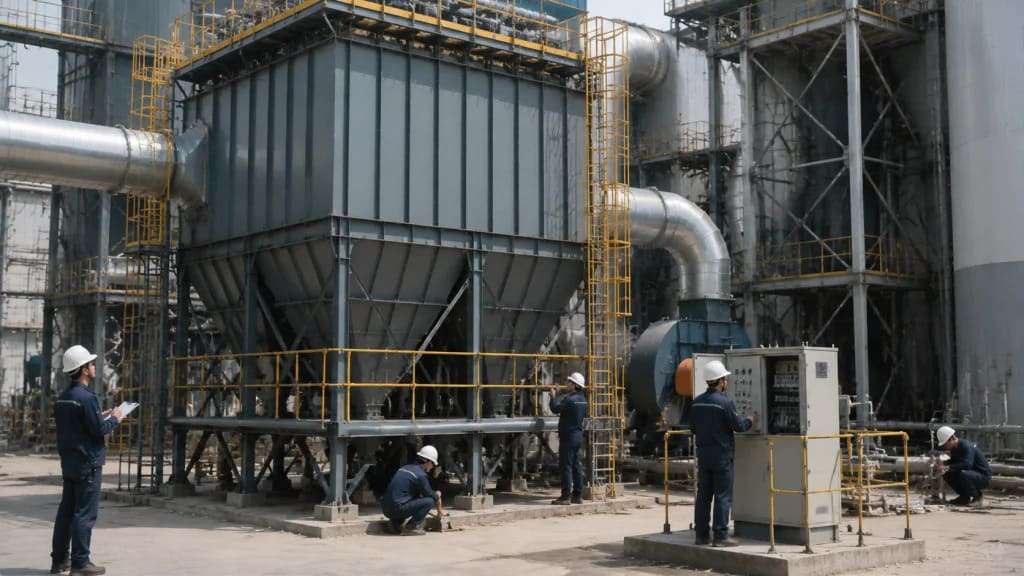
Service Area | Description |
Application assessment | Dust characterization, airflow measurement, regulatory review |
Technology selection | Cyclone, baghouse, cartridge, ESP, wet scrubber, HEPA (single or hybrid) |
System design | CFD flow modeling, ductwork sizing, fan selection, filter media specification, explosion protection |
Fabrication & assembly | Modular or site-built, structural support, access platforms, hoppers, rotary airlocks |
Controls integration | PLC/HMI, pressure differential control, pulse timer boards, remote monitoring (SCADA, IoT) |
Installation & commissioning | Field supervision, start-up, performance testing, operator training |
Ongoing support | Filter media supply, preventive maintenance, bag/cartridge replacement, emission testing |
Thousands of systems operating across cement, steel, chemical, pharmaceutical, food, woodworking, and power industries. Validated to global standards.
In-house engineering, fabrication, controls, and field service. Single-source accountability reduces project risk.
Dedicated industry teams understand your process: temperature excursions, sticky dust, combustible hazards, hygienic requirements.
Optimized air-to-cloth ratios extend filter life. Energy-efficient fans and cleaning systems reduce operating costs. Modular designs simplify future expansion.
From cement kilns to pharmaceutical containment, woodworking shops to battery manufacturing, our dust control solutions deliver compliance, safety, and reliability. Partner with us to engineer your path to cleaner air and regulatory peace of mind.