
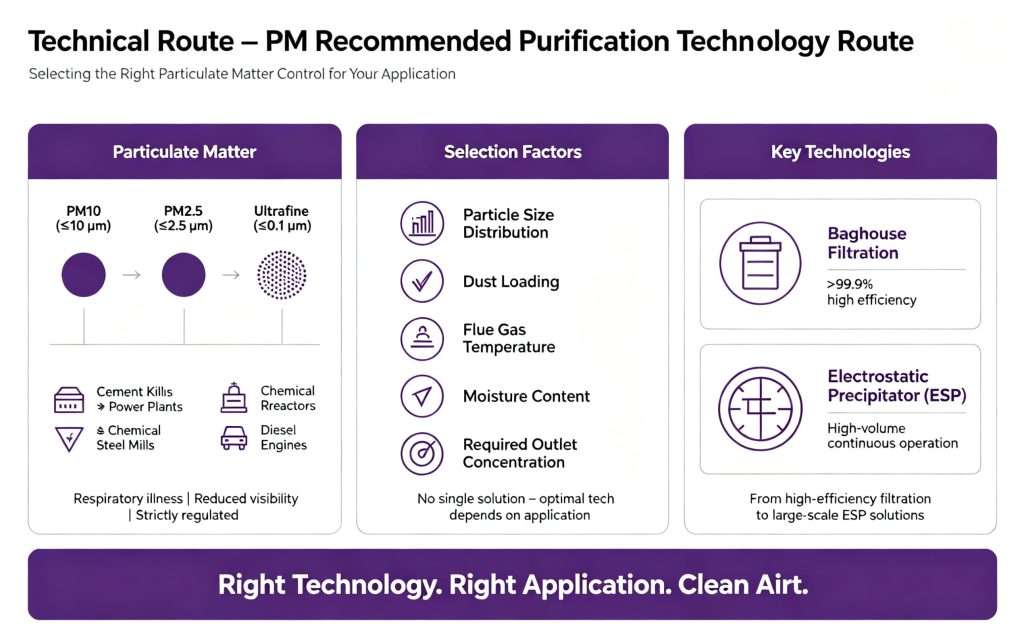
Particulate matter (PM) – including PM10 (≤10 µm), PM2.5 (≤2.5 µm), and ultrafine particles (≤0.1 µm) – is emitted from industrial processes including cement kilns, power plants, steel mills, chemical reactors, and diesel engines. PM causes respiratory illness, reduces visibility, and is strictly regulated worldwide (EPA, EU Industrial Emissions Directive, China GB). There is no single solution for PM removal – the optimal technology depends on particle size distribution, dust loading, flue gas temperature, moisture content, and required outlet concentration. This technical route guides you through the recommended PM purification technologies for each application scenario, from high-efficiency baghouse filtration (>99.9%) to electrostatic precipitation (ESP) for high-volume continuous operation.

Application Scenario | Recommended Technology | Expected Efficiency | Key Advantage |
High dust loading, high temperature (cement, steel) | ESP or high-temperature baghouse | 99.5-99.9% | Handles high volume, continuous operation |
Fine particles (<1 µm), moderate temperature (chemical, pharmaceutical) | Cartridge collector (nanofiber) | 99.9%+ | High efficiency for submicron particles |
Very high efficiency (<0.1 µm), toxic dust (nuclear, battery) | HEPA/ULPA filter | 99.97-99.999% | Maximum capture, zero release |
Sticky/hygroscopic/explosive dust (grain, chemical) | Wet scrubber | 90-99% | No fire risk, simultaneous gas absorption |
Coarse pre-filtration (mining, woodworking) | Cyclone | 70-90% (10 µm+) | Low cost, no moving parts |
High volume, moderate efficiency (power plant) | ESP | 99.5-99.9% | Low pressure drop, long life |
How it works – Dust-laden air passes through woven or felted fabric bags. Dust cakes on the bag surface; cleaned by pulse jet (compressed air), reverse air, or mechanical shaking. Filtration efficiency: 99.5-99.9% for particles >0.5 µm.
Filter media selection – Polyester: 135°C max, low cost, general industrial. Aramid (Nomex): 204°C max, high-temperature applications. PTFE (Teflon): 260°C max, chemical resistance, high cost. Fiberglass: 260°C max, brittle, acid-sensitive.
Cleaning methods – Pulse jet (most common): compressed air blast (5-7 bar), online cleaning, continuous operation. Reverse air: gentle cleaning, lower efficiency, for fragile bags (fiberglass). Shaker: mechanical shaking, offline cleaning, simple but intermittent.
Applications – Cement kilns (fiberglass or PTFE, 260°C). Steel mills (Nomex, 204°C). Woodworking (polyester). Chemical/pharmaceutical (PTFE-coated).
How it works – Pleated cellulose or synthetic media (polyester, cellulose, nanofiber) with higher surface area than baghouses. Efficiency: 99.9%+ for particles >0.3 µm. Air-to-cloth ratio: 0.6-1.2 m³/min•m².
Nanofiber coating – Ultra-thin nanofiber layer on substrate surface. Captures submicron particles (0.1-0.5 µm) with low pressure drop. Extends filter life (surface loading, not deep-bed). Efficiency improvement: 30-50% over standard media.
Applications – Welding fume (<0.5 µm particles). Pharmaceutical (API containment). Food processing (fine flour, sugar). Metalworking (grinding dust). Battery manufacturing (electrode powder).
How it works – Charged corona wires ionize particles (negative charge). Collection plates (positive ground) attract charged dust. Rapping system dislodges collected dust into hoppers. Efficiency: 99.5-99.9% for particles >0.1 µm. Pressure drop: very low (0.5-1.0 kPa). Operating temperature: up to 400°C (hot-side ESP).
Advantages – Handles very high gas volumes (500,000+ m³/hr). Low operating cost (no filter bags to replace). High temperature capability (up to 400°C). Low pressure drop (saves fan energy).
Limitations – High capital cost. Sensitive to dust resistivity (high or low resistivity reduces efficiency). Not suitable for sticky or high-moisture dust (rapping ineffective). Ozone generation (from corona).
Applications – Coal-fired power plants (fly ash). Cement kilns (preheater exit). Steel sintering plants. Pulp and paper recovery boilers.
How it works – Dust contacts water spray, packed bed, or venturi throat. Particles captured by impaction, diffusion, or interception. Efficiency: 90-99% for particles >1 µm (venturi reaches 0.5 µm). Simultaneous gas cooling and acid gas absorption (SO₂, HCl, HF). Produces wastewater requiring treatment.
Venturi scrubber – High-velocity gas (60-120 m/s) atomizes water. Highest efficiency for fine particles (0.5-1 µm). Higher pressure drop (5-20 kPa) than other wet scrubbers. Applications: steel mills (basic oxygen furnace), chemical reactors.
Applications – Chemical plants (sticky, hygroscopic dust). Grain handling (explosive dust – no spark risk). Food processing (hygroscopic dust). Mining (dust suppression). Hazardous waste incineration (acid gas + particulate).
How it works – Centrifugal force separates coarse dust from gas stream. Dust spirals down to collection hopper; clean gas exits through central vortex. Efficiency: 70-90% for particles >10 µm, <20% for 1 µm. Pressure drop: low (0.5-1.5 kPa). No moving parts, no filter media.
Advantages – Very low cost. No maintenance (no bags, no moving parts). High temperature capability (up to 1,000°C with ceramic lining). Handles high dust loading (pre-filter upstream of baghouse).
Applications – Woodworking (sawdust pre-filtration). Mining (rock dust). Agriculture (grain cleaning). Cement (clinker cooler exhaust). Sawmills (chips and coarse dust).
How it works – HEPA (High Efficiency Particulate Air): 99.97% at 0.3 µm (most penetrating particle size). ULPA (Ultra Low Penetration Air): 99.999% at 0.12 µm. Dense micro-glass fiber or PTFE membrane media. High pressure drop (0.5-1.5 kPa). Limited dust holding capacity – requires pre-filtration.
Applications – Pharmaceutical containment (API dust <1 µg/m³ operator exposure). Nuclear facilities (radioactive particles). Cleanrooms (ISO 5-8). Medical facilities (hospital isolation rooms). Battery manufacturing (lithium, cobalt, nickel dust).
Technology | Efficiency (at size) | Operating Temp | Pressure Drop | Relative Cost | Best For |
Baghouse | 99.9% (>0.5 µm) | 135-260°C | 1.0-1.5 kPa | Medium | General industrial |
Cartridge (nanofiber) | 99.9%+ (>0.3 µm) | 80-135°C | 1.0-1.8 kPa | Medium-high | Fine dust, <1 µm |
ESP | 99.5-99.9% (>0.1 µm) | 150-400°C | 0.5-1.0 kPa | High | High volume, continuous |
Wet scrubber | 90-99% (>1 µm) | Ambient-80°C | 1-20 kPa | Medium | Sticky/explosive dust |
Cyclone | 70-90% (>10 µm) | Up to 1,000°C | 0.5-1.5 kPa | Low | Coarse pre-filtration |
HEPA/ULPA | 99.97-99.999% (>0.12-0.3 µm) | Ambient-80°C | 0.5-1.5 kPa | High | Toxic, ultra-fine dust |
Particle size distribution (D50, D90). Dust loading (g/m³ or mg/m³). Composition (abrasive, sticky, hygroscopic, explosive, toxic). Temperature (°C). Moisture content (dry or wet). Flue gas flow rate (m³/hr).
Required outlet PM concentration (mg/m³ or µg/m³). Regulatory limit (EPA, EU, China GB). Emission point (stack, indoor, worker breathing zone).
Coarse dust (>10 µm) + low cost → cyclone. Medium dust (0.5-10 µm) + general industrial → baghouse. Fine dust (<1 µm) + high efficiency → cartridge collector or ESP. Toxic/ultra-fine (<0.3 µm) + zero release → HEPA/ULPA. Sticky/explosive + safe operation → wet scrubber. High volume + continuous operation → ESP or baghouse.
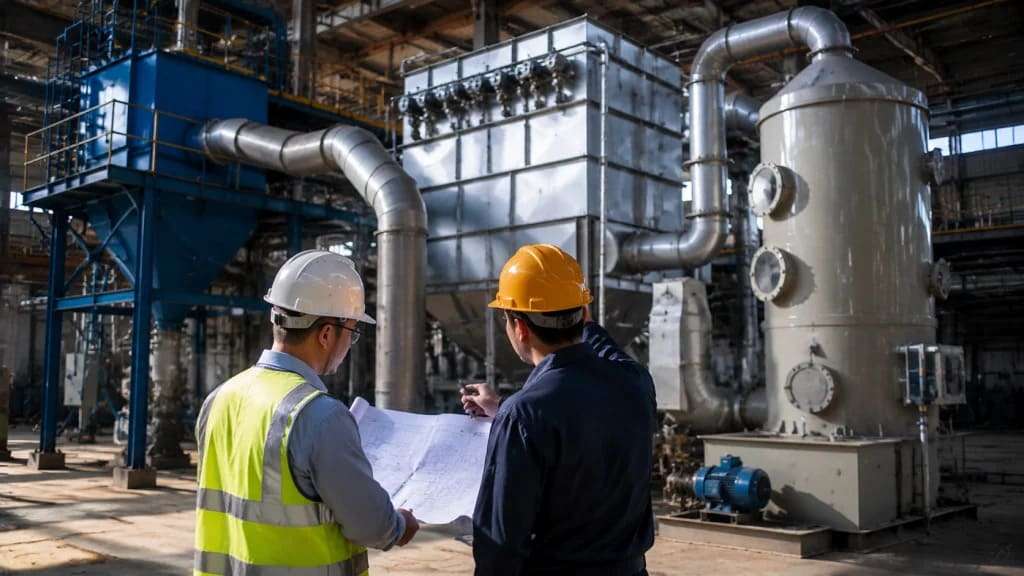
We engineer recommended PM purification routes for any industrial application. Whether you require a high-temperature baghouse (PTFE bags, 260°C) for cement kiln exhaust (200,000 m³/hr, <10 mg/m³ target), a nanofiber cartridge collector for pharmaceutical API containment (99.9%+ at 0.3 µm, <1 µg/m³ operator exposure), or a wet scrubber for explosive grain dust (NFPA compliant, zero spark risk), our team tailors the filtration media, housing design, cleaning mechanism, and control strategy to your specific dust characteristics, gas volume, and regulatory target.
Partner with us to define your path to compliance – recommended PM route, optimized for your application.