
Exploring the engineering behind aluminum-based catalytic filters that decompose ground-level ozone into breathable oxygen – essential for air purification, HVAC systems, aerospace cabin air quality, and office equipment emission control.
Ozone (O₃) is a potent lung irritant regulated by strict occupational safety limits (OSHA PEL: 0.1 ppm over 8 hours). While ozone naturally decomposes to oxygen (2O₃ → 3O₂), this reaction is impractically slow at room temperature. Aluminum honeycomb ozone removal filters provide a lightweight, low-pressure-drop catalytic solution that accelerates decomposition by orders of magnitude, reducing outlet concentrations from hundreds of ppm to below 0.05 ppm. The aluminum honeycomb substrate offers unique advantages: ultra-low wind resistance, high mechanical strength, excellent thermal conductivity for heat dissipation, and the ability to be formed into various shapes and cell densities (up to 1000 cells per square inch).
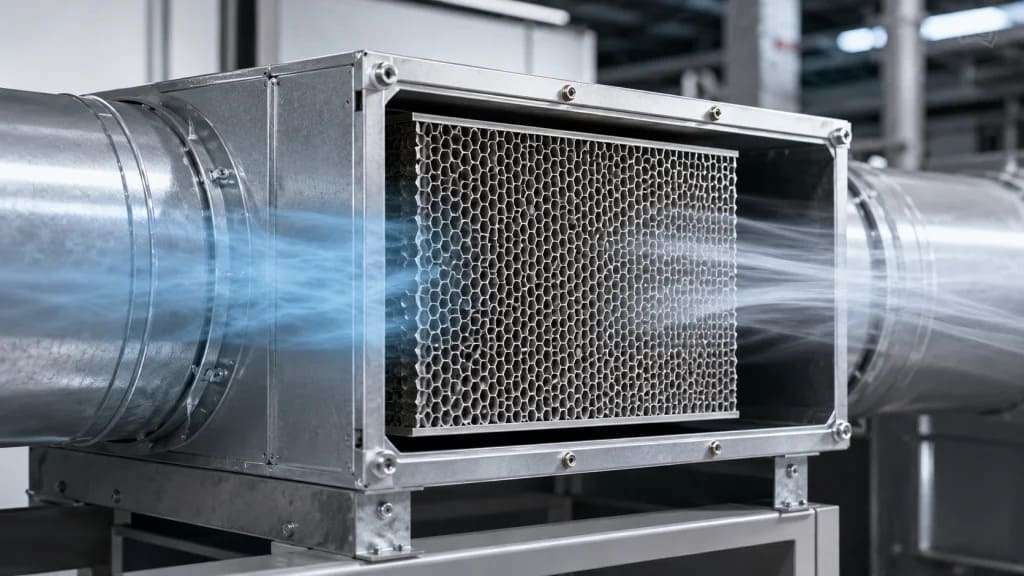

Aluminum honeycomb is the preferred substrate for high-flow ozone removal due to its exceptional geometric surface area, low pressure drop, and structural rigidity.
Geometric parameters:
Parameter | Typical Range | Impact |
Cell size | 0.6–1.5 mm (hexagonal) | Smaller = higher surface area, higher ΔP |
Cell density | Up to 1000 cpsi | Higher = more contact area |
Wall thickness | 0.03–0.08 mm | Ultra-thin reduces weight and thermal mass |
Open frontal area | >90% | Minimizes airflow resistance |
Key advantages over ceramic substrates:
The aluminum honeycomb is coated with a catalytically active layer – typically manganese dioxide (MnO₂) nanomaterials, which is the industry standard for room-temperature ozone decomposition.
Coating formulation and application:
The binder must be carefully optimized: increased binder improves coating adhesion but causes catalyst particles to pack together, reducing exposure of active sites and decreasing ozone conversion.
Reaction equation: 2O₃ → 3O₂ (exothermic, ΔH = -144 kJ/mol)
Proposed mechanism on MnO₂ surface:
Overall stoichiometry: O₃ → O₂ + O* (active site); O₃ + O* → 2O₂
The reaction is catalytic – the active sites are regenerated, enabling continuous operation without material consumption.
Measured performance (laboratory conditions): Under air velocity of 3.0 m/sec, relative humidity ~50%, room temperature (26°C), and initial ozone concentration of 200 ppbV, an aluminum honeycomb filter with 50 µm MnO₂ coating achieved ozone conversion of 29.3% ± 1.7%.
Commercial performance claims: Higher conversion efficiencies (≥97%) are reported for optimized configurations with lower air velocities and higher catalyst loadings.
Key operating parameters (commercial products):
Parameter | Specification |
Operating temperature | 20–90°C (optimal); decreases significantly below -10°C |
Applicable O₃ concentration | ≤200 ppm |
Recommended air velocity | ≤2.5 m/s (lower velocity improves efficiency) |
Gas hourly space velocity (GHSV) | 1,000–150,000 hr⁻¹ |
Service life | 1–3 years (depending on conditions) |
Bed geometry design rule: The height-to-diameter ratio of the catalyst bed should be 1:1 – greater height-to-diameter ratios improve decomposition efficiency.
Traditional granular or pellet catalysts create significant airflow resistance, making them unsuitable for HVAC systems, aircraft cabin air handling, or any application requiring high volumetric flow rates with minimal fan energy consumption.
Aluminum honeycomb addresses this through:
This architecture enables aluminum filters to be deployed in central ventilation systems, air purifiers, and aircraft environmental control systems where pressure drop must be minimized.
Aircraft cabin air purification: Aircraft flying at altitudes above 35,000 feet encounter elevated ozone concentrations from the atmospheric ozone layer. Aluminum honeycomb ozone converters are standard components in aircraft environmental control systems (ECS). Early patents describe cartridges with aluminum honeycomb core, tubular metal shell, and metal rib support members to prevent mechanical disintegration under high airflow and vibration. Modern Russian patents (2024) describe all-soldered catalytic modules consisting of aluminum corrugated plates and spacer plates with cladding material.
HVAC and building ventilation: Central ventilation systems for office buildings, airports, and hospitals – removes ozone from incoming outdoor air or from internal sources (copiers, printers, electrostatic air cleaners).
Office equipment (copiers, printers, laser printers): Corona discharge wires generate ozone as a byproduct. Small aluminum honeycomb cartridges (pencil-eraser to soda-can size) are installed in the exhaust path to prevent ozone exposure to office workers.
Air purifiers and disinfection equipment: UV-C and plasma-based air purifiers generate ozone as an unintended byproduct. Aluminum honeycomb filters are placed downstream of the ozone-generating stage to decompose residual ozone before discharge.
Wastewater treatment off-gas: Ozone is used for advanced oxidation in water treatment. Residual ozone in contactor off-gas is decomposed before atmospheric release.
Industrial processes: UV curing machines, electrostatic precipitators, and high-voltage equipment that generate ozone require abatement.
Comparison with activated carbon:
Comparison with thermal destruction: Catalytic decomposition operates at room temperature with no energy input, whereas thermal destruction requires heating to 300-400°C.
Comparison with granular catalysts: Aluminum honeycomb provides dramatically lower pressure drop, eliminates particle attrition and dust release, and offers higher mechanical robustness under vibration.
We engineer aluminum honeycomb ozone destruction solutions across the full application spectrum. Whether you require a high-cell-density, ultra-low-pressure-drop filter for an aircraft ECS system with 20,000+ hour service life, a compact cartridge for a laser printer or copier with 99%+ decomposition efficiency at 200 ppb inlet, or a hydrophobic MnO₂-coated aluminum filter for high-humidity HVAC applications, our team tailors the substrate geometry (cell density, wall thickness, dimensions), catalyst formulation (MnO₂, hopcalite, or noble metal-based), coating process (adhesion optimization, layer thickness), and housing design to your specific ozone concentration, airflow rate, humidity level, pressure drop budget, and compliance target.
Partner with us to define your path to compliance – aluminum-strength ozone protection.
Advanced coating formulations: Hydrophobic MnO₂ coatings (fluorinated or silane-modified) to resist water vapor poisoning in high-humidity environments – extending service life in tropical climates or near water treatment facilities.
Integrated design with heat exchange: Aluminum honeycomb’s high thermal conductivity enables combined ozone decomposition and heat recovery in HVAC energy recovery ventilators (ERVs).
Nanostructured MnO₂ morphologies: Flower-like, urchin-like, and nanotube MnO₂ structures with increased surface oxygen vacancy density for enhanced low-concentration activity (<10 ppb).
The aluminum honeycomb ozone removal filter is not just a substrate – it is an engineered system balancing geometric surface area, pressure drop, catalytic activity, and mechanical durability. A well-designed filter achieves >99% ozone destruction efficiency, operates at room temperature with no energy input, and provides 1–3 years of continuous service life. Whether you are purifying aircraft cabin air at 40,000 feet, protecting office workers from copier emissions, or removing ozone from HVAC intakes, aluminum honeycomb filters define the state of the art – and we are ready to engineer your solution.