
Exploring the engineering behind Selective Catalytic Reduction (SCR) and its role as the primary NOx reduction solution for lean-burn diesel engines.
Diesel combustion in the engine generates exhaust containing high levels of nitrogen oxides (NOx) due to high in-cylinder temperatures and excess oxygen. An SCR catalyst then selectively converts these NOx molecules into harmless nitrogen (N₂) and water (H₂O) using a injected reductant—typically diesel exhaust fluid (DEF, also known as AdBlue). This chemical reduction process achieves NOx conversion efficiencies of 90-99% across a wide operating range. Finally, the cleaned exhaust, now with dramatically reduced NOx, passes through an Ammonia Slip Catalyst (ASC) if needed, or directly to the tailpipe. This reaction sequence enables modern diesel engines to meet the most stringent NOx limits (Euro 6, EPA 2010+, China 6) while maintaining the fuel efficiency benefits of lean combustion.
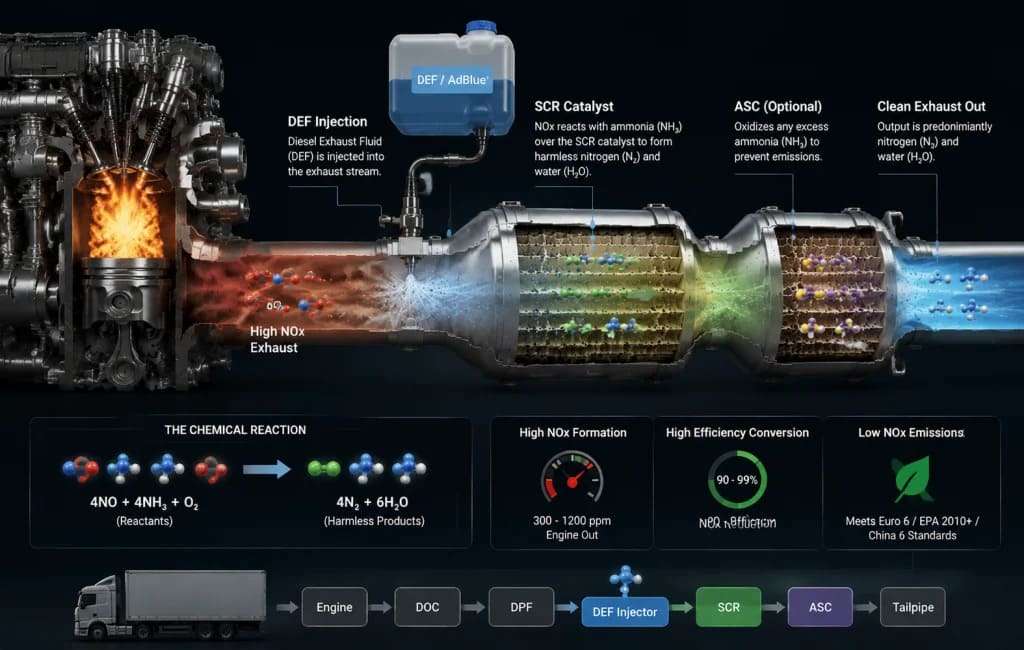
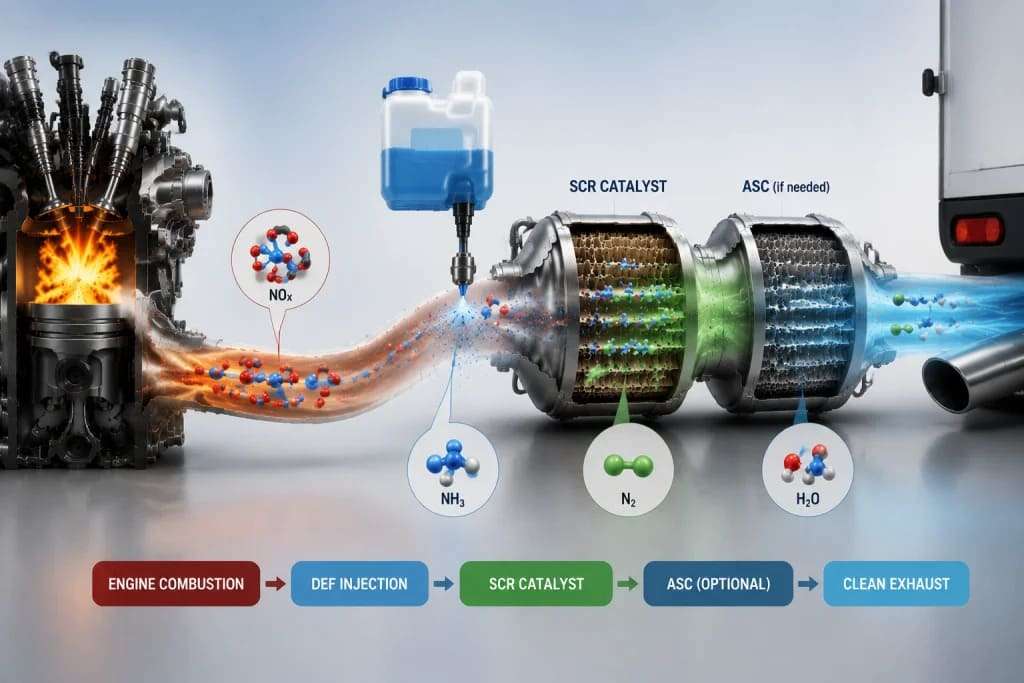
Unlike gasoline engines, which use a Three-Way Catalyst to reduce NOx during rich (stoichiometric) operation, diesel engines run lean with excess oxygen. Under these conditions, NOx cannot be reduced by traditional means—there is no CO or HC available to act as reductants inside the catalyst.
The SCR solution: Inject a controlled amount of ammonia (NH₃) upstream of a specialized catalyst. The ammonia reacts selectively with NOx in the presence of abundant oxygen, producing only N₂ and H₂O.
Why SCR is mandatory:
Diesel engines produce high NOx (300–1200 ppm) due to high combustion temperatures and lean mixtures.
EGR (exhaust gas recirculation) alone reduces NOx by only 30-50% and hurts fuel economy.
Without SCR, even the most advanced diesel cannot meet Euro 6 or EPA 2010+ NOx limits (0.08–0.4 g/kWh, depending on application).
SCR enables engine manufacturers to optimize combustion for fuel efficiency and low CO₂, then “clean up” NOx downstream.

The journey of NOx from the engine cylinder to the tailpipe follows a precise chemical and thermal path, with SCR as the central reduction device.
The process begins in the combustion chamber. High combustion temperatures (above 1800°C / 3272°F) cause atmospheric nitrogen and oxygen to react, forming NO and small amounts of NO₂. The Engine Control Unit (ECU) uses EGR to reduce peak temperatures by diluting intake air with inert exhaust gas—this lowers NOx formation by 30-50% at the source. However, the remaining NOx (typically 300–800 ppm) must be handled by SCR.
As exhaust exits the DOC (where NO has been partially converted to NO₂ to improve SCR kinetics) and passes through or around the DPF, a precise amount of DEF is injected into the exhaust stream.
Location: Downstream of DPF (most common) or between DOC and DPF (compact layouts).
DEF composition: 32.5% high-purity urea, 67.5% deionized water.
Chemical breakdown (thermolysis + hydrolysis):
(NH₂)₂CO → NH₃ + HNCO (isocyanic acid)
HNCO + H₂O → NH₃ + CO₂
Net result: 1 mole of DEF produces 2 moles of ammonia (NH₃). The ammonia is now ready to react with NOx.
Critical dosing control: Too little NH₃ → poor NOx conversion. Too much NH₃ → ammonia slip (toxic, odorous, and regulated). The ECU calculates the required dose based on:
Upstream and downstream NOx sensors
– Exhaust temperature
– Exhaust mass flow
– Catalyst NH₃ storage level (modeled)
The NH₃-laden exhaust enters the SCR catalyst, typically a copper-zeolite (Cu-zeolite) or vanadium-based (V₂O₅/WO₃/TiO₂) flow-through monolith.
Location: Downstream of DEF injector (after adequate mixing distance).
Operating temperature range:
Cu-zeolite: 175–500°C (347–932°F) – preferred for most on-highway applications.
Vanadium: 250–550°C (482–1022°F) – less sensitive to sulfur, common in heavy-duty and older systems.
Primary chemical reactions (on catalyst surface):
Standard SCR (dominant, 70-90% of total):
4NO + 4NH₃ + O₂ → 4N₂ + 6H₂O
Fast SCR (faster kinetics, preferred):
2NO + 2NO₂ + 4NH₃ → 4N₂ + 6H₂O
This requires a 50:50 NO:NO₂ ratio, enabled by an upstream DOC.
NO₂ SCR (slower, less efficient):
4NO₂ + 4NH₃ + O₂ → 4N₂ + 2N₂O + 6H₂O
Nitrous oxide (N₂O) formation is undesirable (greenhouse gas, 300x CO₂ potency).
Efficiency: >95% typical, >99% achievable with optimized NO/NO₂ ratio and temperature.
NH₃ storage mechanism: Zeolite catalysts store ammonia on their high surface area at lower temperatures (150–250°C / 302–482°F). This “NH₃ tank” allows SCR to function during transients when the DEF doser cannot respond instantly, and enables passive reduction during cold starts or low-temperature operation.
After the SCR catalyst, a small amount of unreacted NH₃ may remain (ammonia slip). The ASC, typically coated on the rear of the SCR brick or as a separate downstream device, oxidizes excess NH₃.
Location: Directly downstream of SCR, often integrated on the same substrate.
Reaction: 4NH₃ + 3O₂ → 2N₂ + 6H₂O
ASC composition: Platinum (Pt) on a high-surface-area support—the same chemistry as a DOC but optimized for NH₃ oxidation without forming excessive NOx.
Result: Tailpipe NH₃ emissions below 10–50 ppm (regulated limit), ensuring no ammonia odor or toxicity.
SCR system health is monitored by multiple sensors:
NOx sensors (two required for OBD):
Upstream NOx sensor (pre-SCR): Measures engine-out NOx.
Downstream NOx sensor (post-SCR, often post-ASC): Measures tailpipe NOx and cross-sensitivity to NH₃.
NH₃ sensor (optional, advanced systems): Directly measures ammonia slip for precise dosing control.
Temperature sensors (minimum two): Upstream and downstream of SCR to ensure the catalyst is active (>175°C for Cu-zeolite) and to prevent overheating (>550°C degrades zeolite).
DEF quality sensor: In the DEF tank, measures urea concentration (32.5% ± 0.5%) and triggers faults if adulterated (e.g., water dilution).
OBD logic:
The ECU compares upstream and downstream NOx signals to calculate conversion efficiency.
– If efficiency falls below a threshold (typically 75–85% depending on regulation), a fault is logged.
– Common failure modes: DEF doser clogging, empty DEF tank, catalyst poisoning (sulfur, phosphorus), thermal degradation.
Inducement strategy (heavy-duty only): If the driver ignores DEF refill warnings, the vehicle may enter a “limp home” mode (speed limited to 5 mph / 8 km/h) until the tank is refilled.
We don’t just manufacture SCR catalysts; we engineer them to meet the precise demands of your specific diesel technical route. Whether you require a high-storage Cu-zeolite SCR for urban buses with frequent cold starts and low-temperature operation, or a sulfur-tolerant vanadium SCR for off-highway equipment burning high-sulfur fuel, our team can tailor the zeolite type, copper loading, washcoat thickness, and substrate cell density to your exact exhaust conditions and regulatory targets.
Partner with us to define your path to compliance.
With Euro 7, EPA 2027, and increasingly stringent real-driving emissions (RDE) requirements, SCR technology continues to evolve beyond simple reduction.
The modern high-efficiency diesel route now looks like this:
Engine → DOC → DPF → DEF injector → SCR → ASC → Tailpipe
SCR catalyst coated directly onto a wall-flow DPF substrate.
Benefit: Combines particulate filtration and NOx reduction in a single can, reducing space, weight, and backpressure.
Challenge: Thermal management during DPF regeneration must protect the SCR coating (zeolites degrade above 550–600°C / 1022–1112°F).
Application: Passenger car diesels and hybrid commercial vehicles with tight packaging constraints.
Two SCR catalysts in series: a small, fast-light-off SCR close-coupled to the engine (for cold-start compliance), followed by a large, high-storage underfloor SCR.
Benefit: Dramatically reduces NOx during the first 3–5 minutes of operation (the most challenging RDE window).
Resistive heating elements embedded in or before the SCR catalyst.
Benefit: Enables NOx reduction during cold start and low-load city driving—conditions where diesel exhaust temperatures fall below 150°C (302°F) and conventional SCR is inactive.
Cost premium: Significant, but necessary for near-zero NOx standards (<0.02 g/kWh).
Replaces liquid DEF with a solid salt (strontium chloride or magnesium chloride) that releases ammonia when heated.
Benefit: Eliminates freezing issues (DEF freezes at -11°C / 12°F), reduces system complexity, and allows passive ammonia release at low temperatures.
Application: Off-highway, marine, and high-altitude applications.
Hydrogen combustion produces zero CO₂ but still generates NOx (thermal NOx).
Challenge: H₂-ICE exhaust contains no CO or HC, and very high water content—but SCR still works.
Solution: SCR remains the primary NOx control technology for hydrogen engines, using the same DEF/NH₃ chemistry.
SCR is not just a catalyst—it is a system. From DEF dosing accuracy (±1% over a 50:1 turndown ratio) to NH₃ storage management (balancing storage against slip), every component must work in harmony. A well-engineered SCR system delivers >95% NOx conversion across a wide temperature window, survives 700,000+ km of real-world operation, and enables the diesel engine to continue as the most efficient powertrain for heavy-duty applications. Whether you are developing a long-haul truck, a city bus, a tractor, or a generator set, SCR will define your NOx compliance—and we are ready to engineer the solution.