Carbon Molecular Sieves (CMS) are non-polar adsorbents specifically engineered for the separation of nitrogen from air under ambient temperature and pressure swing conditions. The material contains micropores with diameters of approximately 4 angstroms (4Å), which exhibit strong instantaneous affinity for oxygen molecules. This unique pore structure enables CMS to preferentially adsorb oxygen from compressed air, producing a continuous stream of high-purity nitrogen for a wide range of industrial applications.
Operating Principle – CMS separates air based on the principle of kinetic selectivity. Under equilibrium conditions, the adsorption capacity of CMS for oxygen and nitrogen is quite close. However, the diffusion speed of oxygen molecules through the narrow voids of the carbon sieve micropore system is substantially faster than that of nitrogen molecules. Under non-equilibrium conditions—specifically, during the short adsorption cycle of a Pressure Swing Adsorption (PSA) process—this difference in diffusion kinetics allows oxygen to be preferentially adsorbed while nitrogen is enriched in the gas phase.
The PSA process operates on a two-bed cycle:
By alternating between two beds—one adsorbing while the other regenerates—the PSA system produces a continuous supply of nitrogen. This process operates at ambient temperature without external heating, making it energy-efficient and environmentally friendly.
All CMS grades are manufactured from high-purity elemental carbon, appearing as black cylindrical pellets with uniform particle size distribution, high mechanical strength, and low dust content (<100 ppm). Carbon Molecular Sieves are currently the preferred PSA nitrogen generation adsorbent, with wide applications in chemical, petrochemical, electronics, food, and other industries.

CMS-200 is a premium-grade carbon molecular sieve delivering 200 Nm³ of nitrogen per metric ton of CMS per hour at 99.5% purity. It is a new kind of non-polar adsorbent specially designed for extracting nitrogen-rich gas from air. The most notable feature of CMS-200 is its high gas-producing efficiency, especially for the preparation of nitrogen with a purity of less than 99.5%. It can be used to separate air into nitrogen and oxygen in PSA systems.
Technical Specifications:
Parameter | Specification |
Appearance | Black cylindrical pellets |
Pellet diameter | 1.1 – 1.8 mm |
Bulk density | 630 – 700 g/L |
Compressive strength | ≥95 – 100 N/pellet |
Dust content | ≤100 ppm |
Micropore diameter | 4 Å |
Adsorption cycle time | 120 seconds |
Storage life | >3 years (sealed, dry conditions) |
Performance Data (at 0.8 MPa adsorption pressure):
Nitrogen Purity (%) | Nitrogen Production (Nm³/h·t) | Air/Nitrogen Ratio |
99.99 | 70 – 75 | ≥21 |
99.9 | 125 – 140 | ≥27 |
99.5 | 200 | ≥36 |
99.0 | 240 – 260 | ≥41 |
98.0 | 325 – 330 | ≥48 |
97.0 | 365 | ≥48 |
CMS-260 delivers higher nitrogen productivity than standard grades, producing 260 Nm³ per metric ton of CMS per hour at 99.5% purity. It excels particularly in extracting nitrogen from air, delivering high-purity nitrogen with purities ranging from 97% to 99.995%. CMS-260 is an excellent choice for industries requiring precise gas separation and purification.
Technical Specifications:
Parameter | Specification |
Appearance | Black cylindrical pellets |
Pellet diameter | 0.9 – 1.3 mm |
Bulk density | 640 – 690 g/L |
Compressive strength | ≥70 – 100 N/pellet |
Hardness | ≥98 wt% |
Dust content | ≤100 ppm |
Adsorption cycle time | 2 × 60 seconds |
Micropore diameter | 4 Å |
Performance Data (at 0.7 – 0.8 MPa adsorption pressure):
Nitrogen Purity (%) | Nitrogen Production (Nm³/h·t) | Nitrogen/Air Recovery Rate (%) |
99.99 | 105 – 130 | ≥21 |
99.9 | 170 – 200 | ≥31 |
99.5 | 220 – 265 | ≥40 – 41 |
99.0 | 250 – 325 | ≥45 |
98.0 | 290 – 390 | ≥46 |
97.0 | 330 – 405 | ≥48 |
Note: At 99.5% purity, recovery rate reaches 41% with an air/N₂ ratio of 2.4.
CMS-330 represents the high-capacity tier, delivering 330 Nm³ per metric ton of CMS per hour at 99.5% purity. It is a coal-based option with very high separation rates and reliability. CMS-330 has far exceeded the industry level in the China market and is at the world’s leading level. It produces 99.999% concentration nitrogen more economically via PSA method.
Technical Specifications:
Parameter | Specification |
Appearance | Black, extruded (pellet) |
Pellet diameter | 1.0 – 1.3 mm |
Bulk density | 640 – 680 kg/m³ |
Crush strength | ≥65 – 70 N/pellet |
Hardness | ≥98 wt% |
Dust content | ≤100 ppm |
Adsorption cycle time | 2 × 35 – 45 seconds |
Nominal pore diameter | 4 Å |
Inlet air temperature | ≤20°C |
Performance Data (at 0.7 MPa adsorption pressure):
Nitrogen Purity (%) | Nitrogen Production (Nm³/h·t) | Air/Nitrogen Ratio |
99.999 | 102 – 105 | 5.4 – 6.7 |
99.99 | 158 – 160 | 4.24 – 4.5 |
99.9 | 230 – 245 | 3.02 – 3.5 |
99.5 | 330 – 340 | 2.42 – 3.2 |
99.0 | 410 | 2.05 |
98.0 | 520 | 1.9 |
97.0 | 560 | 1.84 |
CMS-330 represents the high-capacity tier, delivering 330 Nm³ per metric ton of CMS per hour at 99.5% purity. It is a coal-based option with very high separation rates and reliability. CMS-330 has far exceeded the industry level in the China market and is at the world’s leading level. It produces 99.999% concentration nitrogen more economically via PSA method.
Technical Specifications:
Parameter | Specification |
Appearance | Black, extruded (pellet) |
Pellet diameter | 1.0 – 1.3 mm |
Bulk density | 640 – 680 kg/m³ |
Crush strength | ≥65 – 70 N/pellet |
Hardness | ≥98 wt% |
Dust content | ≤100 ppm |
Adsorption cycle time | 2 × 35 – 45 seconds |
Nominal pore diameter | 4 Å |
Inlet air temperature | ≤20°C |
Performance Data (at 0.7 MPa adsorption pressure):
Nitrogen Purity (%) | Nitrogen Production (Nm³/h·t) | Air/Nitrogen Ratio |
99.999 | 102 – 105 | 5.4 – 6.7 |
99.99 | 158 – 160 | 4.24 – 4.5 |
99.9 | 230 – 245 | 3.02 – 3.5 |
99.5 | 330 – 340 | 2.42 – 3.2 |
99.0 | 410 | 2.05 |
98.0 | 520 | 1.9 |
97.0 | 560 | 1.84 |
Carbon Molecular Sieves are extensively used in PSA nitrogen generation systems across diverse industries:
Industry | Application |
**Petrochemical & Oil & Gas** | Blanketing, purging, pipeline pressure maintenance, enhanced oil recovery |
**Metal Heat Treatment** | Controlled atmosphere annealing, carburizing, sintering, brazing |
**Electronics & Semiconductor** | Inert atmosphere for component manufacturing, soldering, wave soldering |
**Food & Beverage** | Modified atmosphere packaging (MAP), food preservation, inert gas blanketing |
**Pharmaceutical** | Inert gas for synthesis, packaging, and storage |
**Coal Industry** | Fire prevention, goaf inerting |
**Cable & Wire** | Nitrogen curing for cross-linked polyethylene (XLPE) cable production |
Product | Productivity at 99.5% Purity | Max Purity | Pellet Diameter | Key Advantage |
CMS-200 | 200 Nm³/h·t | 99.99% | 1.1 – 1.8 mm | High efficiency for ≤99.5% purity |
CMS-260 | 220 – 265 Nm³/h·t | 99.995% | 0.9 – 1.3 mm | Balanced performance across purity range |
CMS-330 | 330 – 340 Nm³/h·t | 99.999% | 1.0 – 1.3 mm | Ultra-high purity and productivity |
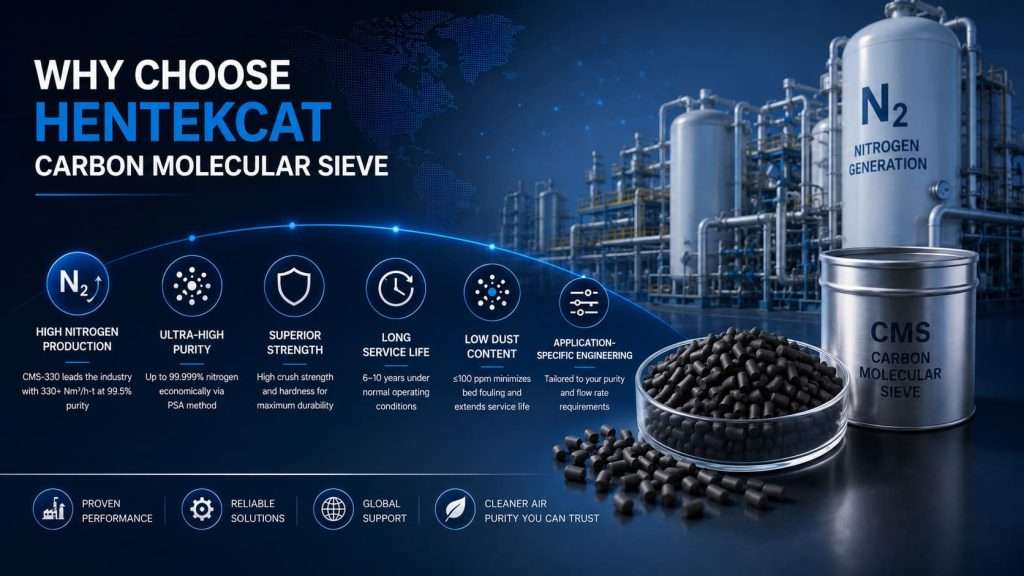
– High nitrogen production capacity – CMS-330 leads the industry with 330+ Nm³/h·t at 99.5% purity
– Ultra-high purity capability – CMS-330 produces 99.999% nitrogen economically via PSA method
– Superior mechanical strength – High crush strength (≥65-100 N/pellet) and hardness (≥98 wt%) resist attrition
– Long service life – 6-10 years under normal operating conditions
– Low dust content – ≤100 ppm minimizes bed fouling and extends service life
– Application-specific engineering – Tailored to your purity and flow rate requirements
HENTEKCAT Carbon Molecular Sieve – Engineered for Performance, Reliability, and Pure Nitrogen.