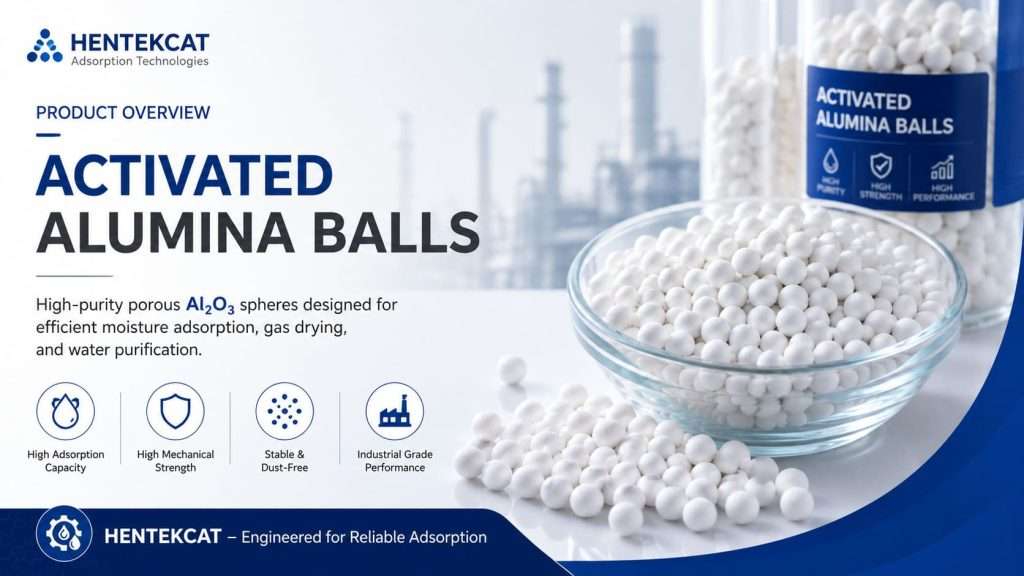
Activated alumina balls are white, spherical porous pellets made from high-purity aluminum oxide (Al₂O₃) through a specialized manufacturing process. Their unique skeletal structure provides uniform micropores, optimal pore diameter, high pore volume, and excellent water adsorption capacity. The product features uniform particle size, a smooth surface, high mechanical strength, and does not expand, crack, or pulverize upon water adsorption. It is non-toxic, odorless, and insoluble in water and ethanol.
As a highly efficient desiccant and adsorbent, activated alumina balls are widely used in petrochemical, natural gas, air separation, compressed air drying, instrument air drying, and water treatment for fluoride and arsenic removal.
Parameter | Typical Value | Reference Standard |
Al₂O₃ Content | ≥92% – 93% | HG/T 3927 |
Specific Surface Area | 280 – 380 m²/g | — |
Total Pore Volume | ≥0.38 – 0.40 cm³/g | — |
Static Adsorption Capacity (RH = 60%) | ≥16.8 – 19% | — |
Water Adsorption Rate | ≥50 – 52% | — |
Crush Strength (3–5 mm) | ≥100 – 180 N/pellet | — |
Bulk Density | 0.60 – 0.89 g/cm³ | — |
Attrition Loss | ≤0.1 – 0.3% | — |

With a specific surface area exceeding 300 m²/g, the porous structure ensures efficient adsorption of moisture and contaminants. In compressed air drying applications, it can achieve pressure dew points as low as -40°C to -70°C.
High crush strength (≥130–180 N/pellet) and low attrition loss (≤0.3%) prevent powdering and cracking under high-pressure airflow, significantly extending service life.
After saturation, the product can be regenerated by heating at approximately 175–315°C, restoring its adsorption capacity for repeated use. Activated alumina is suitable for both heatless and pressure swing adsorption (PSA) regeneration processes.
Non-toxic, odorless, and insoluble in water and ethanol. It exhibits strong selective adsorption for fluoride ions, making it suitable for drinking water defluoridation applications.
Application Area | Specific Use | Recommended Size |
Compressed Air Drying | Air compressors, dryers, and refrigerated air dryers | 3–5 mm, 4–6 mm |
Instrument Air Drying | Deep drying for automated instrument air systems | 3–5 mm, 4–6 mm |
Air Separation / Oxygen Production | Air separation units and PSA oxygen generation systems | 4–6 mm, 5–8 mm |
Natural Gas Drying | Gas and liquid phase drying in petrochemical industries | 4–6 mm, 6–8 mm |
Drinking Water Defluoridation | Fluoride and arsenic removal in high-fluoride water sources | 1–3 mm, 2–4 mm |
Catalyst Support | Petrochemical catalyst carrier applications | 2–4 mm, 3–5 mm |
Activated alumina balls can be regenerated through several methods to restore adsorption capacity.
Heating the saturated product to 175–315°C drives off adsorbed moisture. Studies show that reducing regeneration temperature from 300°C to 200°C decreases adsorption capacity by only about 3%, while reducing regeneration energy consumption by approximately 30%.
Lowering the adsorption vessel pressure regenerates the adsorbent bed, making it suitable for heatless regeneration systems.
Using dilute nitric acid impregnation followed by calcination at 300–500°C can restore the adsorption capacity of spent activated alumina.
Under normal operating conditions, activated alumina balls can achieve thousands of adsorption–regeneration cycles, with a typical service life of 3–5 years or longer.
Available Sizes (mm): 1-3, 2-4, 3-5, 4-6, 5-7, 5-8, 6-8, 8-10
Packaging Options:- 25 kg/bag – 25 kg/drum – 500 kg/supersack (tonne bag) – 1,000 kg/supersack (custom sizes available upon request)
Storage Conditions: Store in a ventilated, dry warehouse. Protect from moisture. Do not open packaging before use to prevent moisture absorption.
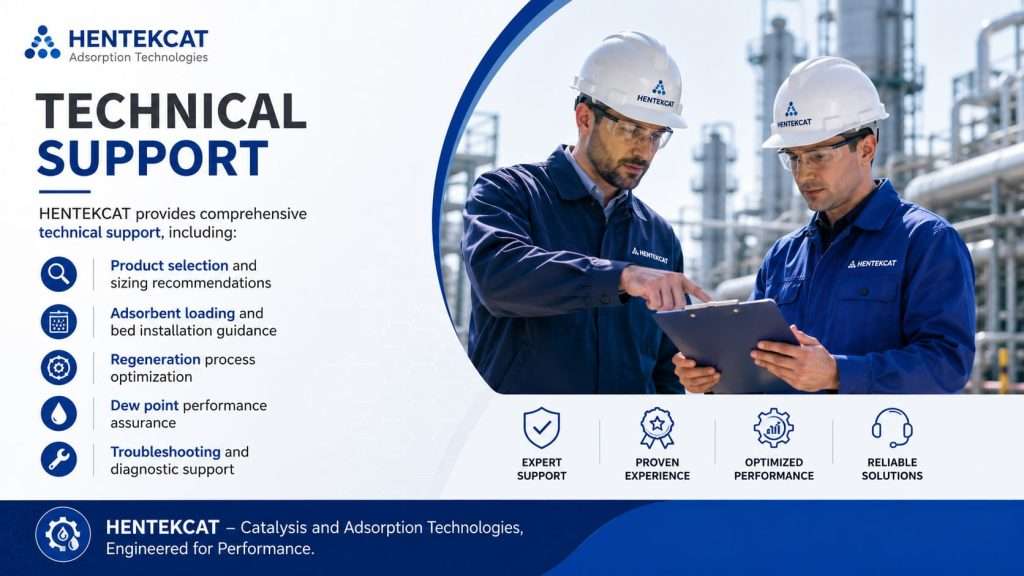
HENTEKCAT provides comprehensive technical support, including:
HENTEKCAT – Catalysis and Adsorption Technologies, Engineered for Performance.