
Exploring the engineering behind pre-configured, application-flexible catalyst solutions that serve the aftermarket, small-volume OEM, and specialty vehicle markets—where customized one-off designs are impractical but certified emissions performance is still required.
Unlike dedicated, engine-specific catalyst systems calibrated for a single vehicle platform (e.g., a TWC for a specific Toyota or Volkswagen model), a **Universal Catalyst Package** is designed to meet emissions performance targets across a range of engine sizes, configurations, and applications. The universal package typically includes a catalyst substrate (pre-washcoated and PGM-impregnated), a mounting mat, a housing/can (or canning instructions), and sometimes inlet/outlet adapters. The end user—whether an exhaust shop, a small fleet operator, a classic car restorer, or an off-highway equipment rebuilder welds or clamps the universal catalyst into an existing exhaust system to replace a failed converter, upgrade a non-catalyst vehicle, or enable emissions compliance for an imported or custom-built machine.
The universal package value proposition: Provide certified or verifiable emissions reduction (typically 80–95%+ conversion efficiency for target pollutants) without requiring vehicle-specific calibration, extensive engineering validation, or custom tooling. This makes emissions compliance accessible for millions of legacy vehicles, small engines, and specialty applications that would otherwise be economically infeasible to equip with original equipment (OE) catalysts.
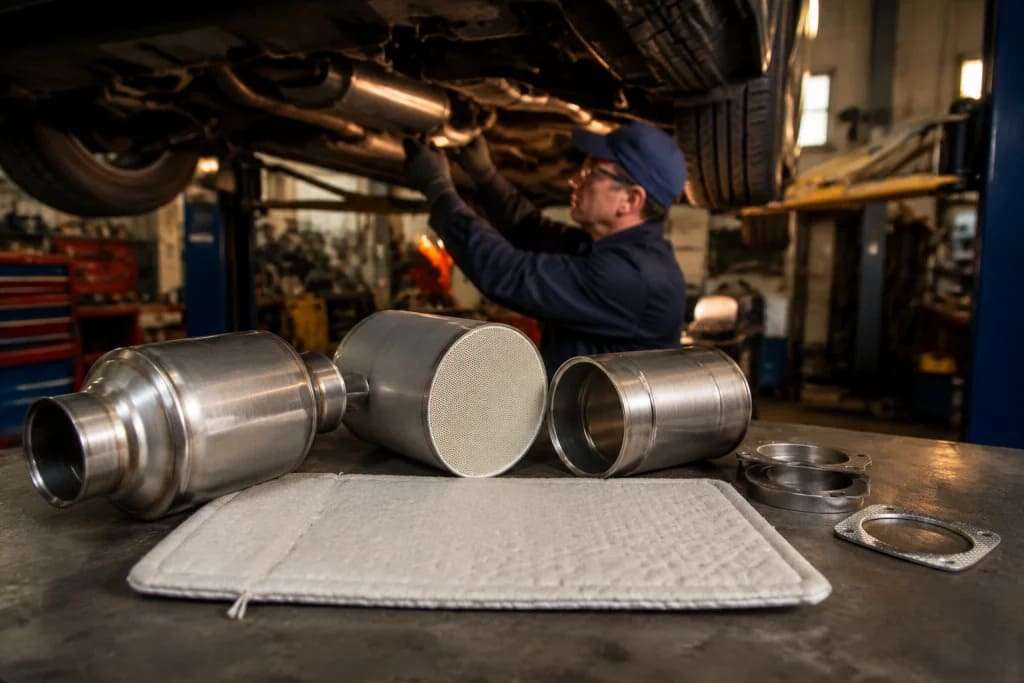
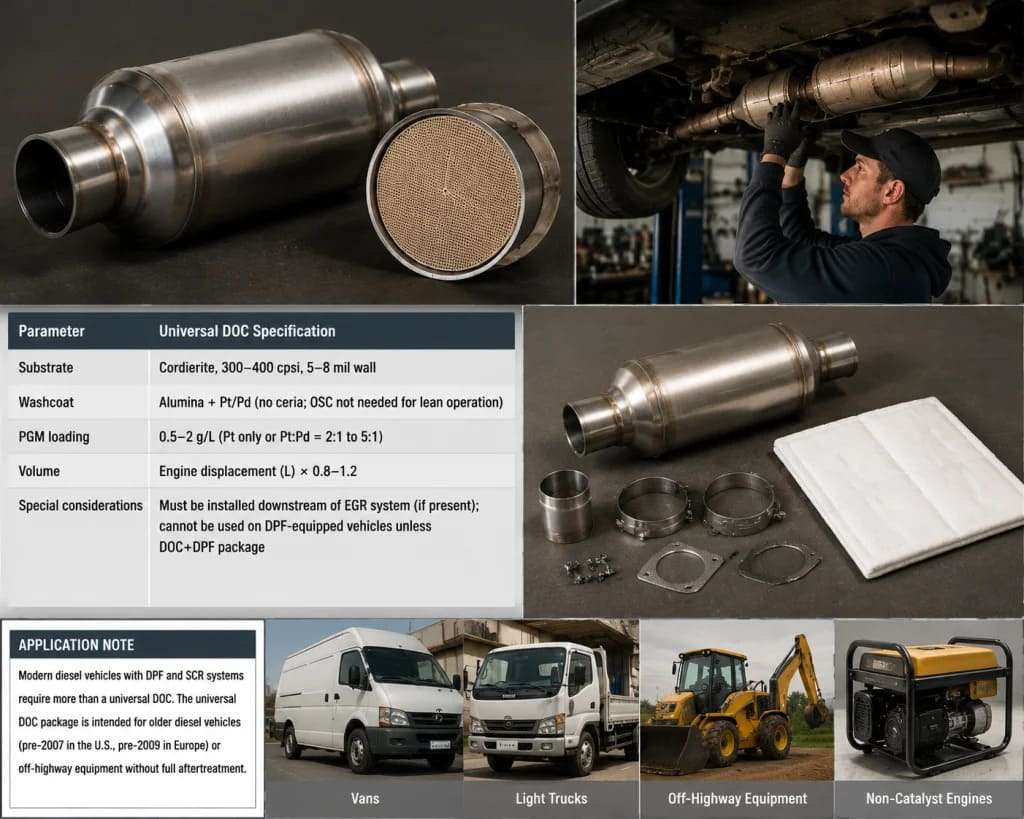
Universal packages bridge the gap between highly engineered OE catalyst systems and generic, non-compliant “test pipe” replacements. The technical route addresses:
Application uncertainty: The same universal catalyst may be installed on a 1.6L four-cylinder, a 4.0L six-cylinder, or a small industrial engine. The package must tolerate varying exhaust flow rates, temperatures, and AFR (air-fuel ratio) control quality.
Installation variability: The installer may not have sophisticated welding or alignment equipment. The package must accommodate imperfect fitment, orientation errors, and varying inlet/outlet pipe diameters.
Regulatory requirements: Aftermarket catalysts in regulated markets (U.S. EPA, California CARB, European ECE, China GB) must meet minimum efficiency and durability standards—often verified through standardized testing (e.g., EPA’s “2000-mile” or “120,000-mile” certification for replacement converters).

We describe the universal TWC (Three-Way Catalyst) package for gasoline engines—the most common universal catalyst application—followed by variations for diesel (DOC/SCR) and industrial (VOC) packages.
The universal package must be matched to the engine’s displacement, cylinder count, fuel system type (carbureted vs. port fuel injected vs. direct injected), and expected exhaust temperature range.
Key matching parameters:
| Engine Size | Recommended Substrate Volume | Cell Density | Typical Application |
| <1.0L (motorcycle, small generator) | 0.5–1.0L (30–60 in³) | 400–600 cpsi | Two-wheelers, lawn equipment, small utility engines |
| 1.0–2.0L (compact car, small SUV) | 1.0–1.8L (60–110 in³) | 400–600 cpsi | Aftermarket replacement for economy cars, older imports |
| 2.0–3.5L (midsize sedan, SUV, light truck) | 1.8–2.5L (110–150 in³) | 400–600 cpsi | Mainstream universal replacement market |
| 3.5–5.0L (full-size SUV, van, V8 pickup) | 2.5–4.0L (150–240 in³) | 300–400 cpsi | High-flow packages for V8 and V6 applications |
| 5.0L+ (heavy-duty truck, motorhome) | 4.0–6.0L (240–360 in³) | 200–300 cpsi | Large universal or multi-brick configurations |
Rule of thumb (gasoline universal TWC): Substrate volume (liters) = engine displacement (liters) × 1.0 to 1.5. Example: A 2.0L four-cylinder requires 2.0–3.0L of catalyst volume for OE-like performance. Universal packages often use the lower end of this range (cost optimization) but rely on higher PGM loading to compensate.
Critical considerations:
Carbureted engines (pre-1980s vehicles, small engines): Run richer and less precisely controlled than EFI (electronic fuel injection). Universal TWC must tolerate AFR variations without overheating or rapidly deactivating. Higher PGM loading and additional oxygen storage materials (ceria-zirconia) are specified.
GDI engines (post-2010 vehicles): Higher particulate emissions. Universal package may require a GPF (Gasoline Particulate Filter) or a catalysed GPF (four-way catalyst), not just a flow-through TWC.
Turbocharged engines: Higher exhaust flow rates and potentially higher temperatures. Larger substrate volume or higher cell density (to maintain residence time) is required.
The universal package manufacturer selects a substrate geometry optimized for the target application range.
Typical universal TWC substrate specifications:
| Parameter | Value (Typical Range) | Notes |
| Material | Cordierite | Low cost, excellent thermal shock resistance |
| Cell density | 400–600 cpsi | Balance of surface area vs. pressure drop |
| Wall thickness | 3–5 mil (0.075–0.125 mm) | Thin enough for rapid light-off, thick enough for durability |
| Shape | Round (most common) or oval | Round simplifies canning and universal fitment |
| Diameter | 4.0–6.0 inches (100–150 mm) | Fits typical exhaust pipe sizes |
| Length | 3.0–8.0 inches (75–200 mm) | Volume adjusted by length for given diameter |
Washcoat formulation (universal TWC):
Universal washcoats are formulated to tolerate a wider range of operating conditions than OE-specific washcoats:
Higher ceria-zirconia (CZ) content (30–50% of washcoat vs. 20–30% for OE): Provides enhanced oxygen storage capacity (OSC) to buffer against AFR fluctuations common in older or poorly maintained engines.
Lanthanum-stabilized alumina: Improves thermal durability (prevents surface area loss) for installations where the catalyst is mounted closer to the manifold than originally intended.
Barrier washcoat layer (optional): A bottom layer of alumina without precious metals acts as a poison trap (for phosphorus and zinc from engine oil), extending life in high-mileage or older engines.
PGM loading (universal TWC):
Universal packages typically use higher PGM loading than OE equivalents to compensate for uncertain application conditions and the lack of engine-specific calibration.
| PGM | OE TWC Loading (g/L) | Universal TWC Loading (g/L) | Rationale |
| Platinum (Pt) | 0–1 | 0.5–2 | HC/CO oxidation, added for robustness |
| Palladium (Pd) | 1–4 | 2–6 | Primary HC/CO oxidation, higher to tolerate rich excursions |
| Rhodium (Rh) | 0.1–0.3 | 0.2–0.5 | NOx reduction, higher to tolerate AFR variations |
Total PGM range (universal TWC): 2–8 g/L (vs. 1–5 g/L for OE). The higher loading increases cost but provides a “margin of safety” for unknown installation conditions.
The universal package includes a pre-canned substrate or provides components for the installer to can the substrate themselves.
Pre-canned universal catalyst (most common):
– The substrate is mounted inside a stainless steel (409 or 304 grade) housing with a mounting mat (intumescent, vermiculite-based).
– Inlet and outlet connections are typically 2.0–2.5 inches (50–63 mm) OD pipe matching the most common exhaust pipe sizes for passenger cars and light trucks.
– The housing includes heat shields (single or double wall) to reduce underbody temperatures and protect adjacent components.
Oxygen sensor bungs (M18×1.5 threads, the industry standard for lambda sensors) are pre-welded upstream and downstream of the substrate—critical for OBD-II equipped vehicles (1996+ in the U.S.). Without a downstream sensor, the ECU will set a catalyst efficiency fault (P0420/P0430).
Universal “spin-on” or “weld-on” can (less common, for custom installers):
– The substrate and mounting mat are supplied separately. The installer welds or clamps the assembly into the existing exhaust using inlet/outlet adapters.
–Advantage: Maximum flexibility for odd-shaped or custom exhaust systems (e.g., classic cars, race cars converted to street use, custom motorcycles).
Disadvantage: Higher installer skill required; risk of improper mounting (substrate misalignment, mat compression errors).
Orientation requirements:
– Most universal TWCs are omnidirectional (can be installed in any orientation) but typically marked with a flow direction arrow. Installing backward drastically reduces efficiency (exhaust bypasses the washcoated channels).
– Some universal packages are engine position-specific (close-coupled vs. underfloor) with different thermal durability specifications. Close-coupled catalysts (near the exhaust manifold) require higher temperature tolerance.
Universal packages include or offer as an accessory a fitment kit:
| Component | Purpose |
| Inlet/outlet reducers or expanders | Adapt from the catalyst’s 2.0–2.5″ pipes to the vehicle’s (often 1.75″ or 2.25″) |
| Universal exhaust clamps (band or U-bolt) | For clamp-on installations (no welding) |
| Oxygen sensor extension harness | If the OE sensor wiring does not reach the new bung locations |
| Exhaust sealant paste | For slip-fit connections |
| Gaskets (donut or flat) | For flanged connections |
| Mounting brackets / hangers | To support the catalyst weight and prevent exhaust system sag |
| Heat shield wrap (optional) | For installations near fuel tanks, brake lines, or plastic body panels |
Installation best practices (provided in package documentation):
Universal catalyst packages sold in regulated markets must meet minimum emissions performance standards.
United States – EPA Aftermarket Catalyst Regulations (40 CFR Part 1036, 40 CFR Part 1065, and enforcement policy):
| Vehicle Category | Durability Requirement | Efficiency Requirement |
| Light-duty (cars, SUVs) | 25,000 miles (basic) or 50,000 miles (intermediate) or 120,000 miles (advanced) | 90–95% of OE efficiency (varies by model year) |
| Heavy-duty (trucks >8,500 lb GVWR) | 50,000 miles | Must not increase emissions above OE levels |
California – CARB Executive Order (EO) for Aftermarket Converters:
– More stringent than EPA. Universal catalysts must be tested on specific engine families (vehicle groups with similar emissions characteristics).
– CARB issues an Executive Order (EO) number that must be stamped on the converter housing.
The installer must look up the vehicle by make, model, year, and engine size to confirm the universal catalyst is approved for that application.
Verification labels: A tamper-resistant label with the EO number is affixed to the vehicle after installation.
Europe – ECE Regulation No. 103 (Replacement Catalytic Converters):
– Universal replacement converters must be tested to the original vehicle’s type approval standards.
– Requires documentation of the test results (emissions before and after replacement).
Practical reality: Many universal packages are sold without formal certification for “off-road use only” or “racing use only” placing the liability on the installer and vehicle owner. Responsible manufacturers clearly label certified vs. non-certified packages.
Universal packages are often installed to resolve existing emissions problems (failed OE catalyst, P0420/P0430 codes). The package documentation includes a diagnostic flow chart:
Common post-installation issues:
| Symptom | Likely Cause | Solution |
| P0420/P0430 returns (catalyst efficiency code) | Downstream O₂ sensor sees insufficient oxygen storage; universal catalyst may have lower OSC than OE | Install a **O₂ sensor spacer / defouler** (not legal in all jurisdictions) or replace with a higher-OSC universal package |
| Engine runs poorly, misfires, or lacks power | Excessive backpressure (catalyst too small or clogged) | Check exhaust backpressure; replace with larger-volume package |
| Rattling noise from catalyst | Substrate broken (thermal shock or impact damage) | Replace substrate; check mounting alignment |
| Strong sulfur (rotten egg) smell | Catalyst overloaded with sulfur (from fuel or oil); temporary condition | Drive at highway speeds for 30+ minutes to desulfate; change fuel supplier if persistent |
| Catalyst glows red (visible overheating) | Excessively rich fuel mixture; unburned fuel burning on catalyst | Diagnose engine (O₂ sensors, fuel injectors, ignition) before replacing catalyst again |
| No light-off (cold start emissions fail) | Catalyst too far from engine; temperatures never reach 300°C (572°F) | Relocate catalyst upstream (closer to manifold) |
For diesel-powered vehicles (vans, light trucks, off-highway equipment) where the OE DOC has failed or the vehicle was originally non-catalyst.
| Parameter | Universal DOC Specification |
| Substrate | Cordierite, 300–400 cpsi, 5–8 mil wall |
| Washcoat | Alumina + Pt/Pd (no ceria; OSC not needed for lean operation) |
| PGM loading | 0.5–2 g/L (Pt only or Pt:Pd = 2:1 to 5:1) |
| Volume | Engine displacement (L) × 0.8–1.2 |
| Special considerations | Must be installed downstream of EGR system (if present); cannot be used on DPF-equipped vehicles unless DOC+DPF package |
Application note: Modern diesel vehicles with DPF and SCR systems require more than a universal DOC. The universal DOC package is intended for older diesel vehicles (pre-2007 in the U.S., pre-2009 in Europe) or off-highway equipment without full aftertreatment.
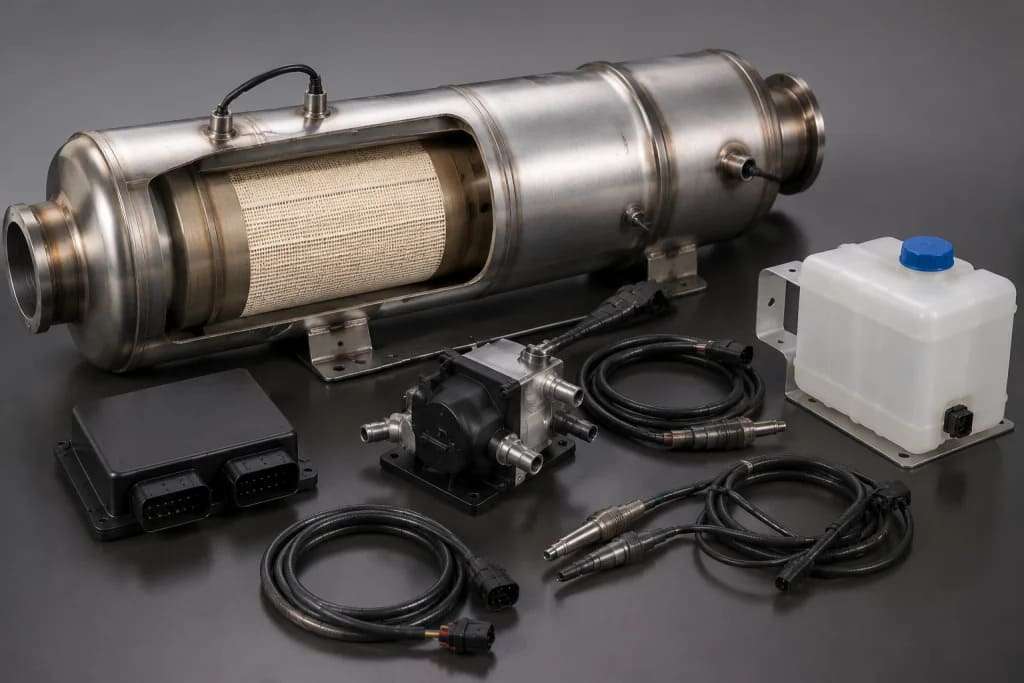
For diesel vehicles where the OE SCR system has failed (e.g., agricultural equipment, older buses, marine diesels) and OE parts are unavailable or cost-prohibitive.
| Parameter | Universal SCR Specification |
| Substrate | Cordierite, 400–600 cpsi, 4–6 mil wall |
| Washcoat | Cu-zeolite (175–500°C) or Fe-zeolite (250–550°C) |
| Volume | Engine displacement (L) × 1.0–1.5 |
| Additional components | DEF doser (universal, PWM-controlled), dosing control unit (standalone or CAN integration), DEF tank with quality sensor, temperature sensors (pre/post SCR), NOx sensor (optional for closed-loop control) |
Complexity warning: Universal SCR is significantly more complex than universal TWC or DOC. The dosing control unit must be calibrated to the engine’s NOx output and exhaust flow a task beyond most general exhaust shops. Universal SCR packages are typically sold to specialty diesel shops or OEMs integrating SCR into non-automotive applications (gensets, pumps, compressors).
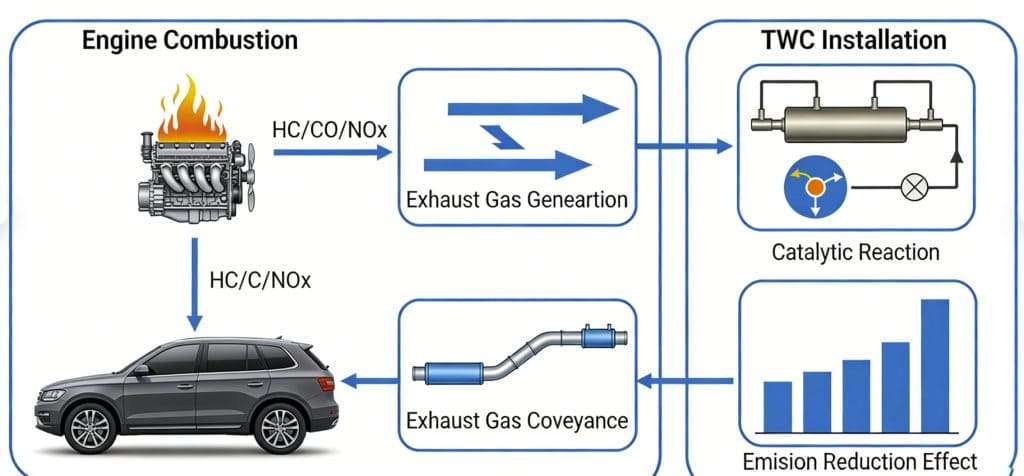
An emerging category for GDI-equipped vehicles (2010+ in Europe, 2015+ in North America, 2018+ in China) where the OE GPF has failed but an OE replacement is unavailable or excessively expensive.
| Parameter | Universal GPF Specification |
| Substrate | Cordierite or SiC wall-flow, 200–300 cpsi, 8–10 mil wall, 50–60% porosity |
| Coating | Catalysed GPF (cGPF) with TWC washcoat (Pt/Pd/Rh + ceria-zirconia) |
| Volume | Engine displacement (L) × 1.0–1.2 |
| Special considerations | Requires differential pressure sensor (to monitor soot load) and temperature sensors for regeneration management; passive regeneration only (no active fuel post-injection control on universal package) |
Current limitation: Most universal GPF packages are still in development. The complexity of regeneration management (ensuring the GPF does not clog) has limited aftermarket penetration.
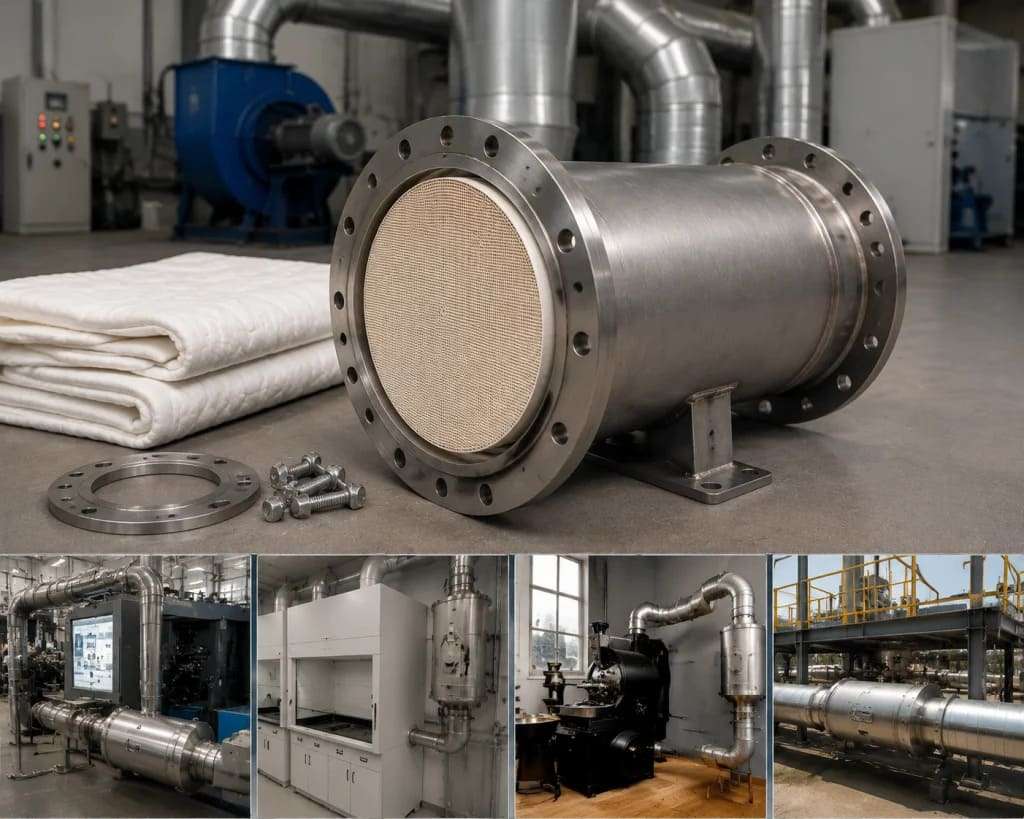
For industrial applications (small coating lines, printing presses, chemical laboratories, wastewater treatment off-gas) where a custom catalytic oxidizer is cost-prohibitive.
| Parameter | Universal VOC Package Specification |
| Substrate | Cordierite or metal, 200–400 cpsi, 5–10 mil wall |
| Washcoat | Alumina or zeolite (for chlorinated VOCs) |
| PGM loading | Pt-only or Pt/Pd, 0.5–3 g/L |
| Form factor | Pre-canned in flanged housing (4–12 inch / 100–300 mm diameter) for bolting into existing ductwork |
| Temperature requirement | Inlet gas must be preheated to 300–400°C (572–752°F) before the catalyst |
| Typical applications | Small print presses (<10,000 m³/h), laboratory fume hoods, coffee roasters, crematories, rendering plants |
Installation note: Universal VOC packages do not include the preheater (burner or electric heater) or heat exchanger. The customer must provide preheated air within the catalyst’s operating window.
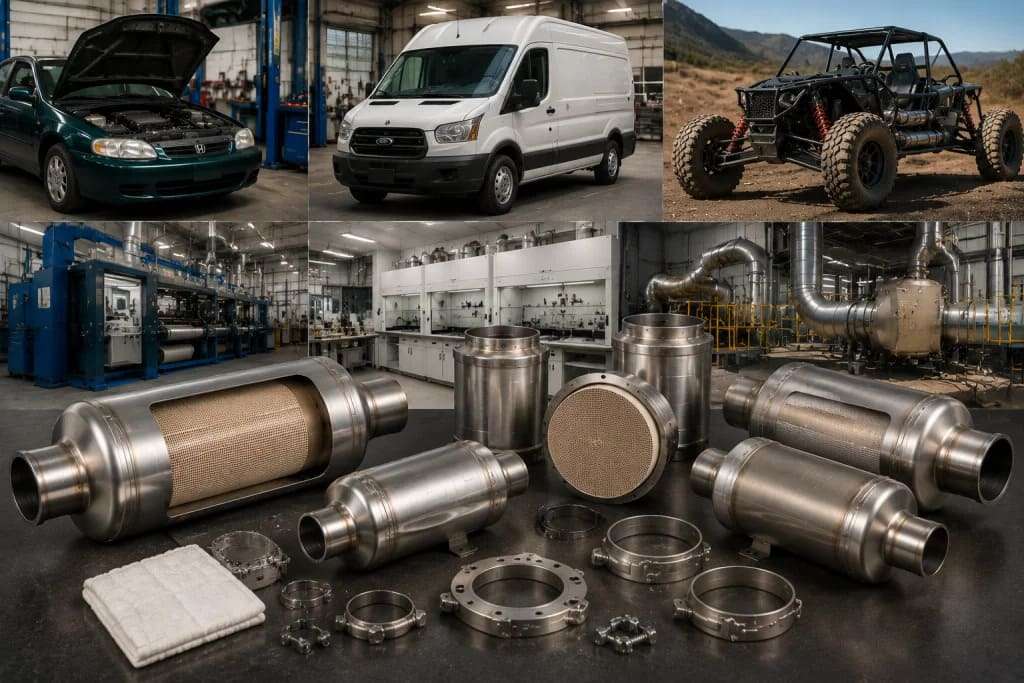
We don’t just manufacture universal catalysts; we engineer them to provide maximum application flexibility without sacrificing emissions performance. Whether you need a CARB-compliant universal TWC for a 1998 Honda Civic with a failed OE converter, a high-flow universal DOC for a 2005 Ford diesel van with a deleted (illegally) DPF that needs restoration to legality, or a non-certified universal package for a custom-built off-road buggy, our team can tailor the substrate volume, cell density, washcoat chemistry (OSC level, poison tolerance), and PGM loading to your specific balance of cost, performance, and compliance requirements.
Partner with us to define your path to compliance—even when there is no OE path.
Universal catalysts pre-equipped with Bluetooth or CAN (Controller Area Network) interfaces to aftermarket O₂ sensors, temperature sensors, and pressure sensors.
Benefit: Plug-and-play diagnostics for the installer; real-time catalyst health monitoring via smartphone app.
Application: High-end aftermarket for classic cars, custom builds, and enthusiast markets.
Small (2–3 inch diameter) individual catalyst modules that can be stacked in series (to increase volume) or parallel (to reduce backpressure).
Benefit: Installer can “build” the correct catalyst size by adding or removing modules—no need to stock dozens of different volume packages.
Challenge: Sealing between modules; increased cost.
LPG/CNG engines (common in forklifts, fleet vehicles, buses) have different exhaust chemistry (higher HC, lower CO) than gasoline. Ethanol (E85) engines have higher aldehyde emissions. Hydrogen combustion engines (H₂-ICE) produce zero CO/HC but high NOx and water vapor.
Universal solution: Substrates with broader washcoat formulations (higher Pd for methane oxidation, different zeolites for aldehyde control, or TWC+SCR hybrid for H₂-ICE).
Market opportunity: Rapidly growing as fleets convert to alternative fuels.
The installer scans the vehicle’s exhaust system geometry (using a smartphone lidar or structured light scanner).
A universal housing is 3D-printed (metal or high-temperature polymer) to match the exact contours, with the universal substrate inserted.
Benefit: Eliminates welding, reduces installation time, ensures optimal positioning (distance from manifold, orientation).
Current status: Early adoption in motorsports and high-end restoration shops.
End-of-life OE catalysts are collected, the substrate is removed, and the can is cleaned and inspected.
A new universal substrate (with fresh washcoat and PGM) is installed in the original OE canning.
Benefit: Lower cost (reused metal housing, no new stamping/welding), reduced waste, preserved OE fitment (perfect alignment with vehicle hangers and heat shields).
Certification challenge: Regulatory agencies (EPA, CARB) do not currently have a pathway for remanufactured catalyst certification—but this is under discussion.