Motorcycles, scooters, and mopeds face increasingly stringent emissions regulations worldwide – from Euro 5 (Europe), Bharat Stage VI (India), China 4, to EPA standards (North America). Unlike passenger cars, motorcycles present unique challenges: extreme temperature cycling (frequent cold starts and hot restarts), compact packaging constraints, high vibration levels, and cost sensitivity. We provide complete, validated exhaust aftertreatment solutions for two-wheelers, three-wheelers, and small-displacement vehicles.
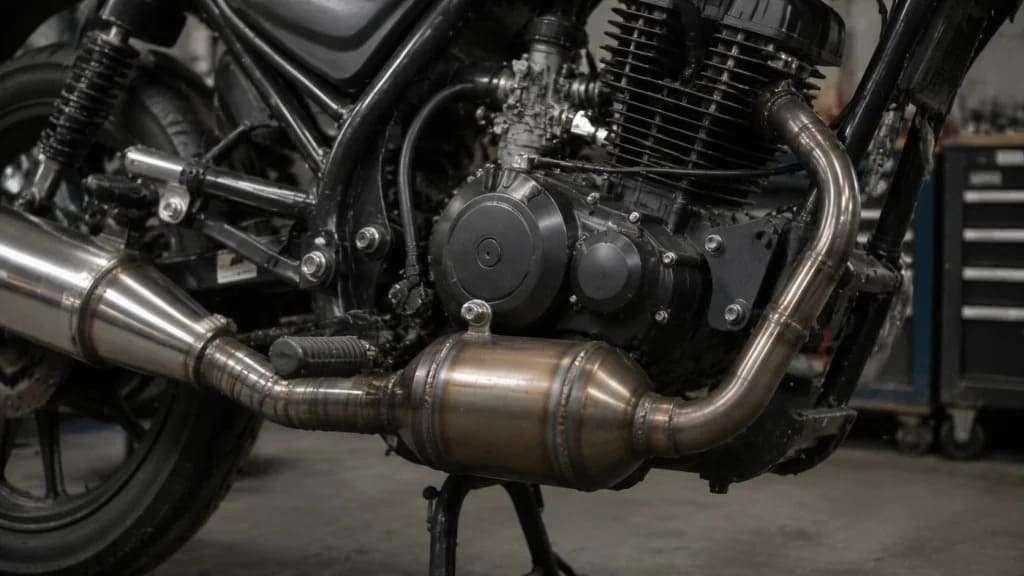
Most motorcycles use single- or twin-cylinder engines with carburetors or port fuel injection (PFI). Emissions include CO, HC, and NOx. Motorcycle catalysts mount directly to the exhaust pipe (close-coupled), experiencing rapid heating and thermal shock. Our systems integrate Three-Way Catalyst (TWC) technology into compact, thermally durable, vibration-resistant packages.
Standard configuration (Euro 3/4, China 3/4, carbureted/basic EFI):
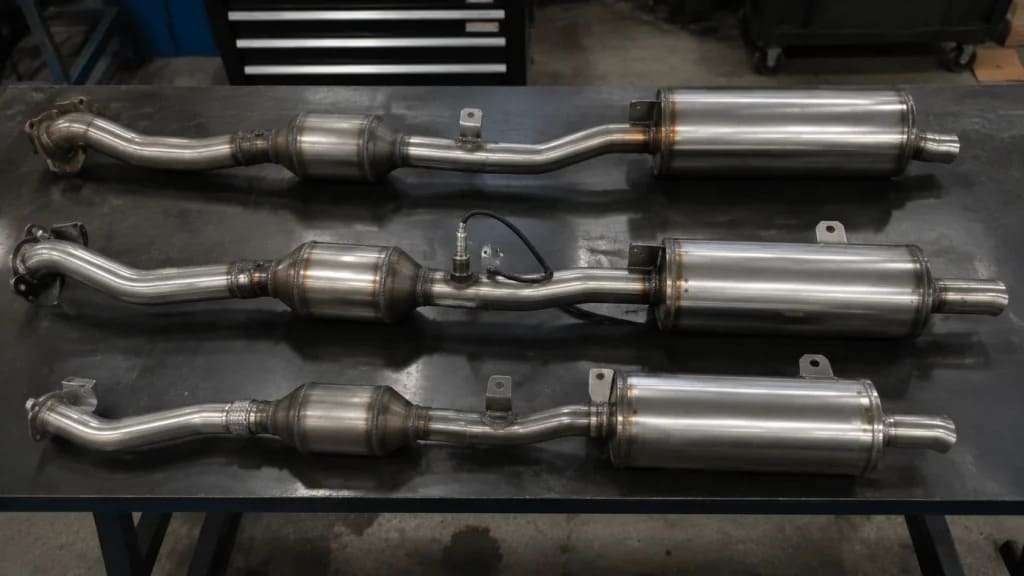
Engine → Exhaust pipe → Catalytic converter → Muffler → Tailpipe
Enhanced configuration (Euro 5, BS VI, China 4, closed-loop EFI):
Engine → Oxygen sensor (lambda) → Catalytic converter → Muffler → Oxygen sensor (post-catalyst, optional) → Tailpipe
High-performance / dual-sport configuration (tight packaging):
Engine → Exhaust header → Main catalytic converter → Muffler → Tailpipe

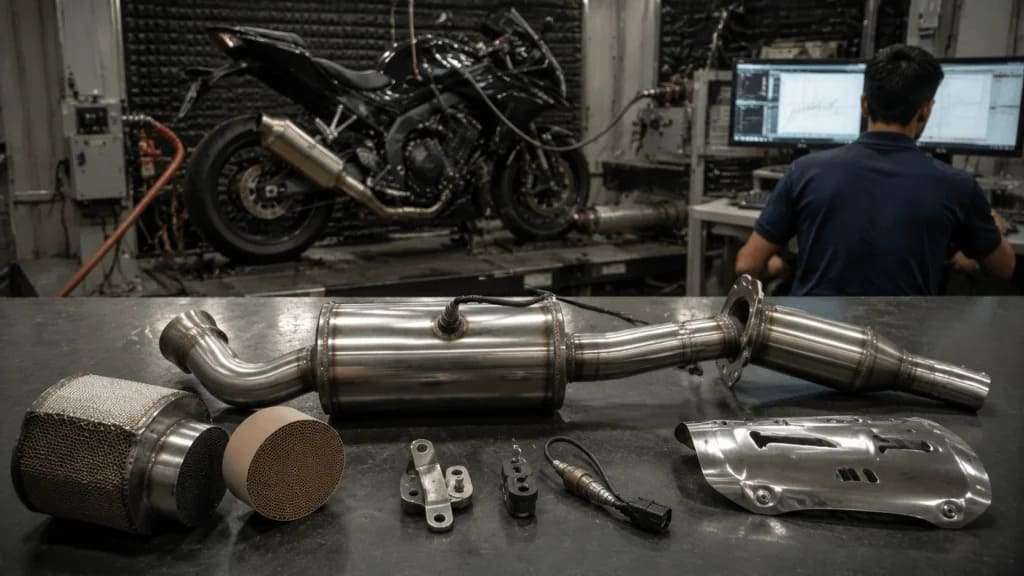
Converts CO, HC, and NOx under near-stoichiometric conditions. Metallic substrate (FeCrAlloy foil, 200–600 cpsi, 2–3 mil wall) preferred for motorcycles for fast light-off, low thermal mass, and vibration resistance. Cordierite ceramic (400 cpsi, 4–6 mil wall) is lower cost but heavier and fragile. Pd/Rh washcoat (1–3 g/L Pd, 0.1–0.2 g/L Rh). Ceria-zirconia provides oxygen storage capacity. Conversion efficiency: >90% CO/HC, >85% NOx. Light-off (T50): 200–250°C.
Thin-wall stainless steel foil (FeCrAlloy), spiral or stacked layers. Ultra-low thermal mass: heats to light-off in 15–30 s vs. 45–60 s for ceramic. Excellent vibration resistance, high cell density (up to 1,200 cpsi). Max temp: 900°C vs. 1,050°C for ceramic.
Upstream (pre-catalyst) for fuel trim control; downstream (post-catalyst) for catalyst monitor (OBD). Heated zirconia. Required for EFI, not carbureted engines.
Catalyst often integrated into muffler (pre-silencer or main can). Stainless steel (409/304) with heat shields (<180°C surface). Saves space, reduces parts, simplifies installation.
Pollutant | Carbureted Engine Out | EFI Engine Out | After Catalyst (Euro 5) | After Catalyst (BS VI) |
CO | 3–6% | 0.5–2% | <1.0 g/km | <1.0 g/km |
HC | 500–2,000 ppm | 200–600 ppm | <0.3 g/km | <0.3 g/km |
NOx | 100–300 ppm | 100–400 ppm | <0.15 g/km | <0.15 g/km |
Light-off time: 15–30 s (metallic) vs. 45–60 s (ceramic). Conversion efficiency: 90–95% CO, 85–95% HC, 80–90% NOx.
Motorcycle Type | Engine Displacement | Fuel System | Substrate | Key Requirements |
Scooter / Moped | 50–125cc | Carbureted or EFI | Metallic (400–600 cpsi) | Fast light-off, compact packaging |
Commuter motorcycle | 100–200cc | Carbureted or EFI | Metallic (400 cpsi) | Low cost, vibration resistance |
Street motorcycle | 250–500cc | EFI (closed-loop) | Metallic (600 cpsi) | OBD compliance, dual sensors |
Adventure / Dual-sport | 400–800cc | EFI | Metallic (400–600 cpsi) | Off-road vibration durability |
Large displacement / Touring | 800–1,300cc | EFI (closed-loop) | Metallic or ceramic (400 cpsi) | High flow, heat management |
Three-wheeler | 150–300cc | Carbureted or EFI | Metallic (300–400 cpsi) | Low cost, extended idle operation |
Metallic substrate reaches 250°C in 15–30 s. Captures heat immediately for short trips (urban rides 2–5 km). Thin-wall foil (2 mil, 0.05 mm) minimizes thermal mass.
Handles 5–10g at 50–200 Hz without cracking. Flexible mounting accommodates thermal expansion.
Metallic foil withstands rapid cooling from rain splash; heat shields provide additional protection.
Catalyst volume proportional to engine displacement (cc × 0.5–1.0). Integrates into muffler or mid-pipe.
Upstream sensor for fuel control; downstream sensor for catalyst efficiency (<80–90% triggers OBD fault). Not needed for carbureted engines.
Pd/Rh only, optimized ratio 10:1–20:1. Low loading (1–2 g/L), base metal oxides (Mn, Co, Ni) as partial substitutes.
Millions of motorcycle catalysts in production across Asia, Europe, and North America. Validated to Euro 5, BS VI, China 4, and EPA standards.
In-house metallic substrate fabrication, washcoat formulation, coating, canning, and muffler assembly.
Metallic substrate + thin-wall foil + optimized Pd loading achieves T50 in 20–25 s, 50% faster than ceramic
Low-PGM designs (1–1.5 g/L) for high-volume, cost-sensitive markets. High-OSC washcoats for carbureted engines.
From 50cc scooters to 1,000cc adventure bikes, our motorcycle exhaust aftertreatment solutions deliver compliance, durability, and performance in the most challenging two-wheel environments. Partner with us to engineer your path to cleaner riding.