
Copper(II) oxide (CuO) based catalysts represent the industry standard for the adsorptive removal of trace oxygen from industrial gas streams. Oxygen contamination—even at parts-per-million levels—can severely damage downstream processes: deactivating Fischer-Tropsch catalysts in syngas conversion, compromising inert atmospheres in glove boxes, degrading semiconductor manufacturing environments, and promoting corrosion in boiler systems.
Unlike conventional filtration or membrane separation, CuO catalysts function through a chemisorption and oxidation mechanism. Under reducing conditions, the catalyst reacts with trace oxygen to form stable copper-containing compounds, effectively scavenging O₂ from the gas stream. The process is highly efficient, capable of reducing oxygen levels from hundreds of ppm to below 1 ppm in optimized systems. Crucially, the catalyst operates across a broad temperature range—from ambient conditions up to 230°C—making it adaptable to diverse industrial applications.
The fundamental reaction governing oxygen removal is the oxidation of reduced copper species: 2Cu + O₂ → 2CuO. In practice, the catalyst is typically supplied in an oxidized state (CuO) and must be pre-reduced (activated) before use, converting it to metallic copper or lower oxidation state species that actively scavenge oxygen.
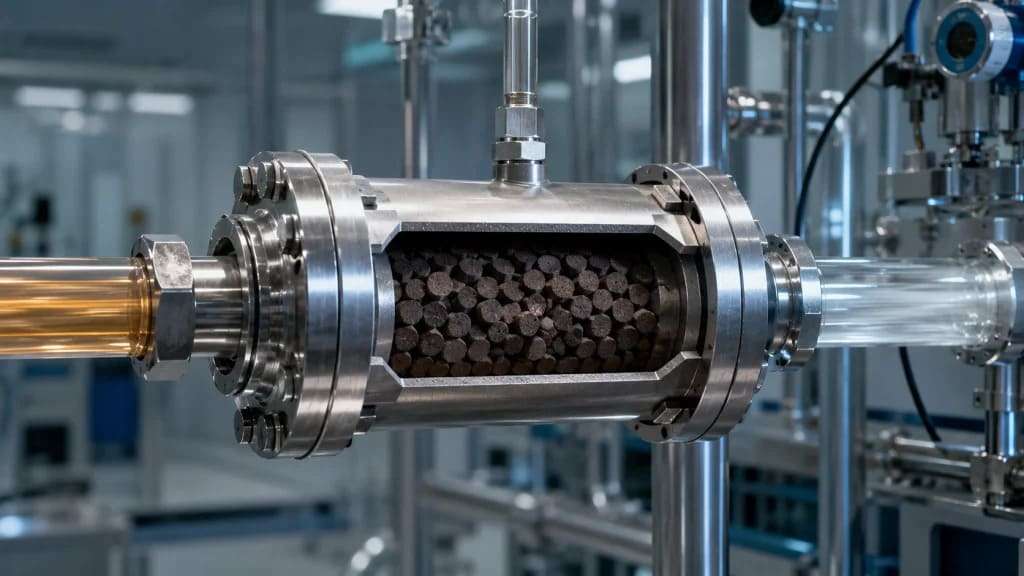

Commercial CuO oxygen removal catalysts are sophisticated multi-component formulations designed to maximize oxygen capacity, mechanical strength, and resistance to poisons.
Component | Function | Typical Content |
CuO | Primary active phase for oxygen chemisorption | 40-60 wt% |
ZnO | Promoter; enhances reduction behavior and stabilizes copper dispersion | 20-40 wt% |
Al₂O₃ | High-surface-area support; provides mechanical strength and prevents sintering | Balance (10-20 wt%) |
Promoters (Ce, Zr) | Improve redox cycling and oxygen storage capacity | 1-5 wt% |
Ceria (CeO₂) promotion has been shown to significantly enhance performance. Research on CuO–CeO₂/Al₂O₃ catalysts for syngas purification demonstrated exceptional oxygen removal capacity: 3000 ml of oxygen per gram of catalyst with a service lifetime of 160 hours under optimized conditions (200°C, 3.45 × 10⁵ Pa, 3000 hr⁻¹ GHSV). The ceria component provides oxygen storage capacity (OSC) that buffers against oxygen concentration spikes and enhances the redox cycling between Cu⁺ and Cu²⁺ states.
CuO oxygen removal catalysts are manufactured in several physical forms depending on application requirements:
Form Factor | Dimensions | Crush Strength | Bulk Density | Primary Application |
Tablets (cylindrical) | 5 × 3 mm | ~55 N (side wall) | 1.15-1.25 kg/L | Fixed-bed reactors |
Pellets (φ3×3) | 3 × 3 mm | 70 N (side wall) | 1.15-1.25 kg/L | Glove boxes, small systems |
High crush strength (typically 55-70 N) is critical to prevent particle attrition and dust generation during operation, which could contaminate downstream equipment. The bulk density of 1.15-1.25 kg/L ensures adequate packing while maintaining acceptable pressure drop across the bed.
Before use, the CuO catalyst must be activated—converted from its as-supplied oxidized state to the active oxygen-scavenging form. The activation procedure typically involves:
For ethylene-containing streams, special activation procedures are required to prevent polymerization or undesirable side reactions. BASF recommends contacting their technical service for application-specific protocols.
Failure to properly activate results in negligible oxygen removal capacity—the catalyst will simply pass oxygen through unchanged.
The oxygen removal process follows a redox cycle that has been extensively studied through in-situ reduction and oxidation experiments.
During operation (oxygen scavenging mode):
Reaction kinetics follow an O₂-preferential adsorption mechanism: oxygen molecules are preferentially adsorbed on the copper surface, where they dissociate and react to form CuO. This process is highly selective for oxygen even in complex gas mixtures containing hydrogen, carbon monoxide, or hydrocarbons.
Capacity and breakthrough — The catalyst has a finite oxygen capacity determined by its active copper content. Once the copper is fully oxidized, the catalyst is “spent” and must be regenerated or replaced. The CuO–CeO₂/Al₂O₃ system achieved 3000 ml O₂/g capacity before breakthrough.
Unlike disposable scavengers, CuO catalysts are regenerable — the oxidation process can be reversed, restoring the catalyst to its active reduced state.
Regeneration cycle:
However, each cycle causes some degree of sintering — irreversible agglomeration of copper particles that reduces active surface area and oxygen capacity. After many cycles, the catalyst will require replacement.
Research on CuO/γ-Al₂O₃ catalysts demonstrated that samples subjected to H₂ reduction followed by re-oxidation exhibited higher CO oxidation activity than untreated catalysts. The enhanced activity resulted from the formation of reactive lattice oxygen species (O²⁻) with weakened Cu-O bonds, which are more readily available for surface reactions.
Temperature window — CuO catalysts operate effectively across a broad temperature range:
Temperature | Performance Characteristics |
Ambient – 80°C | Suitable for glove boxes and ambient purification; slower kinetics, higher bed volume required |
80 – 200°C | Optimal for most industrial applications; balances kinetics and energy cost |
200 – 230°C | Maximum operating temperature for continuous service; above this, sintering accelerates |
Pressure — Operation from atmospheric pressure to elevated pressures (3.45 × 10⁵ Pa demonstrated) is possible; higher pressure increases oxygen partial pressure and driving force for adsorption.
Space velocity — Gas hourly space velocity (GHSV) typically ranges from 1000 to 10,000 hr⁻¹ depending on inlet oxygen concentration and temperature. The CuO–CeO₂/Al₂O₃ system achieved 3000 hr⁻¹ GHSV with 160 hours lifetime.
Gas compatibility — The catalyst is compatible with:
Gas Stream | Compatibility | Notes |
N₂, Ar, He, Kr, Xe | Excellent | Primary application |
H₂, synthesis gas | Good | Requires careful activation; hydrogen competes with oxygen |
CO, CO₂ | Good | CO can reduce CuO; must be accounted for in oxygen balance |
Hydrocarbons (ethylene) | Limited | Special activation required; potential for polymerization |
H₂S, COS, PH₃, AsH₃ | Adsorbed (poison) | Removes these impurities; acts as guard bed, but reduces oxygen capacity |
Irreversible poisons (permanent capacity loss):
Poison | Source | Effect |
H₂S, COS | Sour gas streams | Forms CuS; blocks active sites |
PH₃, AsH₃ | Chemical manufacturing | Chemisorbs on copper surface |
Halides (Cl, F) | Various industrial processes | Corrosion and site blocking |
Heavy metals | Contaminated feed | Surface coverage |
Reversible deactivation (recoverable through regeneration):
Mechanism | Cause | Recovery Method |
Complete oxidation (saturation) | Normal operation exceeding capacity | Reduction with H₂ |
Surface carbon deposition | Hydrocarbon decomposition | Air burn-off at 300-400°C |
Moisture adsorption | High humidity feed | Dry gas purge |
Sintering (partially reversible or irreversible) — Prolonged exposure to temperatures above 300°C causes copper particles to agglomerate, reducing active surface area and oxygen capacity. Once sintered, performance cannot be fully restored.
Application | Operating Conditions | Target Outlet O₂ | Key Requirement |
Glove box purification | Ambient-80°C, atmospheric pressure | <1 ppm | Long cycle life, safe handling |
Inert gas generation (N₂, Ar) | 100-200°C, pressure swing | <1 ppm | High capacity, regeneration capability |
Syngas purification for Fischer-Tropsch | 200°C, 3.45 × 10⁵ Pa | <1 ppm | Poison resistance, 3000 ml/g capacity |
Ethylene purification | 150-200°C | Low ppb | Prevents polymerization during activation |
Boiler feedwater O₂ scavenging | High temperature | Trace | Alternative to chemical scavengers |
Electronics manufacturing (semiconductor) | Ambient | <0.1 ppm | Ultra-high purity requirement |
Syngas purification — Biomass-derived syngas for Fischer-Tropsch synthesis must have oxygen reduced to below 1 ppm to prevent catalyst deactivation. CuO–CeO₂/Al₂O₃ achieves 160-hour lifetime with 3000 ml/g oxygen capacity.
Dual-function capability — Beyond oxygen removal, CuO catalysts also effectively remove trace sulfur compounds (H₂S, COS), arsine (AsH₃), and phosphine (PH₃) from gas streams, serving as a combined purification bed.
We engineer CuO-based oxygen removal solutions across the full application spectrum. Whether you require a high-capacity CuO–CeO₂/Al₂O₃ catalyst for syngas purification with 3000 ml/g oxygen capacity and 160-hour lifetime, a pre-reduced CuO/ZnO tablet for inert gas generation achieving <1 ppm outlet oxygen, or a low-temperature formulation for glove box ambient operation with 70 N crush strength for dust-free performance, our team tailors the copper loading (40-60 wt%), promoter composition (Ce, Zr, Zn), support architecture (Al₂O₃, high-surface-area mixed oxides), physical form (tablet, pellet, extrudate), and activation protocol to your specific gas composition, oxygen concentration, flow rate, temperature window, and regeneration frequency requirements.
Partner with us to define your path to compliance – copper-based oxygen scavenging, ultra-pure protection.
Ceria-promoted formulations — CuO–CeO₂ systems demonstrate superior oxygen capacity (3000 ml/g vs. conventional) through enhanced oxygen storage capacity and redox cycling. CeO₂ buffers against oxygen spikes and stabilizes copper dispersion.
Peroxide-mediated surface tuning — Recent research demonstrates that adsorbed peroxide species (O₂²⁻) on CuO surfaces can selectively enhance reducibility for H₂ oxidation while suppressing CO oxidation — opening pathways for application-specific selectivity tuning.
Regenerable glove box catalysts — Next-generation formulations operating at ambient temperature with improved cycle life are under development, reducing the frequency of costly catalyst replacement.
Self-cleaning and poison-resistant formulations: Materials resistant to sulfur, phosphorus, and silicon poisoning – critical for wastewater and industrial applications with contaminated feedstocks.
The CuO oxygen removal catalyst is not merely an adsorbent — it is a precision-engineered chemical scavenger operating through reversible redox chemistry. A well-designed CuO catalyst achieves <1 ppm outlet oxygen, provides oxygen capacity up to 3000 ml/g, tolerates elevated temperatures (200°C+) and pressures (3.45 × 10⁵ Pa), and resists poisoning from common industrial impurities. Whether you are purifying inert gas for semiconductor manufacturing, protecting Fischer-Tropsch catalysts from oxygen deactivation, or maintaining oxygen-free glove box environments, CuO catalysts define the standard for adsorptive oxygen removal — and we are ready to engineer your solution.