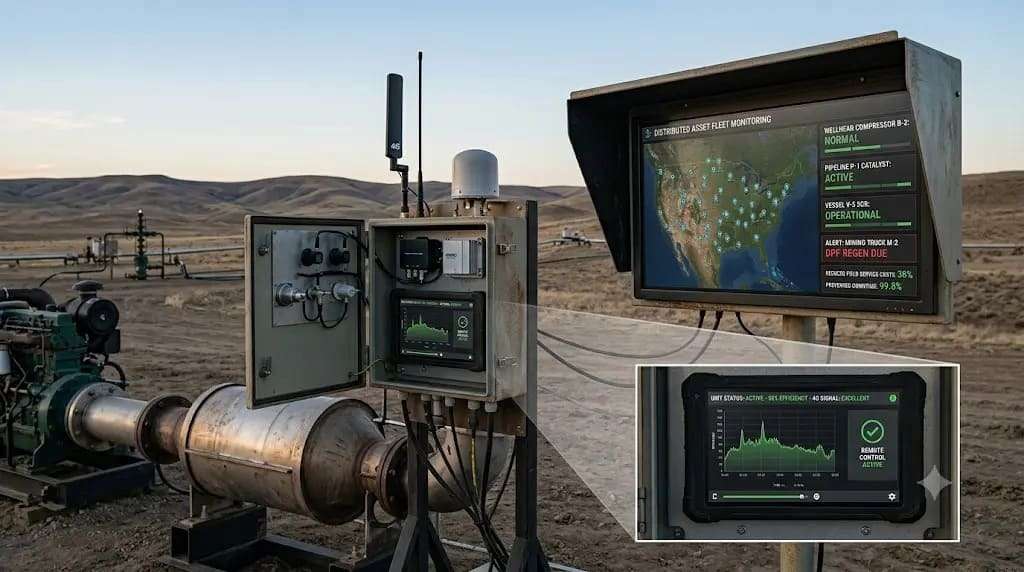
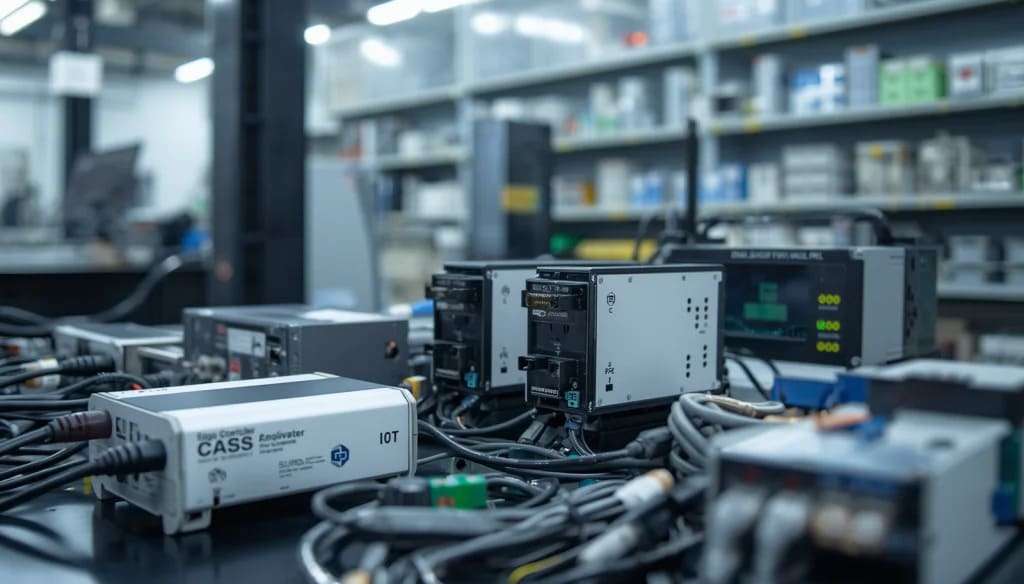
Core Component 1: On-Site Sensors and Edge Controller
How it works: Sensors continuously monitor critical aftertreatment parameters. Edge controller aggregates data, executes local control logic, and transmits to the cloud.
Key sensors for aftertreatment monitoring: Temperature, Pressure, NOx, NH₃ slip, O₂, DEF level/quality, Flow rate, Catalyst bed temperature, Vibration, GPS location, Engine runtime.
Edge controller functions:
- Data acquisition (100ms–1s sampling)
- Local alarms (e.g., high DPF pressure drop)
- Closed-loop control (DEF dosing, NOx feedback)
- Data buffering (30+ days offline)
- OBD fault code reading
Remote command execution
Core Component 2: Communication Gateway
How it works: Transmits data from edge controller to cloud using available networks.
Communication options:
- Cellular (4G LTE/5G) – low-cost, real-time
- Satellite (Iridium, Starlink) – global coverage, higher latency
- LoRaWAN/Sigfox – low-power, periodic updates
- Ethernet/fiber – highest bandwidth, reliable
Gateway features: Dual paths, encrypted transmission (TLS 1.2+, AES-256), VPN, remote configuration, geofencing.
Core Component 3: Cloud Platform (Data Ingestion and Storage)
How it works: Ingests streaming data, stores securely, available for analytics/visualization.
Platform architecture:
- Message broker (MQTT, Kafka)
- Time-series DB (InfluxDB, TimescaleDB, AWS Timestream)
- Object storage (AWS S3, Azure Blob)
- Stream processing engine (Flink, Spark)
- API layer (REST/GraphQL)
Data retention:
- High-resolution (1s): 30–90 days
- Aggregated (1m–1h averages): 1–3 years
- Compliance data: 5–10 years
Core Component 4: Analytics and Predictive Alerts
How it works: Machine learning models predict failures before occurrence.
Predictive maintenance models: DPF ash cleaning, SCR catalyst life, sensor drift detection, DEF consumption anomaly, RUL estimation.
Real-time alerting: Critical alerts via SMS, push, email. Escalation paths and alert suppression for known events.
Core Component 5: User Dashboard and Remote Control
How it works: Web/mobile dashboards provide real-time visibility and remote control.
Fleet view features: Map-based location, status indicators, key metrics, compliance status, alert severity.
Asset detail view features: Real-time trends, historical comparison, alarm history, digital twin, camera feed.
Remote control actions: Start DPF regeneration, adjust DEF dosing, engine derate, clear faults, initiate catalyst heating, export compliance reports. All actions logged and secured with two-factor authentication.
Core Component 6: Compliance Reporting
How it works: Automated regulatory reports from validated sensor data.
Report types: Daily, monthly, annual emissions reports. Exceedance notifications. Audit trails (5–10 years). Tamper-proof hashing for evidentiary quality.
Regulatory integration: EPA CEMS, EU IED templates, China GB APIs. Direct API submission to portals.