
Nitrogen oxides (NOx) – primarily nitric oxide (NO) and nitrogen dioxide (NO₂) – are formed during high-temperature combustion processes in boilers, furnaces, gas turbines, kilns, and chemical reactors. NOx contributes to acid rain, ground-level ozone (smog), and respiratory illness. Increasingly stringent regulations (EU Industrial Emissions Directive, EPA Cross-State Air Pollution Rule, China GB 16297) require industrial facilities to reduce NOx emissions by 80-95%. We provide complete, validated NOx treatment solutions tailored to your process conditions.
Unlike automotive applications with relatively stable exhaust conditions, industrial NOx sources vary dramatically in flue gas volume, temperature, oxygen content, and presence of poisons (sulfur, dust, alkali metals). Our systems integrate selective catalytic reduction (SCR) or selective non-catalytic reduction (SNCR) technologies into a robust, reliable package designed for continuous industrial operation.
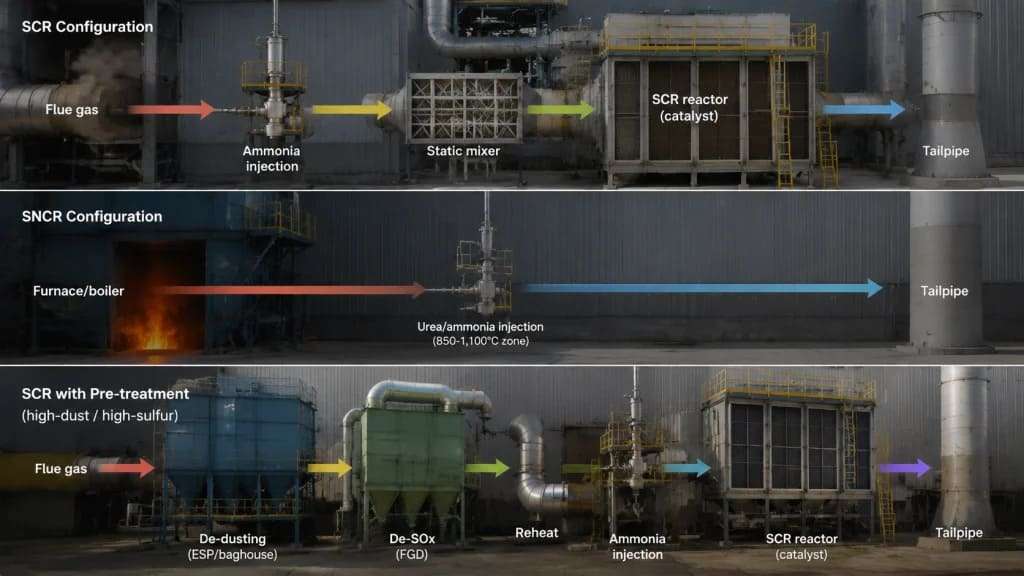
SCR configuration (most common, highest efficiency):
Flue gas → Ammonia injection → Static mixer → SCR reactor (catalyst) → Tailpipe
SNCR configuration (lower cost, moderate efficiency):
Furnace/boiler → Urea/ammonia injection (850–1,100°C zone) → Tailpipe
SCR with pre-treatment (high-dust / high-sulfur applications):
Flue gas → De-dusting (ESP/baghouse) → De-SOx (FGD) → Reheat → Ammonia injection → SCR → Tailpipe

Industry standard for >90% NOx removal. Ammonia (NH₃) or urea is injected upstream of a catalyst bed. NOx reacts with NH₃ to form N₂ and H₂O. Operating temperature: 200–450°C. Catalyst types: honeycomb (ceramic), plate (high-dust), corrugated (low pressure drop). Removal efficiency: 85–95% standard, 95%+ advanced. NH₃ slip: <5–10 ppm.
Cost-effective alternative for >70% reduction. Urea or ammonia is injected directly at 850–1,100°C. Thermal NOx reduction without catalyst. Efficiency: 30–70%. NH₃ slip: 10–30 ppm. Suitable for small to medium boilers, cement pre-calciners, and waste incinerators.
Pollutant | Raw Emission | After SCR (85–95%) | After SNCR (50–70%) | Regulatory Limit |
NOx (coal boiler) | 300–600 mg/m³ | 30–90 mg/m³ | 90–300 mg/m³ | <100–200 mg/m³ |
NOx (gas turbine) | 25–150 ppm | 2–15 ppm | 10–50 ppm | <9–25 ppm |
NOx (cement kiln) | 300–1,000 mg/m³ | 45–150 mg/m³ | 90–500 mg/m³ | <200–400 mg/m³ |
NOx (waste incinerator) | 150–400 mg/m³ | 15–60 mg/m³ | 45–200 mg/m³ | <100–200 mg/m³ |
NH₃ slip | N/A | <5–10 ppm | <10–30 ppm | <10–30 ppm |
Industry / Source | Flue Gas Characteristics | Technology Selection | Key Requirements |
Coal-fired power plant | High dust (5–20 g/m³), SO₂ (500–3,000 ppm), 300–400°C | High-dust SCR (plate catalyst) | DeNOx + SO₂ oxidation control |
Gas-fired boiler / turbine | Clean flue gas, low dust, 300–500°C | Honeycomb SCR (vanadia) | Low NH₃ slip, high NOx reduction (95%+) |
Cement kiln | High dust, high alkali (K, Na), 300–350°C | SNCR or low-dust SCR (after baghouse) | Alkali-resistant catalyst |
Waste incinerator | High moisture (15–30%), HCl, SO₂, 200–250°C | Low-temperature SCR (zeolite or precious metal) | Poison resistance, low temperature |
Nitric acid plant | High NOx (1,000–3,000 ppm), 200–250°C | High-performance SCR | Very high NOx removal (95%+) |
Industrial boiler (refinery, chemical) | Moderate dust, SO₂ variable, 250–400°C | Tail-gas SCR (after boiler) | Compact footprint, fast delivery |
Glass furnace | High dust, sticky (Na, Ca), 350–450°C | Plate SCR (anti-stick coating) | Fouling resistance, long life |
Meets EPA 40 CFR Part 63, EU IED 2010/75/EU, China GB 13223, GB 4915, GB 18485. Performance guarantees included.
SCR: 85–95% standard, 95%+ with optimized design. SNCR: 50–70%. Dual-stage (SNCR + SCR): 85–92%.
Vanadia: 250–450°C, low-temperature SCR: 150–250°C, high-temp: 400–550°C, zeolite SCR: 175–550°C.
High-dust plate catalysts, alkali-resistant formulations, sulfur-resistant vanadia for high-SO₂ applications.
CFD-optimized grids ensure NH₃:NOx distribution <±5% at catalyst face. Closed-loop NOx feedback minimizes NH₃ slip (<5 ppm).
Honeycomb catalysts: 3–5 years (coal), 5–8 years (gas). Plate catalysts: 5–8 years. Modular design allows layer-by-layer replacement.
Service Area | Description |
Application assessment | Flue gas analysis (NOx, SO₂, dust, temp, moisture, O₂), regulatory target, site review |
Technology selection | SCR, SNCR, or hybrid based on reduction, temperature, poison exposure |
Catalyst engineering | Type (honeycomb, plate, corrugated), pitch, volume, vanadia loading, layer count |
Ammonia system design | Storage, vaporization, injection grid, dilution air, safety interlocks |
Reheat system | Burner or heat exchanger for cold flue gas (post-FGD) |
Controls integration | PLC/DCS, NOx feedback, NH₃ slip monitoring, catalyst management |
Installation & commissioning | Civil works, reactor erection, catalyst loading, performance testing, training |
Hundreds of SCR systems operating in power, cement, waste-to-energy, glass, and chemical industries. Validated to global NOx limits.
Vertically integrated extrusion, coating, and testing. Full control over quality, composition, and delivery.
Ensures uniform flow and NH₃ distribution for high NOx reduction and low slip.
Catalyst testing, spare layer supply, used catalyst recycling, performance monitoring.
From coal-fired power plants to gas turbines, cement kilns, and waste incinerators, our SCR and SNCR solutions deliver compliance, reliability, and value. Partner with us to engineer your path to cleaner air.