
Exploring the engineering behind emissions control solutions for off-highway applications—construction, agriculture, mining, forestry, and material handling—where operating conditions differ fundamentally from on-road vehicles.
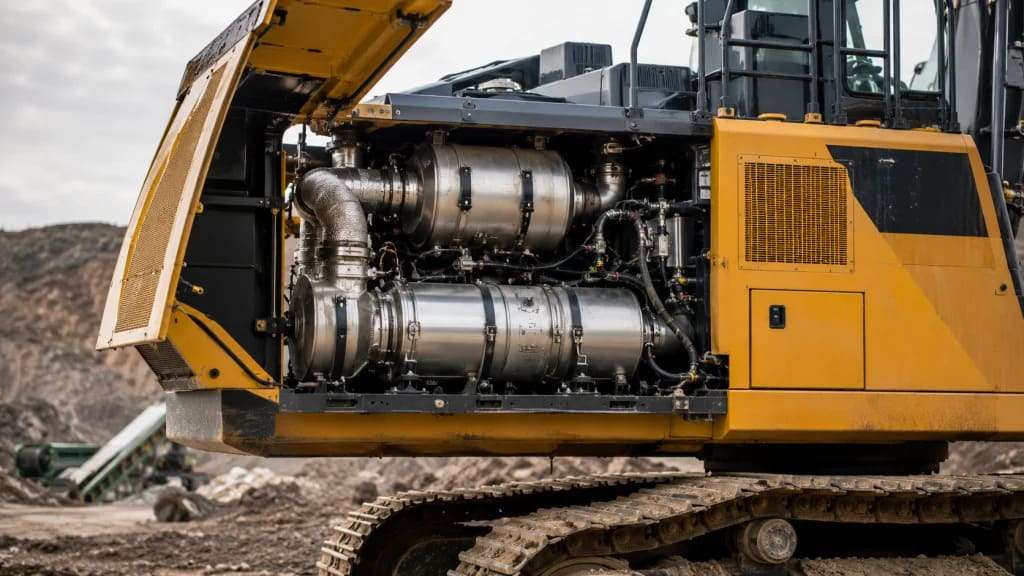
Non-road engines (tractors, excavators, loaders, bulldozers, harvesters, forklifts, generators, compressors, pumps, marine propulsion, and locomotives) face unique demands: extreme vibration, dust, moisture, variable loads, long idle periods, limited maintenance access, and operating lives of 10,000–30,000+ hours. Regulations mirror on-road standards with a delay: EU Stage V (2019–2021), EPA Tier 4 Final (2014–2016), China Stage IV (2020–2023). These require PM (particulate matter) reductions of 90–99% and NOx reductions of 80–95% compared to earlier tiers. The technical route depends on engine power category:
Power Range | Typical Aftertreatment | Application Examples |
<19 kW (25 hp) | TWC or no aftertreatment | Small mowers, chainsaws, generators |
19–56 kW (25–75 hp) | DOC + (optional DPF) | Compact tractors, skid steers, small excavators |
56–130 kW (75–174 hp) | DOC + DPF + (optional SCR) | Mid tractors, wheel loaders, backhoes |
130–560 kW (174–750 hp) | DOC + DPF + SCR + (ASC) | Large excavators, bulldozers, combines |
>560 kW (750 hp) | DOC + DPF + SCR + ASC | Mining haul trucks, locomotives, marine |

Unlike on-road engines with tightly controlled transient cycles, non-road engines operate at sustained high loads (digging, pulling) or extended low loads (idling, fine positioning). The ECU must maintain exhaust temperatures high enough for passive DPF regeneration and SCR activity (250°C+ for SCR, 350°C+ for passive DPF). At low idle (700–900 rpm), exhaust temperatures fall to 100–150°C—below SCR light-off. Strategies include variable geometry turbochargers (VGT), intake throttles, and exhaust backpressure valves to raise temperatures.
The Diesel Oxidation Catalyst converts CO and HC, oxidizes NO to NO₂ (for downstream SCR and passive DPF regeneration), and generates exotherms during active regeneration. Non-road DOC requirements: Higher poison resistance – agricultural fuels may contain sulfur (500–2,000 ppm vs. <10 ppm on-road); hydraulic oil and grease contamination from harsh environments. Mechanical robustness – extreme vibration (rock drills, compactors) and thermal cycling (intermittent operation). Oversizing – 20–40% larger volume than comparable on-road DOC to extend service intervals (maintenance every 1,000–3,000 hours vs. 500–1,000 miles).
Non-road DPFs see higher soot loads due to older engine technology (mechanical fuel injection on smaller engines) and lower average temperatures (less passive regeneration). Ash accumulation is the lifetime limiter: engine oil ash (Ca, Zn, Mg, P) cannot be burned off. Non-road engines use higher oil consumption (1–3% of fuel consumption vs. 0.05–0.1% for on-road) due to looser tolerances and high-load operation. DPF service life: 3,000–8,000 hours before ash cleaning (vs. 150,000+ km / 3,000+ hours for on-road). Regeneration strategies: Passive (NO₂-based) when load >30–40%; active (fuel post-injection, burner, or electric heater) when soot load exceeds 4–6 g/L; service (stationary) regeneration in shop using diagnostic tool.
Low-load regeneration problem: Telehandlers, cherry pickers, and small excavators often operate at <20% load. Active regeneration may not complete, leading to DPF clogging. Solutions include regen request button (operator initiates regeneration during high-load operation) and parked regeneration (engine runs at elevated idle while machine is stationary).
Non-road SCR operates across wider temperature swings than on-road: cold starts in winter (-30°C / -22°F), extended low-load idling (100°C / 212°F), and sustained high-load operation (500°C+ / 932°F+). Low-temperature SCR (175–250°C) requires Cu-zeolite (SSZ-13) with optimized copper loading (2.5–3.5% vs. 2–3% on-road).
DEF freezing management: DEF freezes at -11°C (12°F). Non-road equipment often operates in cold climates without heated storage. Solutions include engine coolant circulation (standard on larger machines), electric tank heaters (battery-powered, limited duration), and airless injection (uses exhaust heat alone for thawing – slower but robust).
DEF tank sizing: Agricultural harvesters and mining trucks operate 12–24 hour shifts. DEF consumption is 3–6% of fuel consumption (vs. 2–4% on-road) due to higher engine-out NOx. Tank sizes: 20–100+ liters (vs. 10–20 liters for passenger cars).
Ammonia slip is more critical for non-road due to operator exposure (open cabs, enclosed spaces like greenhouses and warehouses). ASC (Pt on alumina) oxidizes NH₃ slip to N₂, targeting <25 ppm tailpipe NH₃ (Stages IV–V). Dual-layer SCR+ASC substrates (SCR coating on inlet, ASC on outlet of same brick) save space.
Agricultural (tractors, harvesters): Highest dust loading – heavy-duty pre-filters (cyclone or self-cleaning) protect DOC/DPF. Seasonal operation – harvesters work 2–6 weeks/year; long idle periods (9–10 months) require anti-seize coating on injectors and corrosion protection. Biodiesel compatibility (B20, B100) – higher injector coking risk.
Construction (excavators, loaders, bulldozers): Extreme vibration – robust mounting with rubber isolators; braided stainless lines for DEF. Hydraulic oil contamination – crankcase ventilation system (closed-loop) prevents oil mist entering aftertreatment. Tight packaging – compact aftertreatment cans (often vertical or side-mounted).
Mining (haul trucks, loaders): Highest power (1,000–3,000+ hp). Multi-brick aftertreatment (2–4 parallel trains). Diesel particulate filter regeneration underground – ventilation critical; electric regeneration preferred (no additional exhaust heat or fuel-borne catalysts). High altitude (2,000–4,500m) – reduced oxygen affects DPF regeneration; altitude compensation in ECU.
Material handling (forklifts, reach stackers): Low-load operation (lifting then idling) – frequent incomplete regenerations; aftertreatment heaters maintain temperature. Indoor use (warehouses) – zero tolerance for NH₃ slip or regeneration smoke; electrically heated SCR (eSCR) or hybrid/electric alternatives.
Marine (workboats, ferries, tugs): High sulfur fuel (1,000–10,000+ ppm) – sulfur poisons Cu-zeolite; vanadia SCR (V₂O₅/WO₃/TiO₂) is sulfur-tolerant but requires higher temperature (280°C+). Wet exhaust (water-cooled manifolds) – corrosion-resistant coatings (Inconel, 316L stainless). Very long life (20,000–50,000 hours) – serviceable aftertreatment with replaceable catalyst bricks.
Locomotive & stationary (gensets, pumps): Constant speed (1,500/1,800 rpm) – predictable exhaust conditions; simplified calibration. Space constraints (genset enclosures) – high-temperature insulation and forced cooling. Remote monitoring – satellite or cellular telematics for DEF level, soot load, and fault codes.
Non-road OBD is less stringent than on-road (no mandatory inducement in many regions) but evolving. Key monitors: DOC conversion efficiency (temperature rise across DOC during regeneration), DPF differential pressure (soot load model and ash accumulation), SCR conversion efficiency (upstream/downstream NOx sensors – not universally mandated; some regions use temperature + model only), DEF quality and level (warnings only, no speed limiting in most non-road jurisdictions).
Service intervals: DOC/DPF cleaning at 3,000–8,000 hours (ash removal via reverse air pulse or thermal regeneration). SCR catalyst replacement at 8,000–12,000 hours (zeolite degradation). DEF filter replacement at 1,000–2,000 hours.
We don’t just adapt on-road catalysts – we engineer non-road solutions from the ground up. Whether you require a vibration-resistant, high-sulfur-tolerant DOC for a 560 kW mining truck operating at 4,000 meters altitude, or a compact DOC+DPF+SCR vertical package for a wheel loader with <100 cm of chassis clearance, our team tailors substrate geometry, washcoat chemistry (vanadia SCR for marine, Cu-zeolite for ag), PGM loading (higher for low-load regeneration), and mechanical packaging (ISO 150,000 vibration testing) to your specific power category, duty cycle, and regulatory deadline.
Partner with us to define your path to compliance – off-road and on-mission.
Electrification as aftertreatment: Battery-electric loaders and excavators (BEV) eliminate exhaust. For remaining ICE, hybrid aftertreatment – electric heaters maintain DPF/SCR temperature during idle, enabling zero cold-start emissions.
Remote telematics & predictive maintenance: On-board sensors stream data to cloud. Machine learning predicts DPF ash cleaning or SCR replacement 500 hours in advance, minimizing unplanned downtime.
Alternative fuels: Hydrotreated Vegetable Oil (HVO) reduces soot by 50–80%, extending DPF cleaning intervals. Methane (gas engines) – oxidation catalyst for CH₄ (challenging; requires high Pd loading). Hydrogen (H₂-ICE) – zero CO₂, but NOx remains; requires SCR.
The non-road aftertreatment system faces the worst operating environment and the longest service intervals – yet must achieve near-zero emissions. A well-engineered non-road system balances high poison tolerance against limited maintenance access, low-load temperature management against high-load durability, and regulatory compliance against machine productivity. Whether you are developing a Stage V tractor, a Tier 4 Final excavator, or a China IV harvester, non-road aftertreatment will define your market access – and we are ready to engineer the solution.