
Hopcalite is a mixed metal oxide catalyst, primarily composed of copper and manganese oxides (CuMnOx), that has served as the industry standard for ambient-temperature carbon monoxide (CO) oxidation since its discovery in 1920. Unlike noble metal catalysts (platinum, palladium, gold), Hopcalite offers a low-cost, readily available alternative for converting poisonous CO into harmless carbon dioxide (2CO + O₂ → 2CO₂). The catalyst’s exceptional low-temperature activity—achieving complete CO conversion as low as 80°C—makes it indispensable for respiratory protection (firefighters, miners, soldiers), air purification systems, and industrial off-gas treatment. The synergistic interaction between copper and manganese oxides creates a redox system (Cu²⁺ + Mn³⁺ ⇆ Cu⁺ + Mn⁴⁺) that enables continuous oxygen transfer and CO adsorption, forming the foundation of its catalytic power.
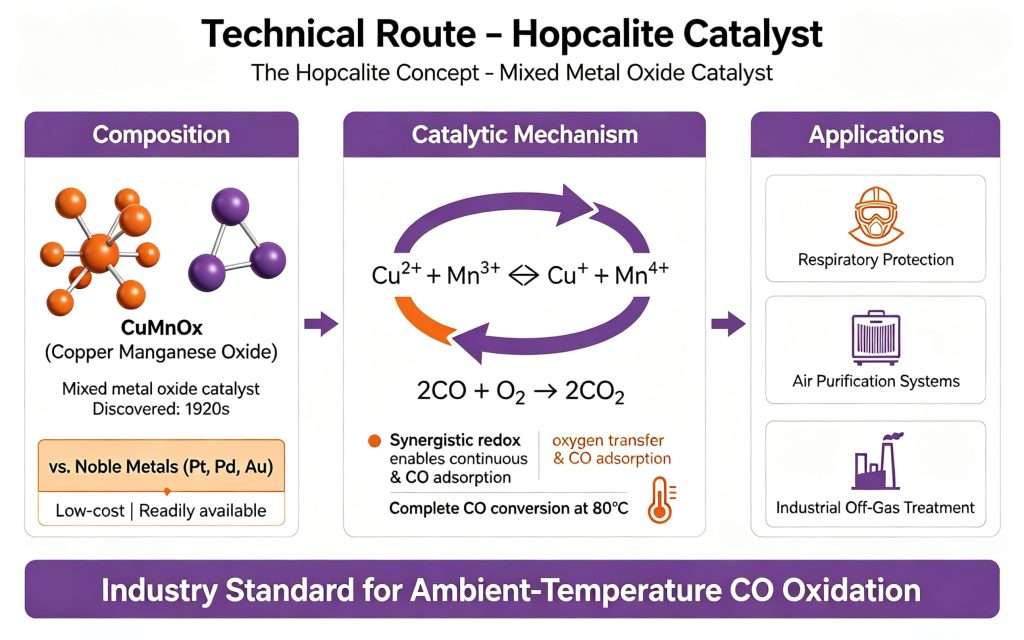

The classic Hopcalite formulation consists of a mixture of copper oxide (CuO) and manganese dioxide (MnO₂), typically with a Mn:Cu mole ratio ranging from 2.2:1 to 3:1. The copper-manganese interaction is critical to catalytic activity.
Redox mechanism: Hopcalite’s superior performance originates from the resonance system Cu²⁺ + Mn³⁺ ⇆ Cu⁺ + Mn⁴⁺. Copper alone is not highly active for CO oxidation, but when combined with manganese in appropriate proportions, the resulting catalyst exhibits dramatically enhanced activity. The exposed Cu⁺ species and oxygen vacancies provide adsorption sites for CO and activation sites for O₂, while lattice oxygen movement from Mn species sustains the catalytic cycle.
Crystal structure: The most active Hopcalite exists in an amorphous or poorly crystalline state. Increased crystallinity is generally associated with a significant decline in activity and surface area. The Cu₁.₅Mn₁.₅O₄ spinel structure has been identified as a particularly active phase.
Triple oxide modifications: Recent advances have produced new-generation Hopcalite incorporating silver to form a delafossite-type crystal structure (Cu, Mn, Ag ternary oxide). This unique architecture, where oxygen is simultaneously bonded to silver, copper, and manganese atoms, maintains high CO oxidation activity even in the presence of water vapor—a long-standing challenge for conventional Hopcalite.
The synthesis method profoundly influences Hopcalite’s catalytic performance. Research comparing five preparation techniques established the following activity order: Co-precipitation (CP) > Reactive Grinding (RG) > Sol-gel (SG) > Pyrolysis (P) > Impregnation (I).
Co-precipitation (CP) — industry standard: This simplest and most widely used method involves adding a precipitating agent dropwise to a solution containing Cu and Mn precursors. Co-precipitation produces the most active Hopcalite due to its lower crystallinity and higher surface area. For optimal results, the Mn/Cu molar ratio should be approximately 0.65, pH maintained at 8, and calcination performed at 350°C for 180 minutes. The resulting catalyst achieves a specific surface area of 199 m²/g, pore volume of 0.4 cm³/g, and mesoporous structure (2-50 nm).
Flame spray pyrolysis (FSP) — moisture-resistant innovation: Traditional co-precipitated Hopcalite rapidly deactivates under humid conditions (water molecules poison active sites). Flame spray pyrolysis addresses this limitation by producing nanoparticles with hydrophobic carbonaceous surface layers. Using metal oleates, 2-ethylhexanoates, or nitrates dispersed in microemulsions as precursors, FSP generates hopcalite nanoparticles with specific surface areas up to 180 m²/g. These materials exhibit significantly reduced deactivation at humidity levels up to 75%, making them promising for respiratory protection in breathing air containing water vapor. The humidity tolerance is attributed to carbon deposits that impart hydrophobic characteristics to the catalyst surface.
Other synthesis methods:
Water vapor poisoning (primary deactivation cause): Water molecules compete with CO and O₂ for adsorption sites on the hopcalite surface. This reversible deactivation has historically limited hopcalite applications in humid environments.
Prevention strategies:
Sintering and thermal degradation: High-temperature calcination causes sintering of active crystallite particles with consequent loss of surface area, poorly affecting catalyst activity. Optimal calcination at 350°C balances activation against thermal stability.
Alkali metal contamination: Sodium ions (Na⁺) from certain synthesis routes strongly inhibit the catalytic reaction. Flame spray pyrolysis produces contaminant-free hopcalite by avoiding alkali-containing precursors.
Respiratory protection (primary application): Hopcalite is the standard catalyst in gas masks for firefighters, miners, and military personnel. It converts lethal CO (as low as 100 ppm causes harm) into CO₂ at room temperature. The catalyst must perform reliably even after long-term storage without activity loss—a requirement that favors hopcalite over sensitive gold-based catalysts.
Industrial air purification: Used in catalytic converters for automobile exhaust treatment, removing CO from vehicle emissions. Also applied in ethylene production facilities for CO afterburning.
Fire safety systems and enclosed spaces: Deployed in submarines, space stations, and fire protection systems where CO accumulation poses life safety risks.
Ozone and VOC removal: Beyond CO oxidation, hopcalite is widely used for decomposing ozone (O₃) and volatile organic compounds (VOCs) in industrial waste gas treatment.
Hopcalite is commercially available in various forms:
Parameter | Typical Specification |
Mn:Cu mole ratio | 2.2:1 – 3:1 |
Effective constituents (Mn+Cu) | 80% minimum |
Mechanical strength | 18-20 N/cm |
Moisture content | 3% maximum |
Forms | Granules, pellets, extrudates, coated honeycomb |
Applications demand customization of catalyst specifications based on specific CO concentration, flow rate, humidity level, and operating temperature.
We engineer hopcalite solutions across the full application spectrum. Whether you require a high-activity co-precipitated Hopcalite for an industrial catalytic converter, a moisture-resistant flame-spray-pyrolysis Hopcalite for respiratory protection in humid environments, or a next-generation Cu-Mn-Ag delafossite catalyst for high-humidity CO oxidation, our team tailors the synthesis method, Mn:Cu ratio, calcination conditions, and physical form to your specific CO concentration, humidity level, and performance targets.
Partner with us to define your path to compliance – hopcalite protection, copper-manganese strength.
Delafossite-structured triple oxides (Cu-Mn-Ag): A new generation of hopcalite with unique crystal structure where oxygen bonds simultaneously to silver, copper, and manganese. Maintains high activity in humid conditions at room temperature, potentially eliminating dehumidifiers from respiratory protection systems.
Scalable flame spray pyrolysis: Enables continuous, contaminant-free production of moisture-tolerant hopcalite nanoparticles. The process is industrially scalable and offers precise control over particle size, composition, and surface properties.
Alkali-modified formulations: Rational synthesis approaches using alkali metal dopants to tune catalyst surface acidity for selective partial oxidation reactions (e.g., propylene epoxidation) rather than total oxidation.
Supported hopcalite composites: Development of methods to apply hopcalite coatings onto various support structures (honeycombs, foams, meshes) for reduced pressure drop and improved mechanical handling.
Hopcalite is not merely a catalyst—it is a century-old proven technology that continues to evolve. A well-engineered hopcalite system achieves >99% CO conversion at room temperature, operates effectively in humid conditions with advanced formulations, and provides reliable long-term performance for life-critical applications. Whether you are protecting firefighters from CO exposure, purifying industrial exhaust, or ensuring air quality in submarines and space stations, hopcalite catalysts define the standard for ambient-temperature CO oxidation—and we are ready to engineer your solution.