
Carbon monoxide (CO) is a colorless, odorless, highly toxic gas requiring abatement from industrial flue gas, automotive exhaust, compressed breathing air systems, and process emissions. Ceramic honeycomb CO removal catalysts utilize cordierite or other ceramic monoliths as structured substrates coated with catalytically active phases—typically hopcalite (manganese-copper oxide) or precious metals (platinum, palladium). The honeycomb architecture provides high geometric surface area, ultra-low pressure drop, and excellent thermal shock resistance, making it the preferred platform for high-flow gas treatment where energy efficiency and compact packaging are critical.
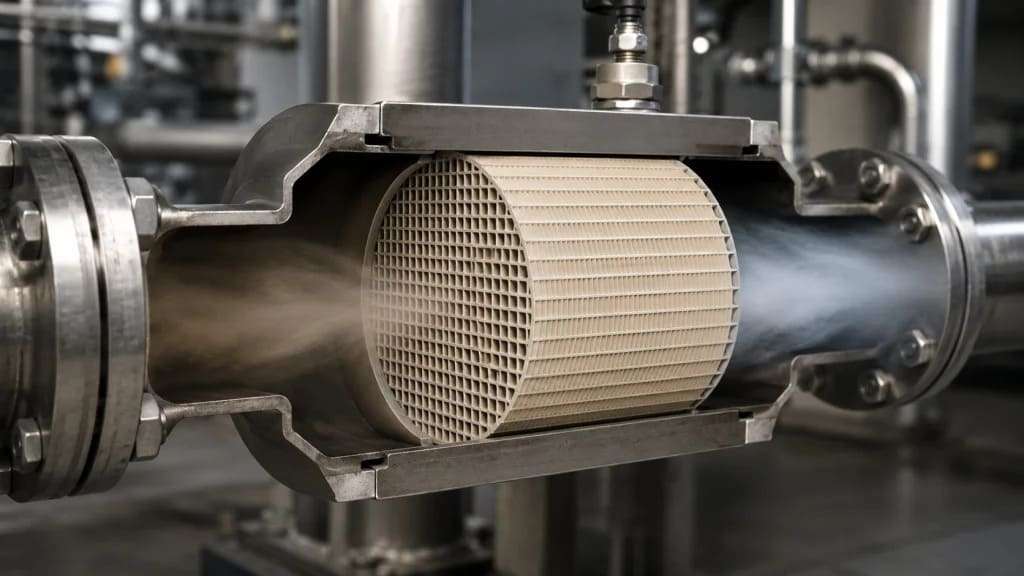

The foundation of the CO removal catalyst is the ceramic honeycomb monolith, typically extruded from cordierite (2MgO•2Al₂O₃•5SiO₂)—a synthetic ceramic with exceptional thermal shock resistance due to its very low coefficient of thermal expansion (0.5–1.5 × 10⁻⁶/°C). The honeycomb structure consists of hundreds or thousands of parallel, square channels per square inch (cpsi), with cell densities typically ranging from 200 to 600 cpsi for CO removal applications.
Key geometric parameters:
The structural integrity of the ceramic carrier is critical: the partition walls between channels must withstand thermal gradients, vibration, and mechanical handling without cracking. The surface porosity (S) of the carrier—the ratio of open pore area on the wall surface—is typically maintained between 3–30% to balance catalyst adhesion against mechanical strength.
Bare cordierite honeycomb has relatively low surface area (≈1–5 m²/g), limiting active phase loading. A pre-coating of palygorskite (PG)—a magnesium aluminum phyllosilicate clay with fibrous morphology—dramatically increases surface area and provides anchoring sites for the catalytic phase.
PG coating method: The cordierite honeycomb is immersed in a PG-water mixed slurry, then dried and calcined. Research demonstrates that PG coating increases active ingredient loading from 3% to 13% and improves NO conversion from 10% to 78% at 100°C for manganese-based catalysts. The significant rise in surface area after PG coating enables high loading and uniform dispersion of active species.
Alternative pre-coatings: γ-alumina (Al₂O₃) washcoat is also widely used, particularly for precious metal catalysts. The alumina provides a high-surface-area support (150–300 m²/g) with excellent thermal stability when stabilized with lanthanum or barium.
Hopcalite-based (manganese-copper oxide) – The industry standard for ambient-to-moderate temperature CO oxidation. Hopcalite catalyst powder (Mn:Cu mole ratio 2.5:1 to 3.5:1) is uniformly coated onto the honeycomb substrate using a slurry or spray method. The synergy between Cu²⁺/Cu⁺ and Mn³⁺/Mn⁴⁺ redox pairs creates surface oxygen vacancies that adsorb and activate CO, with the reaction proceeding as: 2CO + O₂ → 2CO₂. Hopcalite-coated honeycombs achieve >99% CO conversion at room temperature without external heating.
Key parameters for hopcalite-coated honeycombs:
Precious metal formulations (Pt, Pd) – For applications requiring higher temperature stability or resistance to catalyst poisons (sulfur, chlorine), platinum and palladium on alumina-coated honeycombs are preferred. These catalysts achieve efficient CO conversion below 200°C and exhibit superior durability in challenging environments, including chlorine-containing off-gas streams. Commercial products are available as dark brown spherical pellets (3–5mm) or honeycomb monoliths, with the advantage of containing no MnO₂, CuO, or sulfur—making them safe for CO purification in CO₂ streams.
Structure-activity relationship: Research on manganese oxide catalysts on PG-coated cordierite reveals that the synergistic interaction between the palygorskite coating and manganese oxides is the key reason for excellent low-temperature SCR performance. The coating increases the surface Mn⁴⁺/Mn³⁺ ratio, which correlates directly with catalytic activity for oxidation reactions.
The active phase is applied to the honeycomb through controlled coating processes:
Slurry dip coating (for hopcalite) – The ceramic honeycomb is immersed in a stabilized slurry of hopcalite powder (3–8 micron particle size), water, and binder (silica sol or colloidal alumina). Excess slurry is removed by compressed air blow-through (dip-and-blow method), leaving a thin, uniform layer on the channel walls. Multiple coating-drying cycles build up the desired loading.
Spray coating (for precious metals) – For Pt/Pd catalysts, a solution of precious metal salts is sprayed onto pre-washcoated (γ-alumina) honeycombs, followed by drying and calcination to decompose salts to metallic nanoparticles (1–10 nm diameter).
Adhesion requirements: The catalyst separation ratio—the tendency for active coating to detach under thermal cycling—must be controlled. A critical formula predicts separation ratio H = 217.254 + (−0.167)×T + 0.345×D + 28.731×ΔCTE − 3.343×S, where ΔCTE is the difference in thermal expansion between the coated catalyst body and bare carrier, T is internal temperature, D is fine pore volume (<2 μm), and S is surface porosity. For durable catalysts, H must remain ≤35%, with ΔCTE ideally ≤2 × 10⁻⁶/°C.
Reaction mechanism – CO oxidation on hopcalite follows a Mars-van Krevelen redox mechanism: lattice oxygen from MnO₂ oxidizes adsorbed CO to CO₂, creating an oxygen vacancy. Gas-phase O₂ replenishes the vacancy, completing the catalytic cycle. Precious metal catalysts operate via Langmuir-Hinshelwood kinetics: CO and O₂ co-adsorb on metal sites, react, and desorb as CO₂.
Performance benchmarks:
Parameter | Hopcalite Honeycomb | Pt/Pd Honeycomb |
Operating temperature | -20°C to 100°C (ambient) | 100-250°C |
CO conversion efficiency | >99% at room temperature | >99% above 150°C |
Pressure drop | Very low (open frontal area >80%) | Very low |
Service life | 1-5 years (humidity-dependent) | 3-5+ years |
Poison sensitivity | Water (reversible), SO₂ (irreversible) | Sulfur, chlorine (moderate) |
Typical application | Respirators, HVAC, printer exhaust | Industrial flue gas, engine exhaust |
Design parameter – gas hourly space velocity (GHSV) – For honeycomb catalysts, GHSV typically ranges from 10,000 to 50,000 hr⁻¹. Higher GHSV (shorter residence time) reduces pressure drop but requires higher intrinsic catalyst activity to maintain conversion.
Water vapor poisoning (primary hopcalite limitation) – Water molecules compete with CO for active sites. At relative humidity >50%, hopcalite activity drops significantly. Solutions include upstream desiccant layers, hydrophobic coating treatments (silane modification), or switching to precious metal catalysts with better moisture tolerance.
Sulfur poisoning (irreversible) – SO₂ reacts with manganese oxides to form MnSO₄, permanently blocking active sites. For flue gas applications with >10 ppm SO₂, noble metal catalysts are preferred, or a pre-scrubbing stage is required.
Thermal degradation – Above 600-700°C, hopcalite crystallizes and sinters, losing surface area and activity. Precious metal catalysts maintain stability to higher temperatures (800°C+ for Pd on stabilized alumina).
Regeneration options – Water-deactivated hopcalite can be restored by drying at 100-150°C for 2-4 hours. Sulfated or thermally degraded catalysts are not practically regenerable and must be replaced.
Industrial flue gas treatment – CO removal catalysts are applied to steel flue gas, lime kilns, waste incineration smoke, and chemical processing exhausts. The honeycomb format handles high flow rates (thousands to hundreds of thousands of m³/hr) with minimal fan energy penalty.
Compressed breathing air systems (CO removal) – Hopcalite honeycombs are critical components in air purification systems for firefighter SCBA (self-contained breathing apparatus) and industrial breathing air. They convert trace CO (<10 ppm inlet) to <1 ppm outlet at ambient temperature, ensuring safe breathing air.
Office equipment emissions – Laser printers and copiers generate ozone and trace CO from corona discharge. Small honeycomb cartridges integrated into exhaust paths remove both pollutants.
Automotive and engine exhaust – Close-coupled CO removal catalysts (often integrated with TWC or DOC formulations) treat cold-start emissions, achieving >90% CO conversion within 30 seconds of engine start.
Chlorine-containing off-gas treatment – Specialized formulations with enhanced chlorine resistance are used for treating chlorinated organic waste gas, demonstrating that ceramic honeycomb catalysts can be tailored for aggressive chemical environments.
We engineer ceramic honeycomb CO removal solutions across the full application spectrum. Whether you require a hopcalite-coated cordierite honeycomb for ambient-temperature compressed air purification, a high-cell-density (600 cpsi) Pt-Pd monolithic catalyst for industrial flue gas at 250°C, or a PG-pre-coated formulation for enhanced low-temperature activity, our team tailors the substrate geometry (cell density, wall thickness, dimensions), pre-coating composition (palygorskite, alumina, or none), active phase formulation (hopcalite with optimized Mn:Cu ratio, Pt/Pd with rare earth promoters), and coating process (loading percentage, adhesion optimization) to your specific CO concentration, flow rate, humidity level, temperature window, and poison exposure.
Partner with us to define your path to compliance – ceramic honeycomb, structured for performance.
Surface-engineered pre-coatings – Advanced palygorskite or zeolite coatings that not only increase surface area but also actively trap poisons (sulfur, phosphorus) before they reach the active phase, extending service life in contaminated streams.
High-cell-density ultra-thin-wall substrates – Next-generation cordierite honeycombs with 900+ cpsi and wall thicknesses below 0.05 mm (2 mil), dramatically increasing geometric surface area while maintaining low pressure drop through optimized channel geometry.
Low-PGM and PGM-free formulations – Continued development of transition metal oxide catalysts (manganese-cerium, copper-cobalt) that approach precious metal activity at lower cost, combined with nanostructuring to enhance low-temperature performance.
Regenerable poison-resistant coatings – Catalyst formulations incorporating sacrificial components that bind irreversibly to sulfur or chlorine but can be chemically stripped and re-impregnated in-situ, enabling field regeneration without catalyst replacement.
The ceramic honeycomb CO removal catalyst is not merely a coated substrate—it is an engineered system balancing geometric design, interfacial chemistry, and thermal-mechanical durability. A well-engineered honeycomb achieves >99% CO conversion, operates across temperature windows from -20°C to 250°C, and provides years of service life with minimal pressure drop. Whether you are purifying breathing air for firefighters, treating industrial flue gas, or removing CO from office equipment exhaust, ceramic honeycomb catalysts define the state of the art—and we are ready to engineer your solution.