
Modern diesel vehicles face the most stringent emissions regulations in history, including Euro 7, EPA 2027, and China 7. Meeting these standards requires a fully integrated aftertreatment system that controls particulate matter (PM), particulate number (PN), nitrogen oxides (NOx), carbon monoxide (CO), hydrocarbons (HC), and ammonia slip (NH₃). We provide complete, validated diesel aftertreatment solutions for on-highway trucks, buses, vans, and off-highway equipment.
Diesel engines operate lean, meaning they use excess oxygen. This makes traditional three-way catalysis impossible. NOx cannot be reduced in oxygen-rich exhaust without a dedicated reductant, and soot particles require physical filtration. Our systems integrate multiple complementary technologies into a compact and durable package.
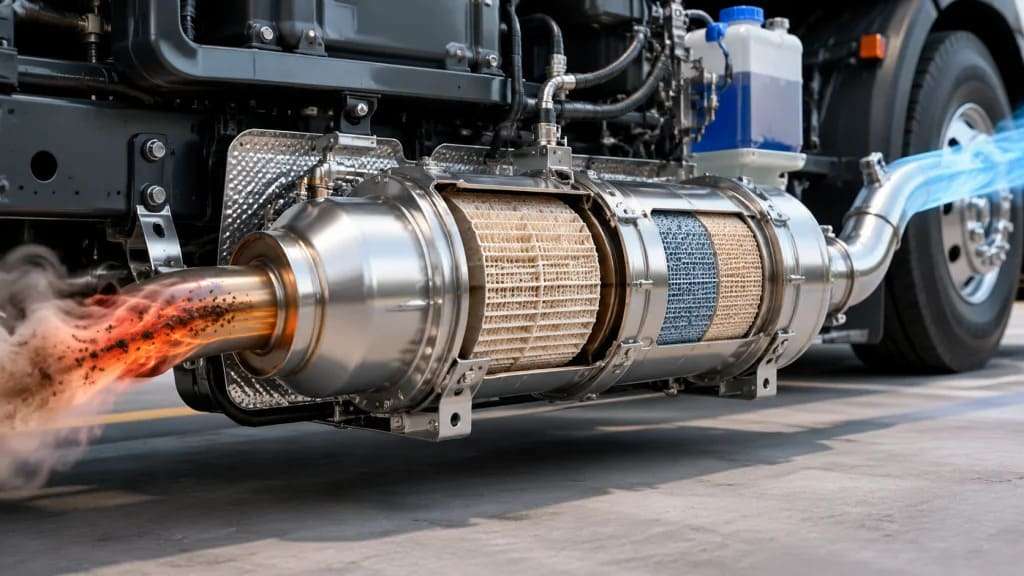
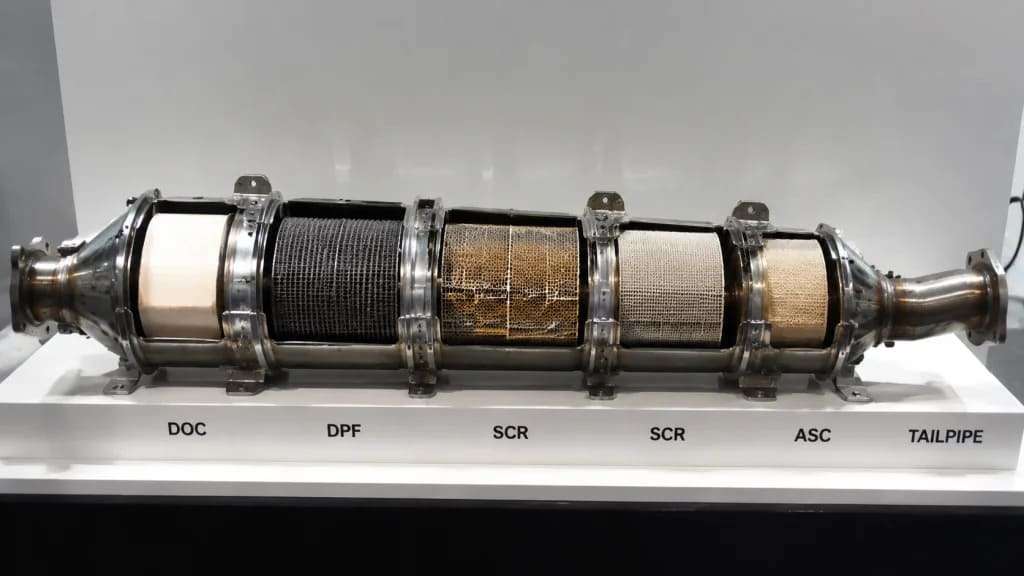
Standard configuration for Euro 6, EPA 2010, and China 6:
Engine → DOC → DPF → SCR → ASC → Tailpipe
Enhanced configuration for Euro 7 and EPA 2027:
Engine → DOC → DPF → SCR → SCR → ASC → Tailpipe
Dual SCR is used for lower NOx limits.

The first line of defense. It converts CO and HC into CO₂ and H₂O. It also oxidizes NO to NO₂, which is critical for downstream passive DPF regeneration and fast SCR reactions. The DOC generates exothermic heat during active DPF regeneration, reaching 600°C or higher. It uses a cordierite honeycomb with Pt/Pd washcoat, typically 0.5–3 g/L. Efficiency is more than 90% for CO and HC conversion.
Traps soot and ash. It uses a wall-flow cordierite or SiC substrate with more than 99% filtration efficiency. Passive regeneration happens during normal driving using NO₂. Active regeneration uses fuel post-injection and DOC exotherm when soot load exceeds the threshold, typically 4–6 g/L. Service life is 300,000+ km with proper ash cleaning.
The primary NOx removal system. It uses Cu-zeolite at 175–500°C or Fe-zeolite at 250–550°C on a cordierite honeycomb. DEF, also known as AdBlue, contains 32.5% urea and is injected upstream. It decomposes into NH₃, which reduces NOx into N₂ and H₂O. Conversion efficiency is 90–99%. Closed-loop control is managed with upstream and downstream NOx sensors.
The final polishing layer. Pt on alumina oxidizes excess NH₃ into N₂. Tailpipe NH₃ is kept below 10 ppm. The ASC is often coated on the outlet section of the SCR brick.
Provides precision delivery of DEF. It includes a tank of 5–50+ L with level and quality sensors, a pump module operating at 2–10 bar, and an injector with internal cooling. Heated lines are used for cold climates because DEF freezes at -11°C. The system is controlled by a DCU or integrated ECU.
Pollutant | Raw Engine Out | After Aftertreatment | Efficiency |
NOx | 300–1,200 ppm | <80 ppm, Euro 7: <40 ppm | 90–97% |
PM | 0.1–0.5 g/kWh | <0.01 g/kWh | >98% |
PN | 1×10¹² #/kWh | <6×10¹¹ #/kWh | >99% |
CO | 100–500 ppm | <10 ppm | >95% |
HC | 50–200 ppm | <10 ppm | >95% |
NH₃ slip | N/A | <10 ppm | N/A |
Vehicle Category | Engine Displacement | Aftertreatment Configuration | Key Requirements |
Light-duty vans | 1.6–3.0 L | DOC + DPF + SCR + ASC | Compact packaging, fast light-off |
Medium trucks | 3.0–7.0 L | DOC + DPF + SCR + ASC | 300,000 km durability |
Heavy-duty trucks | 7.0–16 L | DOC + DPF + SCR + SCR + ASC | 700,000+ km durability, dual SCR |
Buses, transit | 5–9 L | DOC + DPF + SCR + ASC | Low-load regeneration strategy |
Non-road, Stage V/Tier 4 | <19–560+ kW | DOC + DPF + SCR, ASC optional | Extreme vibration, dust, limited maintenance |
Engineered for Euro 7, EPA 2027, China 7, and global equivalents. Real driving emissions compliant, including cold start, high altitude, and high load.
Close-coupled and underfloor configurations. Fast light-off for cold start compliance, reaching 200°C in less than 180 seconds. Heat shields and insulation help maintain temperature. Active thermal management supports low-load operation for urban buses and delivery vehicles.
Passive regeneration is continuous and NO₂-based for highway driving. Active regeneration uses fuel post-injection and DOC exotherm, triggered by the soot load model. Stationary regeneration is available for non-road equipment. Regeneration inhibit is available for hazardous areas such as mines, refineries, and indoor environments.
Includes upstream and downstream NOx sensors for SCR efficiency monitoring, a differential pressure sensor for DPF soot load, temperature sensors before DOC, DPF, SCR, and ASC, plus DEF quality and level sensors.
Built with 409/304 stainless steel canning. Includes vibration-resistant mounting according to ISO 16750-3, salt spray corrosion protection according to ASTM B117 for 1,000+ hours, and thermal cycling testing for 1,000 cycles from -40°C to 800°C. Serviceable designs are available with replaceable catalyst bricks.
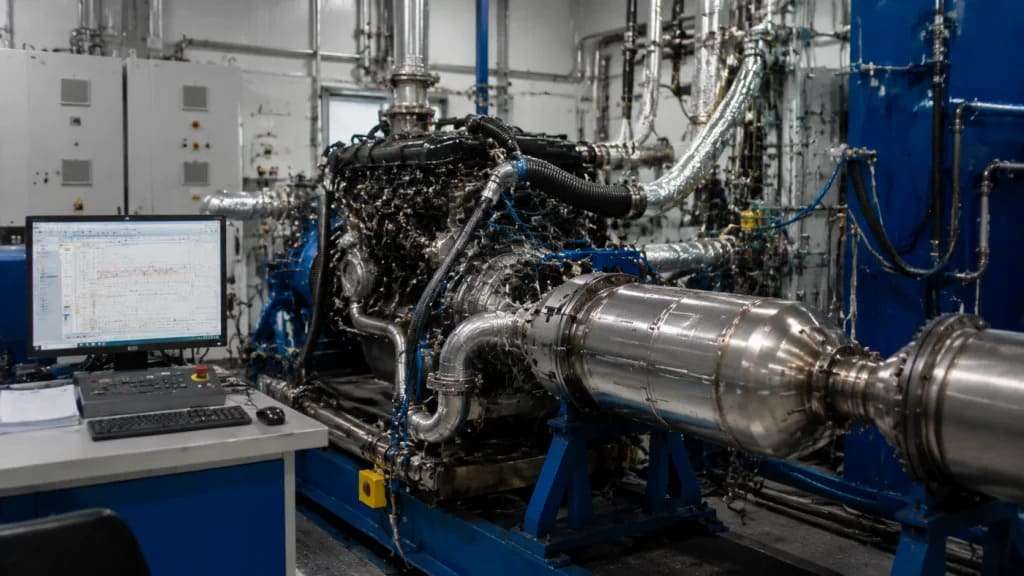
We deliver complete, turnkey aftertreatment systems:
Service Area | Description |
Technology selection | DOC, DPF, SCR, and ASC sizing and formulation based on engine data |
Mechanical packaging | CAD design, flow simulation using CFD, and thermal analysis |
DEF dosing integration | Injector positioning, mixing element design, and crystallization prevention |
Calibration | ECU/DCU integration, base and adaptive calibration, and OBD development |
Validation | Engine dyno testing, emissions testing, durability testing, regeneration testing, vehicle RDE testing, cold testing, and high-altitude testing |
Certification support | Test reports, documentation, and compliance declaration |
Thousands of systems are in operation across on-highway, non-road, marine, and stationary applications. Validated to Euro 6, EPA 2010, China 6, Stage V, and Tier 4 Final.
In-house substrate extrusion, washcoat formulation, catalyst coating, canning, and dosing controls. This provides single-source accountability.
Engineering centers in North America, Europe, and Asia. Field service is available for installation supervision and troubleshooting.
Optimized PGM loading with reduced Pt and strategic use of Pd for competitive pricing without compromising performance.
From Euro 7 heavy-duty trucks to Stage V excavators and Tier 4 Final gensets, our diesel aftertreatment solutions deliver compliance, durability, and value. Partner with us to engineer your path to clean diesel operation.