|

HENTEK CAT Catalyst & Catalytic Converter Solutions

Technical Route – Catalyst Coatings

Exploring the engineering behind catalyst washcoats—the chemically active layer that transforms an inert substrate into a high-performance emissions control device.

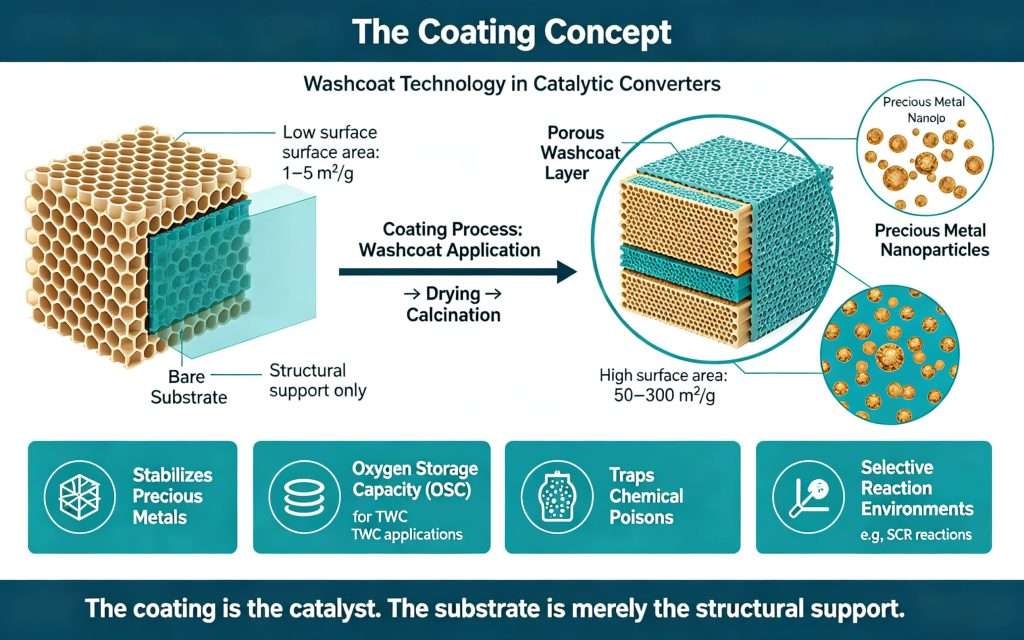
The Coating Concept

A bare catalyst substrate has low surface area (1–5 m²/g)—insufficient to support precious metal nanoparticles. Catalyst coatings (washcoats) bridge this gap: high-surface-area oxide slurries applied to substrate walls, dried, and calcined. The resulting porous layer provides 50–300 m²/g of reactive surface. The washcoat also stabilizes precious metals against sintering, provides oxygen storage capacity (OSC) for TWC applications, traps chemical poisons, and creates specific chemical environments for selective reactions like SCR.

The coating is the catalyst. The substrate is merely the structural support.

The Technical Route: Step-by-Step (Automotive TWC Example)

Step 1: Washcoat Component Selection

A modern TWC washcoat contains 5–15 components.

High-surface-area oxide support (50–70% of mass): Gamma-alumina (γ-Al₂O₃, 150–300 m²/g) with lanthanum or barium stabilization prevents sintering above 1,000°C.

Oxygen storage material – OSC (20–40% of mass, TWC only): Ceria-zirconia (CZ, CeₓZr₁₋ₓO₂) provides 300–800 µmol O₂/g via Ce⁴⁺↔Ce³⁺ redox, buffering air-fuel ratio fluctuations for 1–2 seconds during transients.

Zeolites (0–20% of mass): ZSM-5 or Beta trap cold-start hydrocarbons; SSZ-13 stores NH₃ for SCR.

Promoters & stabilizers (1–10%): Barium oxide (NOx storage, poison trap), lanthanum oxide (thermal stability), silica (binder).

Precious metals – PGM (0.1–2% of mass, 50–80% of cost): Palladium (1–4 g/L, HC/CO oxidation), rhodium (0.1–0.3 g/L, NOx reduction), platinum (0–1 g/L, HC/CO/NO oxidation).

Step 2: Slurry Preparation

Powders are milled in deionized water with dispersants to a D90 of 3–15 µm (below substrate pore size). pH is adjusted to 3–5 (alumina) or 8–10 (zeolites). Solids content is 30–50% by weight. Colloidal binders (1–5%) and rheology modifiers (PVA, methylcellulose) are added. Quality control checks particle size, viscosity (50–500 cP), zeta potential (>30 mV), and solids content.

Step 3: Washcoat Application

Dip-and-blow (flow-through substrates): Substrate is dipped in slurry for 0.5–3 seconds, drained, then blown with compressed air (10–50 psi) to remove excess, leaving a uniform 20–50 µm coating.

Vacuum coating (wall-flow filters – DPF/GPF): Slurry is drawn through porous walls by vacuum, coating both sides. Critical for catalysed GPF.

Spray coating (multi-layer, zoned): Allows precise axial zoning (e.g., high PGM at inlet for fast light-off, low PGM at outlet).

PGM impregnation: Pre-impregnated powder (best distribution), post-coating dipping (lower cost), or in-line injection.

Step 4: Drying & Calcination

Drying (80–150°C, 10–60 minutes): Removes water. Microwave drying (2–5 minutes) reduces cracking by heating water throughout the coating.

Calcination (450–650°C, 1–4 hours): Burns off organics (PVA, methylcellulose → CO₂ + H₂O), converts metal salts to metallic PGM nanoparticles (1–10 nm), sinters washcoat particles into a durable network bonded to the substrate. Ramp rates 5–20°C/min prevent thermal shock.

Step 5: Multi-Layer & Zoned Coatings

Typical TWC three-layer architecture:

  • Bottom (substrate-adjacent, 20–40 µm): Alumina + BaO + La₂O₃ (no PGM) – poison trap, thermal barrier.
  • Middle (30–50 µm): CZ + La-Al₂O₃ + Rh (0.1–0.3 g/L) – NOx reduction, protected from poisons.
  • Top (exhaust-facing, 20–40 µm): CZ + La-Al₂O₃ + Pd (2–4 g/L) – HC/CO oxidation.

Zoned coating (gradient along length): Inlet (0–30%, 4–6 g/L PGM) for rapid light-off; middle (30–70%, 2–4 g/L) for sustained conversion; outlet (70–100%, 0.5–2 g/L) for polishing. Applied via sequential dip or spray with masks.

Step 6: Quality Control

Physical tests: Washcoat loading (gravimetric, ±3%), uniformity (XRF, <10% axial variation), adhesion (tape test, no removal), pressure drop (±10%).

Chemical tests: PGM concentration (XRF/ICP, ±5%), OSC (>300 µmol O₂/g), BET surface area (>50 m²/g fresh, >30 m²/g aged), poison levels (<100 ppm S, P, Zn, Ca).

Catalytic activity: Light-off temperature (T50 <250°C CO, <280°C HC, <300°C NOx), steady-state conversion (>98% CO, >95% HC/NOx at 400°C), aged performance (1,000°C for 4–100 hours, >95% of fresh).

Variations on the Coating Theme

DOC (Diesel Oxidation Catalyst)

γ-Al₂O₃ support, no OSC, Pt or Pt/Pd (0.5–3 g/L), thinner coating (20–50 µm). Function: CO/HC oxidation, NO→NO₂.

SCR (Selective Catalytic Reduction)

Cu-SSZ-13 (175–500°C) or Fe-zeolite (250–550°C), 150–300 g/L loading, no PGM. Coated via vacuum for SCRoF (SCR on filter). Vanadia/Titania for industrial (250–550°C, sulfur-tolerant).

Catalysed GPF (Four-Way Catalyst)

TWC formulation on wall-flow substrate, vacuum-coated both sides (10–30 µm on wall surface). Balances catalytic activity vs. filtration/backpressure via bimodal pore size distribution.

Industrial VOC

γ-Al₂O₃ or TiO₂ (for chlorinated VOCs), Pt-only (0.5–3 g/L), thinner coating (20–50 µm). Lower cost pressure, longer life (5–10 years), 95% DRE vs. 99%+ for automotive.

Advantages of Engineered Catalyst Coatings

We don’t just supply washcoat formulations; we engineer coatings to meet your precise application. Whether you require a high-OSC (800 µmol O₂/g), multi-layer TWC coating for Euro 7 gasoline durability, a low-PGM (0.5 g/L) DOC for cost-sensitive off-highway diesel, or a poison-resistant Pt/Pd VOC coating for silicone-containing solvents, our team can tailor support chemistry, OSC materials, zeolite type, PGM selection, and coating architecture to your performance, durability, and cost targets.

Partner with us to define your path to compliance.

The Future of Catalyst Coatings

Ultra-low PGM & PGM-free: Perovskites (LaFeO₃) and spinels (CuFe₂O₄) show 80–90% of PGM performance for CO/HC oxidation but poor NOx reduction. Commercial in 5–10 years for limited applications.

Electrically heated coatings: Conductive additives (carbon nanotubes, graphene) enable resistive heating—300°C light-off in <1 second. Challenge: durability.

Self-healing coatings: Barium-aluminate reacts with phosphorus poisons, sequestering them away from PGM sites. Gold/ceria oxidizes CO at room temperature and regenerates under lean conditions.

Machine learning-optimized formulations: High-throughput robotic synthesis + ML explores 20+ component composition space. First ML-optimized coatings expected 2026–2028.

Biogenic & recycled washcoats: Alumina from recycled aluminum, zeolites from coal fly ash, ceria from end-of-life converters. Driven by OEM sustainability commitments and EU Critical Raw Materials Act.

The catalyst coating is where chemistry meets engineering—a nanoscale architectural marvel. A well-engineered coating balances surface area against pore size, PGM loading against cost, and stability against reactivity. Whether you are designing a TWC, SCR, DOC, or VOC oxidizer, the coating defines your catalyst’s success—and we are ready to engineer the solution.