
Modern diesel vehicles face simultaneous challenges: reducing particulate matter (PM/PN) and nitrogen oxides (NOx) from lean-burn exhaust where traditional three-way catalysts cannot function. The DOC+DPF+SCR technical route integrates three complementary technologies into a complete aftertreatment system.
This three-step architecture achieves >95% CO/HC reduction, >99% PM removal, and 90–99% NOx conversion, meeting Euro 6/7, EPA 2010/2027, and China 6/7 standards.
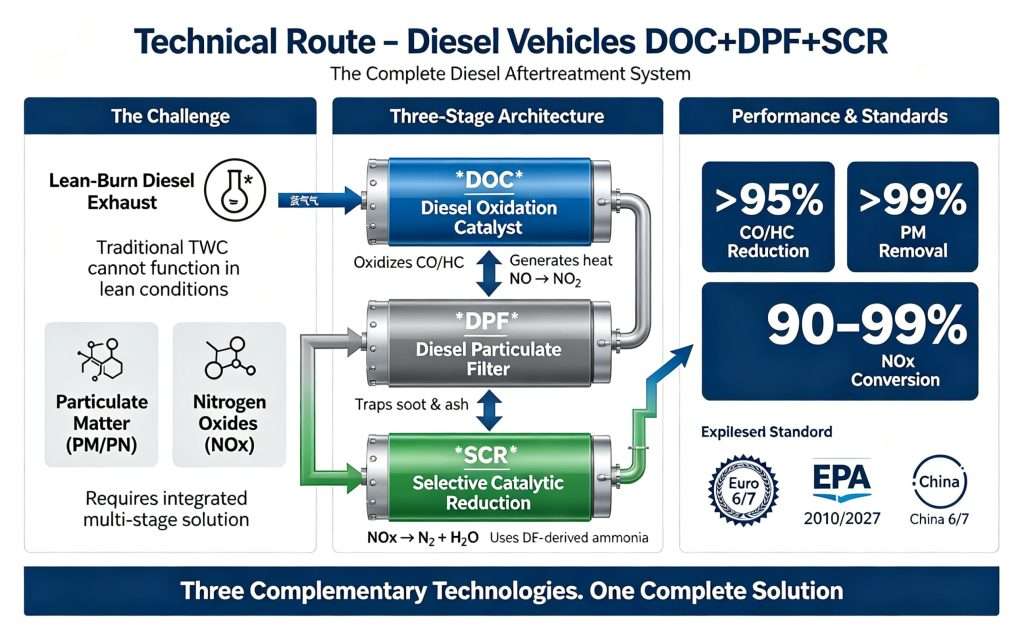

Complete system architecture:
Engine → DOC → DPF → SCR → ASC (optional) → Tailpipe
Function:
Construction:
Performance:
NO → NO₂ conversion: optimized to 40–60% for downstream synergy
Function:
Construction:
Performance:
Ash cleaning interval: 150,000–300,000 km (passenger), 200,000–500,000 km (heavy-duty)
Function:
Construction:
Performance:
Fe-zeolite: high-temperature durability (long-haul trucking)
Component | Primary Function | Secondary Function | Downstream Beneficiary |
DOC | CO/HC oxidation | NO → NO₂ conversion; exotherm generation | SCR (NO₂ for fast SCR); DPF (passive regeneration) |
DPF | PM/PN filtration | Soot storage | SCR (clean gas, no fouling) |
SCR | NOx reduction | NH₃ storage | Tailpipe (clean exhaust) |
ASC | NH₃ oxidation | N₂O suppression | Tailpipe (odorless, safe) |
DOC: engine displacement × 1.0–1.5
DPF: engine displacement × 1.2–1.8
SCR: engine displacement × 1.5–2.5
Space velocity: 30,000–60,000 hr⁻¹ (passenger), 15,000–30,000 hr⁻¹ (heavy-duty)
SCR light-off requires >175°C (Cu-zeolite)
Low-load operation (idle, urban) needs thermal management: close-coupled mounting, exhaust insulation, active heating (eSCR for Euro 7)
DPF regeneration requires >550°C – achieved via late post-injection (fuel penalty 3–5%) or burner system
Closed-loop using upstream and downstream NOx sensors
NH₃ storage model prevents slip while maximizing conversion
Dosing rate: 3–6% of fuel consumption
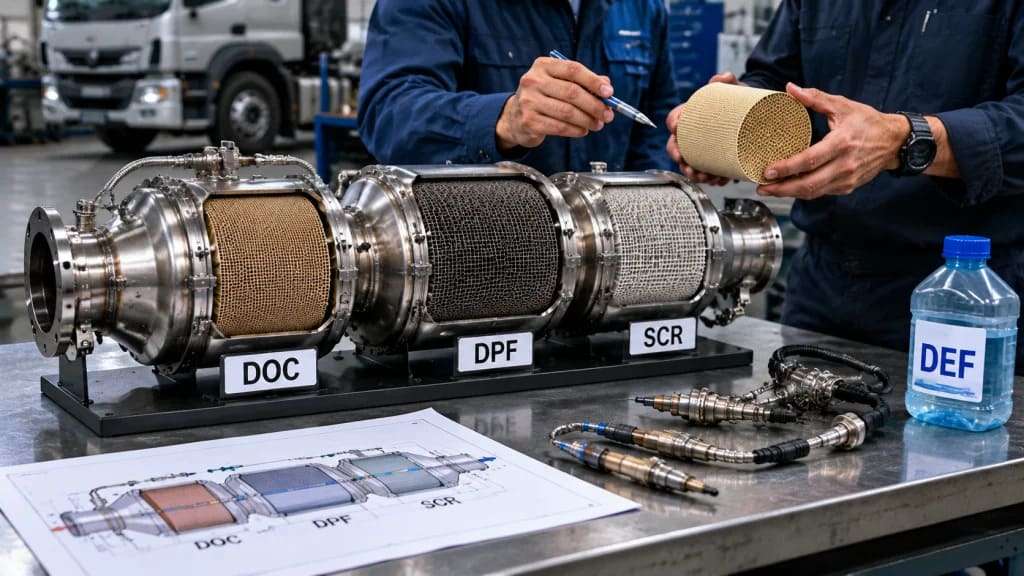
We engineer complete DOC+DPF+SCR systems for any diesel application. Whether you require a compact system for a passenger van (Euro 6d), a high-durability system for a long-haul truck (EPA 2027, 700,000+ km), or a sulfur-tolerant system for off-highway equipment (Stage V/Tier 4), our team tailors catalyst formulations, substrate geometries, PGM loadings, and control strategies to your specific engine, duty cycle, and regulatory target.
Partner with us to define your path to compliance – diesel emission control, fully integrated.
Active heating systems for low-load operation (plug-in hybrids, urban delivery). 48V electric heaters maintain catalyst temperature without fuel penalty
SCR catalyst coated directly on DPF substrate. Saves space (one less brick), reduces backpressure, enables passive regeneration + SCR in same can. Preferred for Euro 7 and tight packaging
Two SCR bricks in series (small, fast-light-off close-coupled + large, high-storage underfloor). Reduces cold-start NOx by 70–90% compared to single SCR
Zero CO₂ diesel replacement retains DOC+DPF+SCR architecture for NOx and PM control. SCR essential for H₂-ICE NOx compliance
The DOC+DPF+SCR technical route is not three separate components – it is an integrated system where each element enables the next. A well-engineered system achieves >99% PM removal, 90–99% NOx reduction, and <10 ppm NH₃ slip across thousands of operating hours. Whether you are certifying a Euro 7 heavy-duty truck or a Tier 4 Final excavator, DOC+DPF+SCR defines the state of the art – and we are ready to engineer your solution.