
Palladium supported on alumina (Pd/Al₂O₃) is one of the most widely used and versatile heterogeneous catalysts in industrial catalysis. The combination of palladium’s exceptional activity for hydrogenation, oxidation, and decomposition reactions with alumina’s high surface area, thermal stability, and mechanical strength creates a catalyst platform applicable across refining, petrochemical, pharmaceutical, and environmental protection sectors. The metal-support interaction between Pd nanoparticles and the γ-Al₂O₃ surface stabilizes the active phase against sintering while providing accessible active sites for reactant adsorption and activation. A well-formulated Pd/Al₂O₃ catalyst achieves >99% conversion efficiency in applications ranging from hydrogen purification to VOC abatement, with service lives exceeding 10,000 hours in many commercial processes.
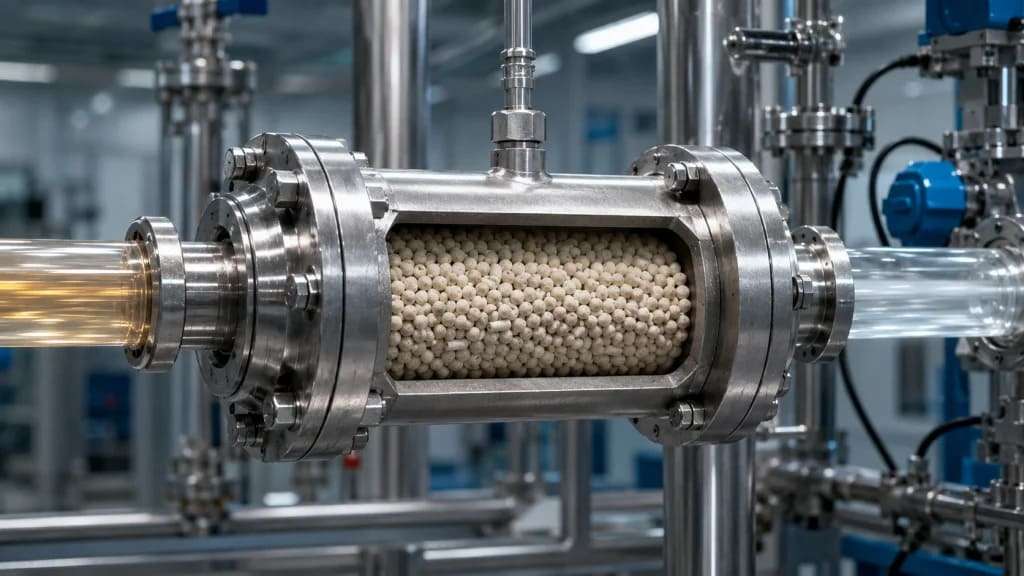

The support is typically γ-alumina (γ-Al₂O₃) , a transition alumina phase with exceptional textural properties:
Property | Typical Range | Significance |
Specific surface area (BET) | 150-300 m²/g | Higher area enables better Pd dispersion |
Pore volume | 0.3-0.8 cm³/g | Affects mass transfer and impregnation |
Average pore diameter | 5-15 nm | Mesoporous structure balances accessibility and surface area |
Crystal phase | γ (or δ, θ at higher temperatures) | γ-phase provides optimal surface hydroxyl density |
Thermal stability | Stable to ~800°C | Above 800°C transforms to low-area α-Al₂O₃ |
Stabilized variants – For high-temperature applications, alumina is doped with lanthanum (La, 2-5 wt%) or barium (Ba) to retard phase transformation and maintain surface area. La-Al₂O₃ maintains >100 m²/g even after 1,000°C aging.
Support morphology – Alumina is available in various forms:
Typical loading range – 0.1 to 5 wt% Pd, with 0.5-2 wt% being most common for general-purpose catalysts.
Dispersion targets – The fraction of Pd atoms exposed at the surface:
Loading (wt%) | Particle Size (nm) | Dispersion (%) | Application |
0.1-0.3 | 1-2 | 60-90% | High-cost, high-activity requirements |
0.5-1.0 | 2-5 | 30-60% | General-purpose hydrogenation |
2-5 | 5-10 | 10-30% | Bulk reactions, lower cost sensitivity |
Dispersion–activity relationship – For hydrogenation reactions, activity typically scales with Pd dispersion (more exposed atoms = higher activity). For oxidation reactions, an optimum particle size (3-6 nm) often exists due to structure sensitivity.
Incipient wetness impregnation (IWI) – most common – A solution of palladium precursor (typically Pd(NO₃)₂ or PdCl₂) is added to the dry alumina support in a volume exactly matching the pore volume. Capillary action draws the solution into the pores. After drying (80-120°C) and calcination (400-600°C), Pd(NO₃)₂ decomposes to PdO particles.
Wet impregnation – Excess precursor solution is used, followed by filtration to remove unabsorbed liquid. Less precise loading control but better for large-scale production.
Ion exchange – Pd(NH₃)₄²⁺ cations exchange with surface hydroxyl protons on alumina. Produces extremely high dispersion but limited to low loadings (<0.5 wt%).
Precipitation-deposition – Pd is precipitated onto the support by adding base (e.g., NaOH, Na₂CO₃) to a suspension of alumina in Pd salt solution. Uniform distribution and good control over particle size.
Particle size control parameters:
As-prepared Pd/Al₂O₃ contains palladium as PdO (palladium oxide). For most catalytic applications, the active species is metallic Pd⁰, requiring a reduction (activation) step:
Gas-phase reduction (most common) :
The reduction reaction: PdO + H₂ → Pd⁰ + H₂O (exothermic). Care must be taken to control the exotherm, especially for high loadings (>2 wt%) where temperature spikes can cause local sintering.
In-situ reduction – For hydrogen-containing feed streams, the catalyst self-activates under reaction conditions. The PdO is gradually reduced by H₂ in the feed.
Liquid-phase reduction – For slurry reactors, hydrazine (N₂H₄), formaldehyde (HCHO), or sodium borohydride (NaBH₄) reduce PdO to Pd⁰ without high-temperature H₂ exposure.
Technique | Information Provided | Target for Fresh Catalyst |
BET surface area | Total and specific surface area | 150-250 m²/g |
H₂ chemisorption | Pd dispersion, particle size | 30-60% dispersion (2-5 nm) |
CO chemisorption | Pd dispersion (alternative to H₂) | 0.5-1.5 CO/Pd ratio |
TEM | Direct particle size visualization | 2-8 nm (uniform distribution) |
XRD | Pd crystallite size, phase identification | Pd⁰ peaks broad (small crystals) |
XPS | Surface Pd oxidation state | Primarily Pd⁰ after reduction |
ICP-OES | Total Pd loading | ±2% of target |
Temperature-programmed reduction (TPR) – Measures the reducibility of PdO species. A sharp reduction peak centered at 50-150°C indicates well-dispersed, easily reducible PdO.
Hydrogen purification (deoxygenation) – Pd/Al₂O₃ catalytically removes trace oxygen from hydrogen streams via the reaction: 2H₂ + O₂ → 2H₂O. Operating at ambient to 150°C, inlet O₂ reduced from hundreds of ppm to <1 ppm. This is critical for fuel cell feed gas, semiconductor manufacturing, and metal heat-treatment atmospheres.
Volatile organic compound (VOC) abatement – Complete oxidation of VOCs (toluene, xylene, acetone, ethanol) to CO₂ and H₂O: CₓHᵧ + (x+y/4)O₂ → xCO₂ + (y/2)H₂O. Light-off temperatures (T50) for aliphatic hydrocarbons: 150-200°C; aromatics: 200-250°C. Pd outperforms Pt for methane oxidation (lean-burn natural gas engines) and is comparable for other VOCs at lower cost.
Selective hydrogenation – Acetylene removal from ethylene streams: C₂H₂ + H₂ → C₂H₄ (target) without over-hydrogenation to C₂H₆. Pd/Al₂O₃ is the industry standard for this front-end and tail-end acetylene converters in ethylene plants, achieving >99% acetylene conversion with >90% selectivity to ethylene. Butadiene hydrogenation: selective conversion to butenes. Nitrile hydrogenation: conversion to primary amines.
Deoxygenation of inert gases (N₂, Ar, He) – Trace O₂ removal via reaction with added H₂ or via direct chemisorption mechanisms. Outlet O₂ <0.1 ppm achievable.
Methane oxidation (lean-burn natural gas engines) – Pd/Al₂O₃ is the preferred catalyst for oxidizing unburned methane from lean-burn natural gas vehicles and stationary engines. Unlike Pt, Pd maintains high activity in the presence of water vapor. Challenge: sulfur poisoning from natural gas odorants (mercaptans) requires periodic regeneration.
Total hydrocarbon oxidation (gas turbine exhaust) – Pd/Al₂O₃ oxidizes unburned hydrocarbons from natural gas-fired turbines to meet emissions limits.
Mechanism | Cause | Reversibility | Mitigation |
Sintering | High temperature (>700°C) | Irreversible | La/Ba stabilization; lower operating T |
Sulfur poisoning | H₂S, mercaptans in feed | Partially reversible (H₂ reduction at 400-500°C) | Guard bed; periodic regeneration |
Coke deposition | Hydrocarbon cracking/polymerization | Reversible (O₂ burn-off at 400-500°C) | Optimize H₂:hydrocarbon ratio |
Chlorine/chloride | Chlorinated feed or improper handling | Reversible (steam treatment) | Avoid chloride-containing precursors |
PdO formation | Oxidizing atmosphere at high T | Reversible (re-reduce with H₂) | Maintain reducing conditions |
Metal-support compound formation | PdAl₂O₄ spinel formation at >800°C | Irreversible | Limit maximum temperature |
Poisoning by Pb, As, Hg | Contaminated feed | Irreversible | Feed pretreatment |
Sulfur regeneration – Sulfated Pd/Al₂O₃ can be partially regenerated by reduction in H₂ at 400-500°C, converting PdS back to Pd⁰. Complete regeneration requires high-temperature oxidation-reduction cycling.
Form | Dimensions | Crush Strength | Bulk Density | Primary Application |
Spheres | 1-5 mm | 30-100 N | 0.6-0.9 g/mL | Fixed-bed reactors |
Cylindrical extrudates | 1/16, 1/8 inch | 20-50 N/cm | 0.6-0.8 g/mL | High-flow fixed-bed |
Trilobe/quadralobe | 1/16-1/8 inch | 15-40 N/cm | 0.5-0.7 g/mL | Optimized mass transfer |
Powder | 20-150 µm | N/A | 0.4-0.7 g/mL | Slurry reactors |
Honeycomb monolith | 200-600 cpsi | >1 MPa crush | 0.4-0.6 g/mL | High-flow, low-ΔP |
Commercial product example – BASF PuriStar® R3-12B (Pd on alumina for gas purification). Reduces O₂ from <50 ppm to <1 ppm in H₂ streams. Copper-promoted variants available for enhanced CO resistance.
We engineer palladium on alumina catalysts across the full application spectrum. Whether you require a high-dispersion (80%), low-loading (0.1 wt%) Pd/Al₂O₃ for selective acetylene hydrogenation in ethylene plants achieving >99% conversion with >90% selectivity, a thermally stabilized (La₂O₃) 2 wt% Pd/Al₂O₃ for methane oxidation in lean-burn natural gas engines with 10,000+ hour service life, a 0.5 wt% Pd/γ-Al₂O₃ sphere for hydrogen deoxygenation reducing O₂ from 100 ppm to <1 ppm at 100°C, or a Pd-Pt bimetallic formulation for enhanced sulfur tolerance and low-temperature light-off, our team tailors the support morphology, Pd loading (0.1-5 wt%), dispersion target (1-10 nm particle size), promoter composition (La, Ba, Ce, Cu), and physical form (sphere, extrudate, powder, honeycomb) to your specific reaction, feed composition, temperature window, and lifetime requirement.
Partner with us to define your path to compliance – palladium on alumina, precision catalysis.
Bimetallic formulations (Pd-Pt, Pd-Au, Pd-Cu) – Alloying with second metals modifies electronic structure, enhancing selectivity, poison resistance, and thermal stability. Pd-Au catalysts show improved acetylene hydrogenation selectivity; Pd-Cu reduces cost while maintaining activity for certain reactions.
Core-shell nanoparticles – Pd shell on cheaper metal core (e.g., Ni@Pd) reduces precious metal content by 50-80% while maintaining surface activity. Controlled synthesis yields uniform 5-10 nm particles.
Single-atom Pd catalysts – Atomically dispersed Pd on alumina achieves near-100% metal utilization. Demonstrated for selective hydrogenation reactions. Thermal stability remains challenging above 300°C.
Hierarchical pore structures – Alumina supports with bimodal pore networks (small pores for high surface area, large pores for rapid mass transport) reduce diffusion limitations in liquid-phase hydrogenation.
Machine learning-optimized formulations – High-throughput synthesis coupled with ML models predicts optimal Pd loading, dispersion, and promoter addition for any target reaction and operating condition.
Palladium on alumina (Pd/Al₂O₃) is not merely a supported metal—it is a precision-engineered catalytic material optimized through decades of industrial application. A well-designed Pd/Al₂O₃ catalyst achieves >99% conversion efficiency, maintains dispersion stability across thousands of operating hours, and resists deactivation from sulfur, coke, and thermal aging. Whether you are purifying hydrogen for fuel cells, removing VOCs from industrial exhaust, selectively hydrogenating acetylene in ethylene plants, or oxidizing methane from natural gas engines, Pd/Al₂O₃ defines the benchmark for noble metal catalysis—and we are ready to engineer your solution.