
Diesel engines produce particulate matter (PM) consisting of soot (carbon), ash (metallic additives from oil), and soluble organic fraction (SOF – unburned fuel and oil). Two primary technologies exist for diesel particulate control: the Partial Flow Filter (POC) and the Diesel Particulate Filter (DPF). While both reduce PM emissions, they differ fundamentally in filtration efficiency, regeneration method, backpressure, cost, and application suitability. POC offers moderate efficiency (50-80%) at lower cost, ideal for less stringent regulations. DPF delivers ultra-high efficiency (>99%) meeting Euro 5/6, EPA 2010+, and China 6 standards. This guide explains the technical differences to help you select the right solution.
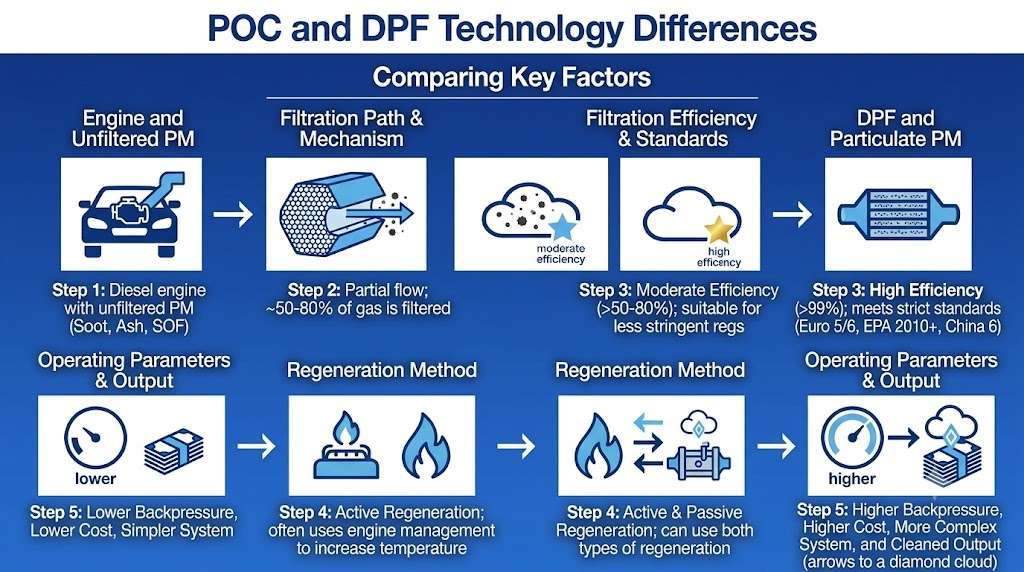

Parameter | POC (Partial Flow Filter) | DPF (Diesel Particulate Filter) |
Filtration efficiency | 50-80% (PM), 30-60% (PN) | >99% (PM), >99% (PN) |
Substrate type | Sintered metal, metal foam, or coarse ceramic | Wall-flow ceramic (cordierite or SiC) |
Regeneration | Passive only (NO₂-based) | Passive + active (fuel post-injection) |
Backpressure | Low (2-5 kPa) | Moderate (5-10 kPa) |
Ash storage capacity | Limited (2-3 g/L) | High (5-8 g/L) |
Cost | Low (30-50% of DPF) | High |
Typical regulation level | Euro 3/4, EPA 2004-2007, China 3/4 | Euro 5/6, EPA 2010+, China 5/6 |
How it works – The POC is a flow-through device (not wall-flow). Exhaust gas passes through a sintered metal, metal foam, or coarse ceramic substrate with tortuous pathways. A portion of the gas flow contacts the filter walls (partial flow), depositing soot. The remaining gas passes straight through, unfiltered. Result: moderate efficiency (50-80%) but low backpressure.
Substrate types – Sintered metal (bronze or stainless steel powder bonded into porous sheet) – highest cost, best durability. Metal foam (open-cell reticulated structure) – low backpressure, moderate efficiency. Coarse ceramic (low cell density, 100-200 cpsi) – lowest cost, lower efficiency.
Filtration mechanism – Diffusion: small particles (<0.5 µm) collide with filter fibers (Brownian motion). Impaction: larger particles (>1 µm) cannot follow gas streamlines. Interception: particles touch filter surfaces. No wall-flow plugging – soot accumulates on surfaces but gas always has a path through.
Regeneration – Passive only: NO₂ (from upstream DOC) oxidizes soot at 250-400°C. No active regeneration (no fuel post-injection). Regeneration efficiency is moderate – some soot always remains (equilibrium soot load). No thermal stress concerns (unlike DPF cracking). Suitable for applications with consistent exhaust temperatures (>250°C).
Applications – Euro 3/4 diesel vehicles (PM reduction required but not PN limits). Off-highway equipment (Stage IIIB, Tier 4 Interim) – moderate PM reduction. Retrofit applications (lower cost than DPF). Applications where backpressure is critical (small engines, turbocharged). Pre-filter upstream of DPF (reduces DPF loading).
How it works – The DPF is a wall-flow monolith: channels are alternately plugged. Exhaust enters open inlet channels and is forced through porous ceramic walls. Soot and ash are trapped on the inlet channel walls. Cleaned gas exits through outlet channels. Result: >99% filtration efficiency for all particle sizes (including sub-23nm nanoparticles).
Substrate types – Cordierite: lower cost, lower thermal conductivity (requires careful regeneration control). Silicon carbide (SiC): higher cost, higher thermal conductivity (better regeneration durability), preferred for heavy-duty and high-load applications. Segmented SiC: multiple blocks bonded together – allows thermal expansion without cracking.
Filtration mechanism – Wall-flow: no straight-through path – all gas passes through porous walls (100% filtration). Soot cake builds on channel walls – the cake itself enhances filtration (cake filtration). Ash (non-combustible oil additives) accumulates permanently, eventually limiting service life.
Regeneration – Passive (NO₂-based, 250-400°C) during highway driving. Active (fuel post-injection, DOC exotherm, 550-650°C) when soot load exceeds 4-6 g/L – ECU triggered, adds 3-5% fuel penalty. Stationary (parked regeneration) for low-load applications. Requires thermal management – excessive temperatures (>900°C) can melt substrate.
Ash accumulation – Ash from engine oil (Ca, Zn, Mg, P) remains in DPF after regeneration. Service life: 150,000-300,000 km (passenger) or 200,000-500,000 km (heavy-duty) before ash cleaning required. Off-highway: 3,000-8,000 hours (higher oil consumption). Cleaning: reverse air pulse or thermal regeneration in specialized oven.
Parameter | POC | DPF |
Flow path | Partial straight-through | 100% wall-flow |
Peak filtration efficiency | 80% | >99.9% |
Particle size capture | >100 nm (ineffective for nanoparticles) | <23 nm (captures all) |
PN compliance (Euro 6, 6×10¹¹ #/kWh) | Not sufficient | Yes |
Active regeneration required | No | Yes (for most applications) |
Fuel penalty for regeneration | 0% | 3-5% (during active regen) |
Ash cleaning interval | N/A (ash passes through) | 150,000-500,000 km / 3,000-8,000 hours |
Soot load limit before failure | N/A (no failure mode) | >8-10 g/L (melting/thermal shock) |
Temperature sensors required | No | Yes (regen control) |
Differential pressure sensor | No (or optional) | Yes (soot load model) |
Regulation requires only moderate PM reduction (Euro 3/4, Tier 4 Interim, China 3/4). Budget is constrained (POC costs 30-50% of DPF). Backpressure is critical (small displacement engines, high-performance diesels). Regeneration cannot be managed (no post-injection capability, equipment with extended idle). PN limits (particle number) are not yet enforced in your region.
Regulation requires ultra-high PM/PN reduction (Euro 5/6, EPA 2010+, China 5/6, Stage V). Particle number (PN) limits apply (6×10¹¹ #/kWh or lower). Your engine management system supports post-injection (common-rail, ECU-controlled). You can accept 3-5% fuel penalty during active regeneration. Equipment operates with sufficient load for passive regeneration (not extended idle).
Some applications use POC upstream of DPF as a pre-filter. Reduces soot load reaching DPF (extends regeneration interval). Lowers peak regeneration temperature (less soot to burn). Improves DPF service life (reduces thermal stress cycles). Higher cost than DPF alone, but may be justified for severe duty cycles (off-highway, mining).
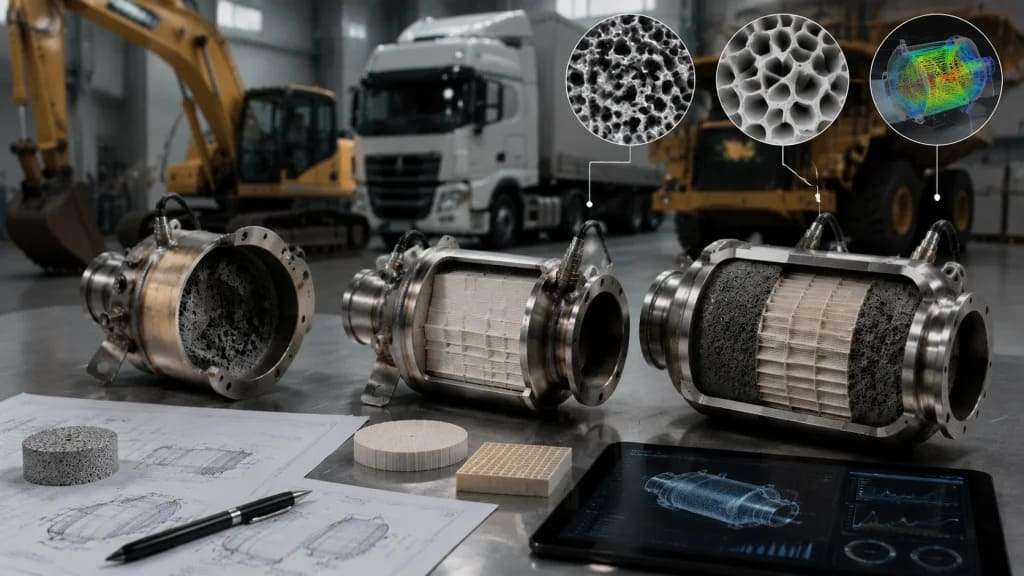
We engineer both POC and DPF solutions for any diesel application. Whether you require a low-cost sintered metal POC for a Tier 4 Interim excavator (60-70% PM reduction, no active regeneration), a high-efficiency SiC DPF for a Euro 6 heavy-duty truck (>99% PN reduction, active regen with OBD), or a POC+DPF pre-filter combination for a mining vehicle (extended DPF life, reduced regen frequency), our team tailors the substrate material, cell geometry, catalyst coating (if catalysed), and regeneration strategy to your engine platform, duty cycle, and regulatory target.
Partner with us to define your path to compliance – POC for value, DPF for full compliance.