|

HENTEK CAT Catalyst & Catalytic Converter Solutions

Technical Route – Gasoline Vehicles TWC

The Three-Way Catalyst Solution

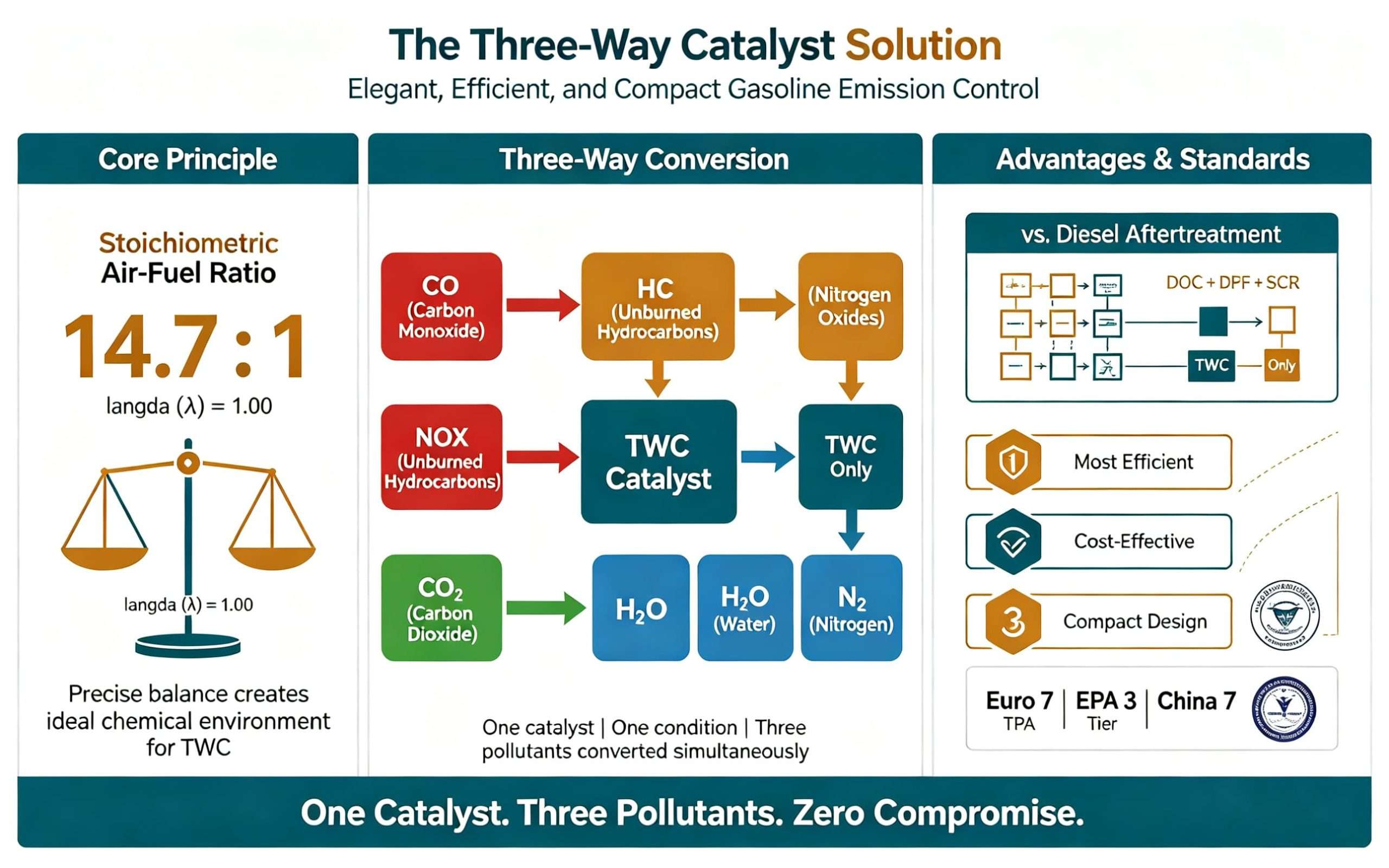
Modern gasoline vehicles operate under a fundamental principle: the stoichiometric air-fuel ratio (14.7:1, lambda = 1.00). This precise balance creates the ideal chemical environment for the Three-Way Catalyst (TWC) – a single device capable of simultaneously converting carbon monoxide (CO), unburned hydrocarbons (HC), and nitrogen oxides (NOx) into harmless carbon dioxide (CO₂), water (H₂O), and nitrogen (N₂).

Unlike diesel engines requiring multiple aftertreatment components (DOC, DPF, SCR), the TWC route is elegantly simple: one catalyst, one stoichiometric condition, three pollutants converted simultaneously. This makes TWC the most efficient, cost-effective, and compact solution for gasoline emission control – meeting Euro 7, EPA Tier 3, and China 7 standards.

The TWC Technical Pathway

Complete system architecture:
Engine → Close-coupled TWC → Underfloor TWC (optional) → GPF (optional) → Tailpipe

Step 1: Stoichiometric Operation – The Foundation

  • Requires exhaust gas with balanced oxygen content: not too lean (excess O₂ prevents NOx reduction) and not too rich (excess CO/HC prevents complete oxidation)
  • Engine Control Unit (ECU) guided by upstream lambda sensor (wideband UEGO) continuously adjusts fuel injection to maintain lambda = 1.00 ± 0.01
  • Enables >98% conversion of all three pollutants simultaneously

Step 2: Three-Way Catalyst – Core Technology

Construction:

  • Cordierite honeycomb (400–900 cpsi, 2–4 mil wall)
  • Pd/Rh washcoat (1–4 g/L Pd, 0.1–0.3 g/L Rh)
  • Ceria-zirconia (CZ) 20–40% of washcoat for oxygen storage capacity (OSC) – buffers brief lambda excursions (1–2 s)

Simultaneous conversion reactions:

  • CO + ½O₂ → CO₂ (oxidation)
  • HC + O₂ → CO₂ + H₂O (oxidation)
  • NO + CO → ½N₂ + CO₂ (reduction – requires CO as reductant)

Oxygen storage mechanism:

  • Lean spikes (excess O₂): Ce₂O₃ + O₂ → 2CeO₂ (stores O₂)
  • Rich spikes (O₂ deficit): 2CeO₂ + CO → Ce₂O₃ + CO₂ (releases O₂)
  • Prevents NOx breakthrough during rich spikes and CO/HC breakthrough during lean spikes

Performance:

  • CO/HC conversion >98% at 300–500°C
  • NOx conversion >95% at operating temperature
  • Light-off (T50): 200–250°C (close-coupled), 250–350°C (underfloor)
  • OSC: 300–800 µmol O₂/g CZ (maintains conversion for 1–2 s during lambda transients)

Step 3: Lambda Control – The Enabler

Upstream oxygen sensor (pre-catalyst):

  • Wideband UEGO measures lambda 0.7–1.3
  • ECU targets lambda = 1.00 using PI control on fuel injection
  • Typical accuracy: ±0.5–1.0% (lambda = 0.99–1.01)

Downstream oxygen sensor (post-catalyst):

  • Switching-type (narrowband) monitors catalyst performance
  • Exhaust lambda should be constant post-TWC
  • Fluctuating signal → depleted OSC → catalyst failure (P0420/P0430 OBD code)

Step 4: TWC Architecture Options

Close-coupled TWC (CCC):

  • Mounted 50–150 mm from cylinder head
  • Fastest light-off (200°C in 15–30 s)
  • Captures 60–80% of cold-start emissions
  • Must withstand 950–1,050°C peak
  • Thin-wall substrates (2–3 mil, 600–900 cpsi)

Underfloor TWC:

  • Mounted 500–1,500 mm from engine
  • Operating temperature: 300–600°C
  • Acts as polishing catalyst (converts remaining 5–10% pollutants)
  • Larger volume, thicker walls (4–6 mil, 400–600 cpsi)

Single-brick (ultra-compact):

  • For engines <1.6L and hybrids
  • Single TWC brick in close-coupled position
  • Highest OSC and PGM loading to compensate for lower volume

Step 5: TWC + GPF Integration (Gasoline Direct Injection)

  • GDI engines produce particulate matter
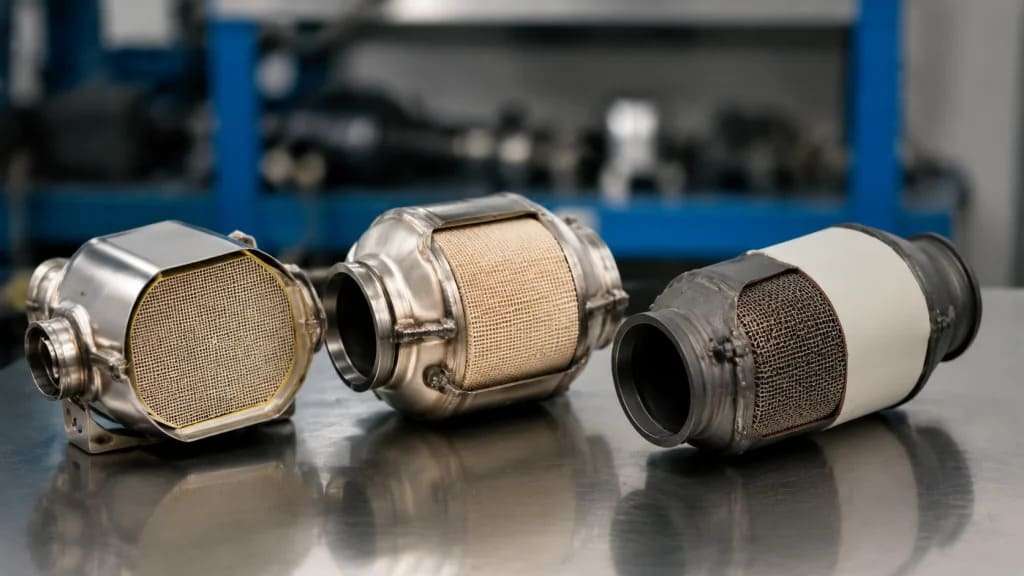
  • Catalysed GPF (cGPF / Four-Way Catalyst) combines TWC washcoat + wall-flow filter
  • Saves space, reduces backpressure vs separate TWC + GPF

cGPF construction:

  • Wall-flow cordierite or SiC (200–300 cpsi, 8–10 mil wall)
  • Full TWC washcoat (Pd/Rh + ceria-zirconia)
  • Filtration efficiency >99% for particles >23 nm
  • Gas conversion >95%
  • Passive regeneration 500–700°C

Key Advantages of the TWC Route

Single-catalyst simplicity: one device converts three pollutants

Lower system cost: no DEF tank, injector, or NOx sensors

Reduced packaging space: critical for small vehicles and hybrids

Fewer failure modes: no complex regeneration strategies

Stoichiometric fuel efficiency: <1% fuel penalty (vs 3–6% for diesel SCR + regeneration)

Fast cold-start compliance: close-coupled TWC reaches light-off 15–30 s, thin-wall 2 mil, electrically heated TWC (eTWC) <10 s

Mature, reliable technology: billions on-road since 1980s, well-understood aging, robust OBD diagnostics, service life 150,000–200,000+ km

Our TWC Engineering Expertise

We engineer complete TWC solutions for any gasoline application:

  • High-OSC (800 µmol O₂/g) close-coupled TWC for high-performance GDI
  • Low-PGM (1 g/L) underfloor TWC for cost-sensitive PFI
  • cGPF (four-way catalyst) for hybrids with tight packaging

We tailor: substrate geometry (cell density, wall thickness), washcoat composition (alumina, OSC, stabilizers), precious metal loading (Pd/Rh ratio), architecture (close-coupled, underfloor, cGPF) to engine, duty cycle, and regulatory target.

Partner with us to define your path to compliance – TWC efficiency, stoichiometric precision.

The Future of the TWC Route

Electrically heated TWC (eTWC)

Resistive heating, <10 s to 300°C, mandatory for Euro 7 PHEVs, 48V supply

PGM reduction technologies

Pd/Rh 10:1–20:1, base metal promoters (Ni, Co, Mn), high-entropy oxide supports (Ce-Zr-La-Y-Pr)

Four-way catalyst (cGPF dominance)

Filtration + gas conversion in single brick, passive regeneration only

Hydrogen combustion (H₂-ICE)

Zero CO₂ gasoline alternative, NOx only, TWC converts NOx stoichiometrically, hybrid TWC+SCR emerging

The Three-Way Catalyst is not just a converter – it is the elegant solution to gasoline emissions. A well-engineered TWC achieves >98% conversion of CO, HC, and NOx simultaneously, reaches light-off within seconds of cold start, and provides 150,000+ km of reliable service. Whether you are certifying a Euro 7 GDI vehicle or a China 7 hybrid, the TWC defines gasoline emission control – and we are ready to engineer your solution.