|

HENTEK CAT Catalyst & Catalytic Converter Solutions

Automotive Exhaust Treatment: Gasoline Vehicle Aftertreatment

Complete Aftertreatment Solutions for Modern Gasoline Engines

Modern gasoline vehicles face complex emissions challenges. Port fuel injection (PFI) engines primarily produce gaseous pollutants (CO, HC, NOx), while gasoline direct injection (GDI) engines add particulate matter (PM) and particulate number (PN) concerns. Hybrid electric vehicles (HEV, PHEV) operate at low exhaust temperatures with infrequent engine operation, making catalyst light-off difficult. We provide complete, validated gasoline aftertreatment solutions for passenger cars, SUVs, light trucks, and hybrid platforms, meeting Euro 7, EPA Tier 3, China 7, and global equivalents.

The Gasoline Aftertreatment Challenge

Gasoline engines operate near stoichiometric (air-fuel ratio 14.7:1), enabling the highly efficient Three-Way Catalyst (TWC) to simultaneously convert CO, HC, and NOx. GDI engines produce fine soot particles that require filtration. Hybrids run intermittently and cool, demanding rapid light-off strategies. Our systems integrate multiple technologies into compact, thermally managed packages.

Our Aftertreatment Architecture

Port Fuel Injection (PFI) – Base configuration:

Engine → Close-coupled TWC → Tailpipe

Gasoline Direct Injection (GDI) – Standard configuration:

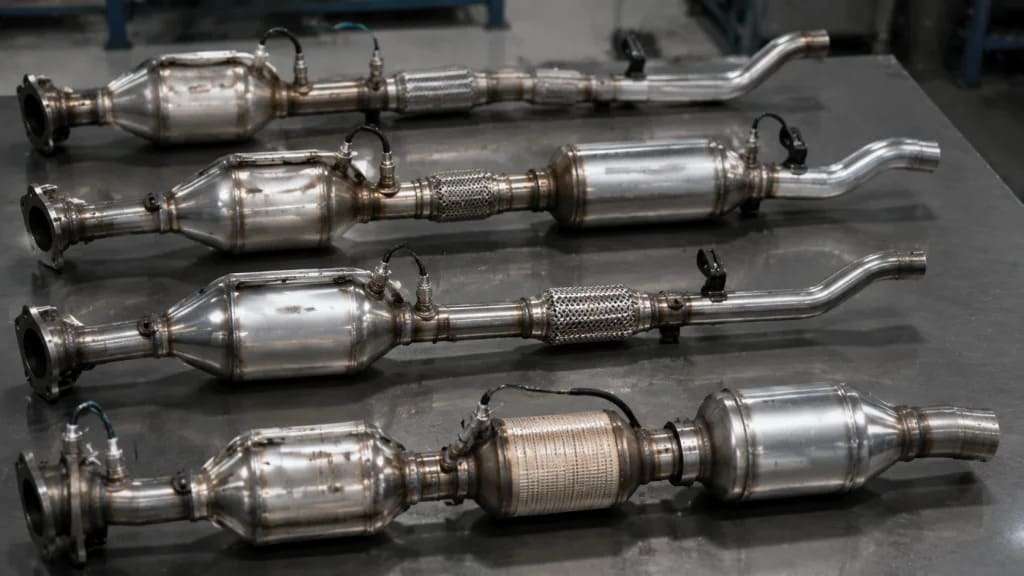
Engine → Close-coupled TWC → Underfloor GPF → Tailpipe

GDI with advanced particulate control (Euro 7 / China 7):

Engine → Close-coupled cGPF (Four-Way Catalyst) → Tailpipe

Hybrid Electric Vehicle (HEV/PHEV) – Low-temperature configuration:

Engine → Electrically Heated Catalyst (eHC) → Close-coupled TWC → Underfloor GPF → Tailpipe

Component Technologies

Three-Way Catalyst (TWC)

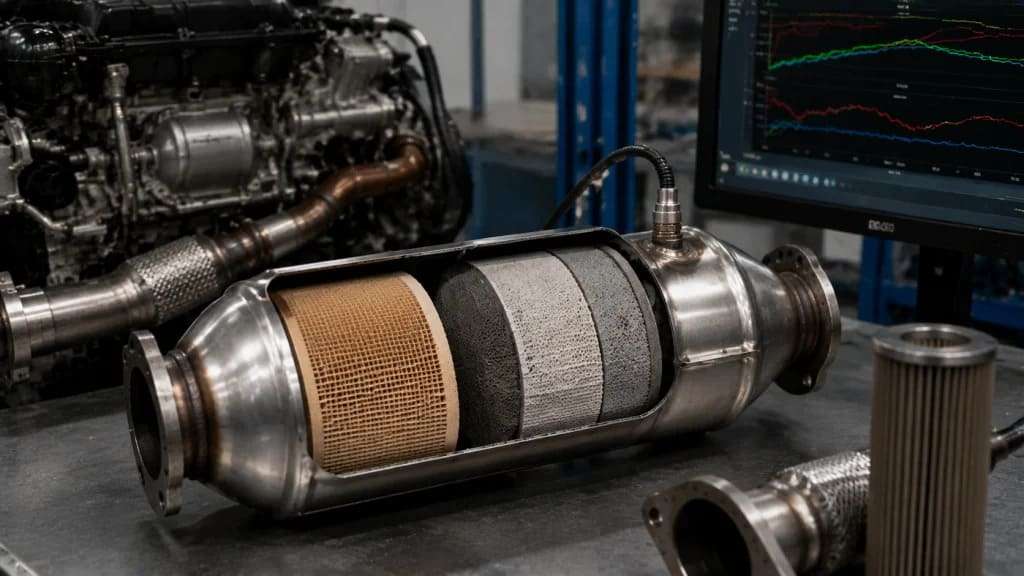
Converts CO, HC, and NOx simultaneously under stoichiometric conditions. Cordierite honeycomb (400–900 cpsi, 2–4 mil wall) with Pd/Rh washcoat (1–4 g/L Pd, 0.1–0.3 g/L Rh). Ceria-zirconia provides oxygen storage capacity to buffer air-fuel fluctuations. Conversion efficiency: >98% CO, >95% HC, >95% NOx. Light-off temperature (T50): 200–250°C.

Gasoline Particulate Filter (GPF)

Captures soot from GDI engines. Wall-flow cordierite or SiC substrate (200–300 cpsi, 8–10 mil wall, 50–60% porosity). Filtration efficiency: >99% for particles >23 nm. Passive regeneration occurs during normal driving (exhaust 500–700°C). Service life: 150,000+ km.

Catalysed GPF (cGPF / Four-Way Catalyst)

Combines TWC and GPF in one brick. Saves space, reduces backpressure, lowers cost. Provides simultaneous gas conversion (>95%) and particulate filtration (>99%).

Electrically Heated Catalyst (eHC)

Used in hybrid and Euro 7 applications. Resistive heating embedded in metallic or ceramic substrate. Reaches 300°C in under 10 seconds from cold start, eliminating cold-start emissions spikes. Powered by 48V supply, critical for plug-in hybrids.

Performance Benchmarks

Pollutant

PFI Engine Out

GDI Engine Out

After Aftertreatment

Efficiency

CO

1–3%

0.5–2%

<0.1% (<100 ppm)

>98%

HC

300–800 ppm

100–400 ppm

<50 ppm

>95%

NOx

200–800 ppm

100–500 ppm

<50 ppm

>95%

PN

1×10¹⁰ #/km

1×10¹²–1×10¹³ #/km

<6×10¹¹ #/km

>99%

Application Coverage

Vehicle Type

Engine

Aftertreatment Configuration

Key Requirements

Compact car (PFI)

1.0–1.6L

Close-coupled TWC

Low cost, 150k km durability

Midsize sedan (GDI)

1.5–2.5L

TWC + underfloor GPF

Balance gas and particulate control

SUV / Crossover (GDI)

2.0–3.5L

TWC + GPF or cGPF

High flow, low backpressure

Performance / Turbo GDI

2.0–4.0L

Dual TWC + GPF

Thermal durability >1,000°C

Full hybrid (HEV)

1.5–2.5L

eHC + TWC + GPF

Fast light-off, infrequent cycles

Plug-in hybrid (PHEV)

1.5–2.0L

eHC + cGPF

Ultra-low cold-start emissions

Key Advantages

Regulation-ready

Engineered for Euro 7 (RDE including cold start, short trips, high load), EPA Tier 3, China 7. Compliant across all real driving conditions.

Cold start optimized

Close-coupled positioning captures heat immediately. Thin-wall substrates (2 mil, 900 cpsi) reduce thermal mass. eHC option achieves 300°C in under 10 seconds. Light-off in 15–30 seconds versus 60–90 seconds for conventional designs.

Thermally durable

Cordierite substrates withstand 1,050°C continuous, 1,200°C peak. La-stabilized alumina washcoat resists sintering. Multi-layer TWC protects Rh from poisoning.

Low backpressure

GPF adds only 2–5 kPa at rated power. cGPF reduces backpressure further. High-porosity substrates (60%+) minimize flow restriction.

Hybrid compatible

Passive thermal management (insulation, heat retention). Electrically heated option for PHEVs. GPF regeneration is passive.

OBD ready

Dual oxygen sensors monitor TWC efficiency. Differential pressure sensor for GPF soot load. Temperature sensors. Catalyst aging model for remaining useful life.

Our Integration Services

Service Area

Description

Technology selection

TWC only, TWC+GPF, or cGPF based on engine type and emissions target

Substrate engineering

Cell density (400–900 cpsi), wall thickness (2–5 mil), volume (engine displacement × 1.0–1.5)

Washcoat formulation

OSC level, PGM loading optimized for cost and performance

Canning & packaging

Close-coupled or underfloor, heat shields, mounting brackets

eHC integration

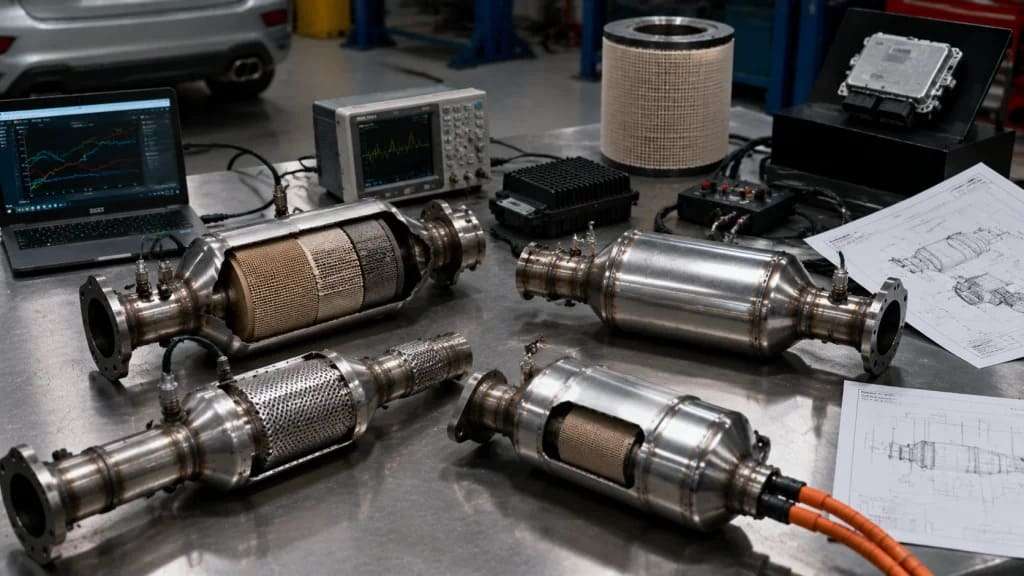
48V power supply, heater control module, thermal management

Calibration

ECU integration, AFR control, catalyst monitoring, OBD development


Why Choose Us

Proven technology

Millions of TWC and GPF units in production. Validated to Euro 6d, EPA Tier 3, China 6b.

Vertical integration

In-house substrate extrusion, washcoat formulation, catalyst coating, canning, and dosing controls. This provides single-source accountability.

Hybrid expertise

Specialized eHC and low-temperature TWC for HEV/PHEV. Cold-start emissions reduced by 70–90% compared to conventional catalysts.

Cost-effective PGM strategy

Pd-Rh formulations optimized for current metal prices. cGPF reduces total PGM by eliminating separate TWC brick.

From small-displacement PFI city cars to high-performance GDI SUVs and next-generation plug-in hybrids, our gasoline aftertreatment solutions deliver compliance, durability, and value. Partner with us to engineer your path to clean gasoline operation.