|

HENTEK CAT Catalyst & Catalytic Converter Solutions

Technical Solutions – TWC System

Complete Three-Way Catalyst Solutions for Gasoline Vehicles

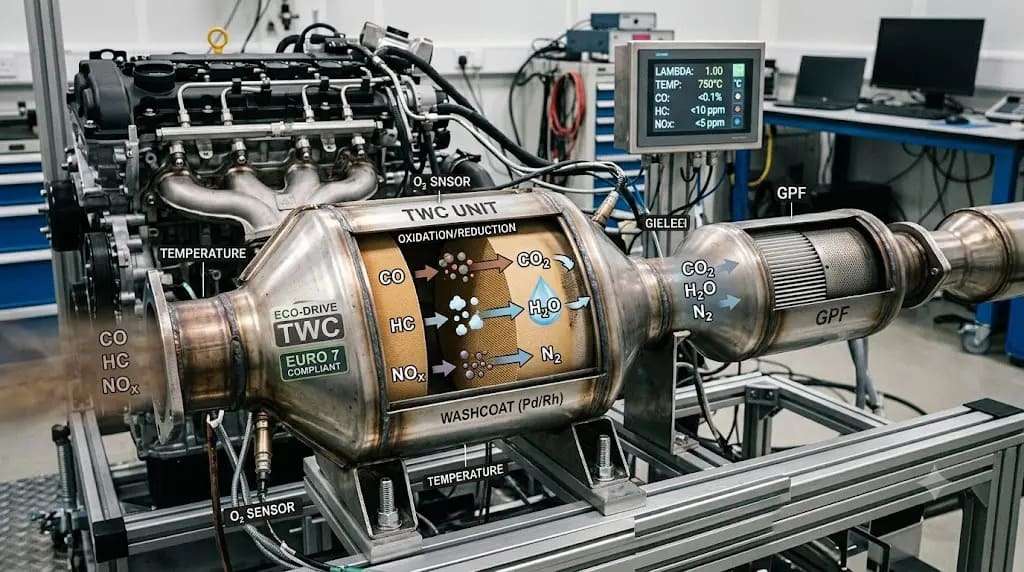
The Three-Way Catalyst (TWC) is the cornerstone of gasoline emission control – a single device that simultaneously converts carbon monoxide (CO), unburned hydrocarbons (HC), and nitrogen oxides (NOx) into harmless CO₂, H₂O, and N₂. Unlike diesel systems requiring multiple components (DOC, DPF, SCR), the TWC achieves >98% conversion efficiency under stoichiometric operation (lambda = 1.00). Our **TWC System** solutions cover port fuel injection (PFI), gasoline direct injection (GDI), hybrid electric vehicles (HEV/PHEV), and performance applications – with substrate options (ceramic or metallic), advanced washcoat formulations (Pd/Rh with high oxygen storage capacity), and integration with GPF for particulate control. Meet Euro 7, EPA Tier 3, and China 7 standards.

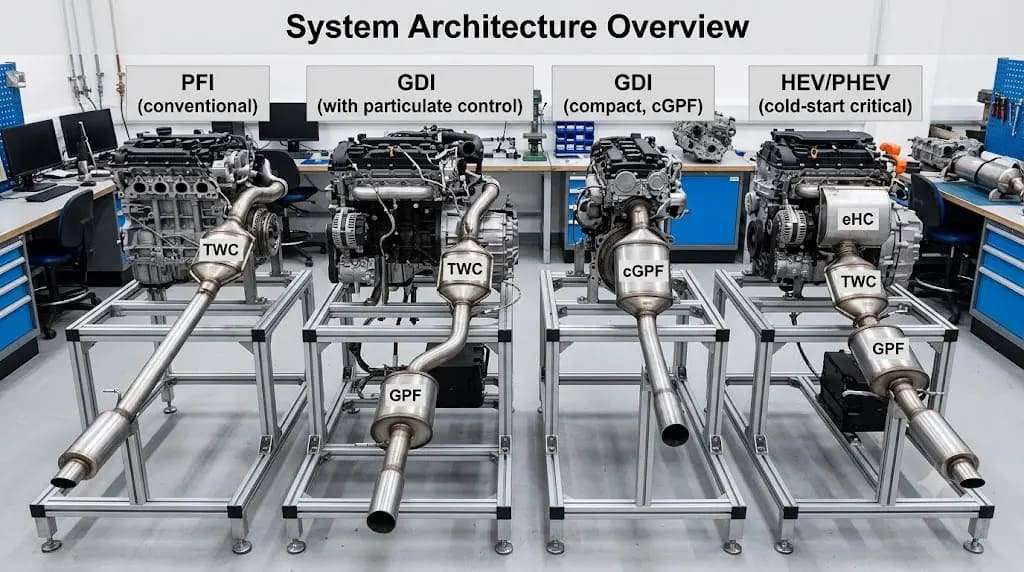
System Architecture Overview

Application

Flow

PFI (conventional)

Engine → Close-coupled TWC → Tailpipe

GDI (with particulate control)

Engine → Close-coupled TWC → Underfloor GPF → Tailpipe

GDI (compact, cGPF)

Engine → Close-coupled cGPF → Tailpipe

HEV/PHEV (cold-start critical)

Engine → eHC → TWC → GPF → Tailpipe

The Technical Route: Step-by-Step

Core Technology 1: TWC Substrate – Ceramic vs. Metallic

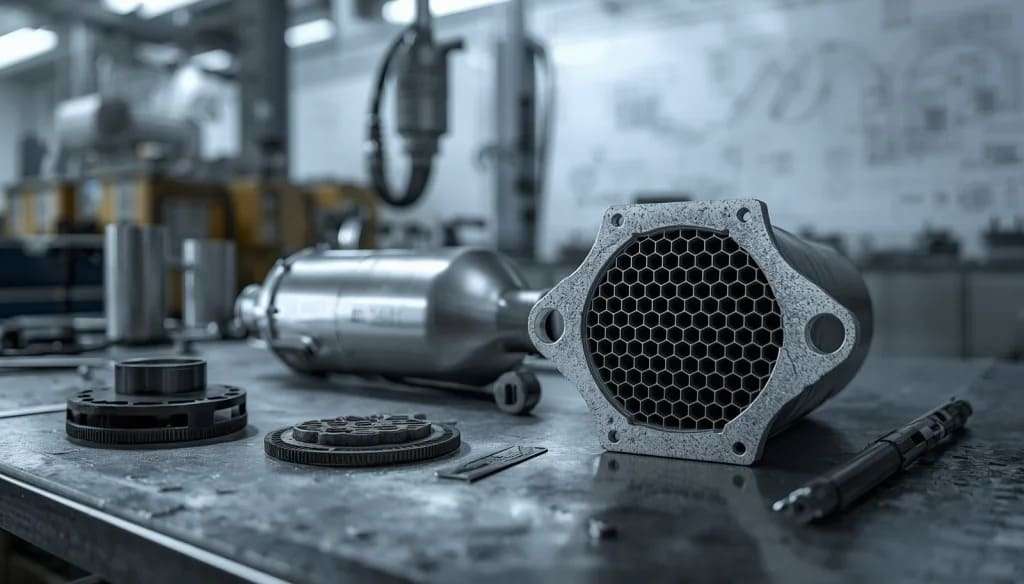
Ceramic honeycomb (cordierite): low cost, thermal shock resistant, 400-900 cpsi, 2-4 mil walls, open frontal area >80%, max 1,050°C continuous. Preferred for underfloor.

Metallic honeycomb (FeCrAlloy): fast light-off, 400-1,200 cpsi, 2-3 mil walls, light-off 15-25s, vibration-resistant, max 900-950°C. Preferred for close-coupled, motorcycles, hybrids, performance vehicles.

Substrate selection guide:

  • Underfloor, cost-sensitive → ceramic
  • Close-coupled, fast light-off → ceramic thin-wall or metallic
  • High vibration → metallic

Performance → metallic or high-flow ceramic

Core Technology 2: TWC Washcoat Formulation

Pd/Rh system: Pd 1-4 g/L (HC/CO oxidation), Rh 0.1-0.3 g/L (NOx reduction), Pd:Rh ratio 10:1–20:1, optional Pt for cold start, total PGM 1–5 g/L.

Oxygen Storage Capacity (OSC): Ceria-zirconia (20-50% of washcoat), 300–800 µmol O₂/g, buffers lambda fluctuations. Higher OSC (40–50%) for carbureted engines and hybrids.

Support & Layers:

  • γ-Al₂O₃ high surface area 150–300 m²/g
  • Stabilizers: La, Ba, Sr
  • Optional zeolites for cold-start HC adsorption

Multi-layer coating: Bottom (poison trap), Middle (NOx reduction), Top (HC/CO oxidation)

Core Technology 3: Stoichiometric Lambda Control

Lambda = 1.00 ±0.01 via upstream wideband UEGO sensor, ECU PI control on injectors. Downstream sensor monitors OSC.
Carbureted engines: Higher OSC (40-50%) compensates, 75-85% conversion
Hybrid vehicles: eHC maintains 300°C+, predictive pre-heating

Core Technology 4: TWC + GPF Integration (for GDI)

Gasoline direct injection challenge: PM/PN filtration required. Solutions: separate TWC + GPF or cGPF – single brick, TWC washcoat on wall-flow filter.
Filtration: >99% particles >23 nm
Gas conversion: >95%
Backpressure: 2–5 kPa
Passive regeneration: 500–700°C

Performance Benchmarks

Parameter

PFI + TWC

GDI + TWC + GPF

GDI + cGPF

HEV + eHC + TWC

CO conversion

>98%

>98%

>95%

>98%

HC conversion

>95%

>95%

>95%

>95%

NOx conversion

>95%

>95%

>90%

>95%

PN filtration

N/A

>99%

>99%

>99%

Light-off time (cold start)

30-45 s

30-45 s

35-50 s

5-10 s

Backpressure (kPa)

2-4

3-6

3-5

3-5


System Configurations by Application

Application

Substrate

Cell Density

Wall Thickness

PGM Loading

Special Features

PFI (Euro 6)

Ceramic

400-600 cpsi

4 mil

1-2 g/L

Standard OSC (20-30%)

GDI (Euro 6d)

Ceramic

600-900 cpsi

2-3 mil

2-3 g/L

+ Underfloor GPF

GDI (cGPF, Euro 7)

Wall-flow ceramic

300 cpsi

8-10 mil

2-3 g/L

Single brick, vacuum coated

Hybrid (HEV/PHEV)

Metallic

400-600 cpsi

2-3 mil

2-4 g/L

eHC 1-4 kW, high OSC 40-50%

Performance (sports car)

Metallic or high-flow ceramic

400 cpsi

2-3 mil

1.5-2.5 g/L

Reduced volume 30-50%, backpressure optimized

Motorcycle

Metallic

200-400 cpsi

2-3 mil

1-2 g/L

Vibration-resistant, integrated with muffler

Key Advantages of Our TWC Systems

High conversion efficiency: >98% CO, >95% HC, >95% NOx, maintains >90% after 150,000+ km

Fast light-off: Close-coupled mounting, thin-wall substrates, metallic for hybrids/performance, eHC for PHEV 5–10s

Durable and poison-resistant: La/Ba-stabilized alumina, ceria-zirconia OSC retention, cordierite withstands 1,050°C continuous, 1,200°C peak

Low backpressure: Open frontal area >80%, thin walls, cGPF reduces pressure vs. TWC+GPF separate

Our Engineering Expertise

We engineer complete TWC systems for any gasoline application. Tailored for substrate geometry, washcoat formulation, PGM loading, and coating architecture for PFI, GDI, HEV/PHEV, performance vehicles, and motorcycles.

Partner with us to define your path to compliance – TWC efficiency, stoichiometric precision.