Exploring the engineering behind the Three-Way Catalyst (TWC) and its role as the primary aftertreatment solution for stoichiometric gasoline engines.
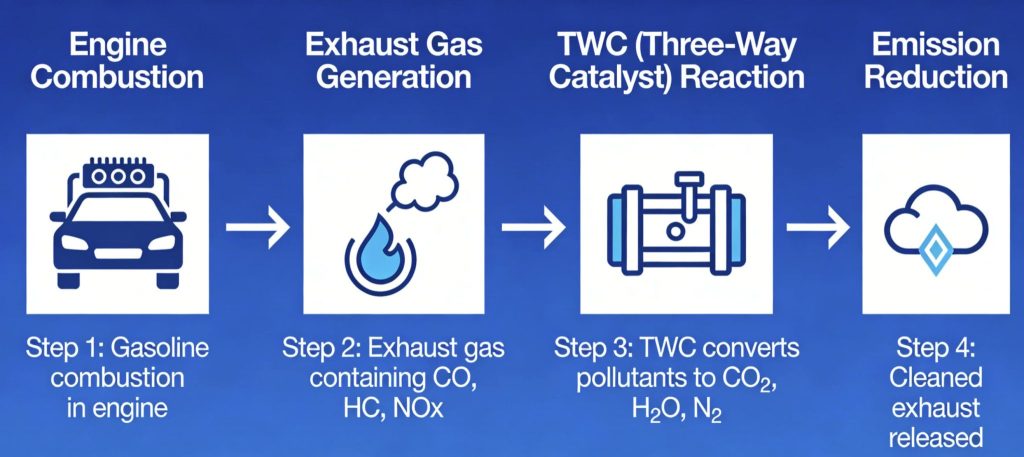
Gasoline combustion in the engine generates exhaust containing CO, HC, and NOx. A Three-Way Catalyst (TWC) then converts these pollutants into CO₂, H₂O, and N₂. This reaction significantly reduces harmful emissions. Finally, the cleaned exhaust is released into the environment. This four-step process ensures that modern gasoline engines operate more cleanly by transforming toxic byproducts into less harmful substances before they exit the vehicle’s exhaust system.
Unlike diesel engines, which operate with excess air (lean burn), modern gasoline vehicles are engineered to run at or near the stoichiometric air-fuel ratio (14.7:1) . This specific operating point is the foundation of the gasoline technical route.
Running at this ratio creates the ideal chemical environment for a single device—the Three-Way Catalyst (TWC) —to manage all primary pollutants simultaneously. This makes the TWC route the most efficient and cost-effective solution for gasoline emission control, eliminating the need for complex secondary systems like SCR (Selective Catalytic Reduction) found in diesel applications.
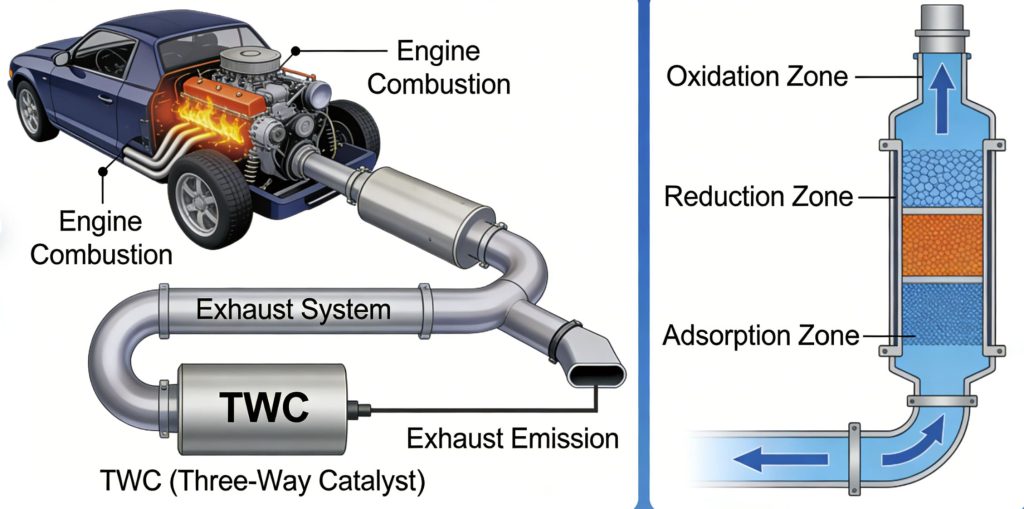
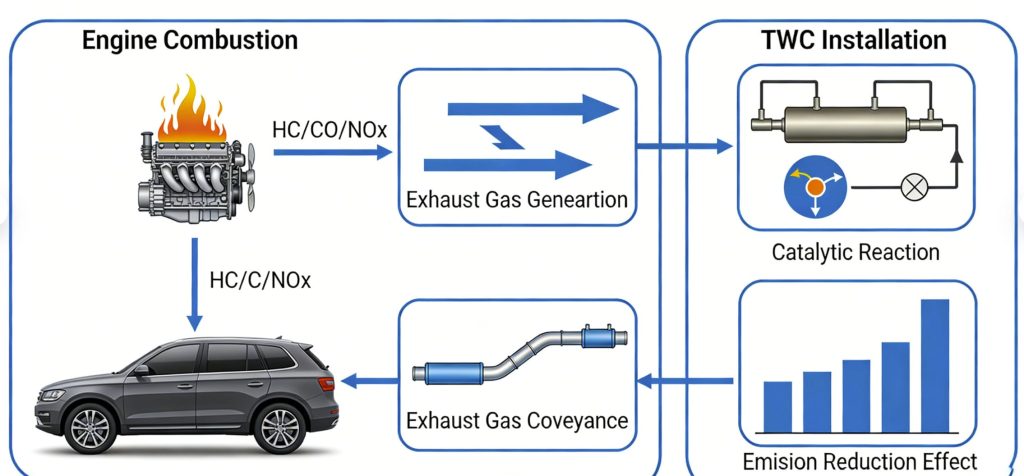
The journey of exhaust gas from the engine cylinder to the tailpipe follows a precise technical path designed to maximize catalyst efficiency.
The process begins in the combustion chamber. The Engine Control Unit (ECU), guided by the upstream Oxygen Sensor (Lambda Sensor) , continuously adjusts the fuel injection to maintain the stoichiometric ratio. This ensures the exhaust gas contains the right balance of Oxygen, CO, HC, and NOx for the TWC to process.
As hot exhaust gases exit the exhaust manifold, they immediately encounter the first stage of treatment: the Close-Coupled Catalyst.
Location: Mounted directly to the exhaust manifold.
Function: To capture “cold start” emissions. By positioning the catalyst here, it rapidly reaches its “light-off” temperature (typically above 300°C / 572°F) to begin conversion within seconds of engine start.
On many vehicles, a second catalyst is located further downstream, under the vehicle floor.
Function: To “polish” the exhaust. It further reduces any remaining pollutants and ensures the system achieves its maximum conversion efficiency (often exceeding 98-99%) by the time gases exit the vehicle.
A second Oxygen Sensor is placed downstream of the TWC. Its role is not to adjust fuel trim, but to monitor the efficiency of the catalyst itself. It checks that the TWC is storing and releasing oxygen properly, signaling to the ECU (and the vehicle’s OBD-II system) that the catalyst is working correctly.
We don’t just manufacture TWCs; we engineer them to meet the precise demands of your specific gasoline technical route. Whether you require a rapid light-off close-coupled catalyst for a hybrid engine or a high-flow underfloor unit for a large SUV, our team can tailor the substrate geometry, washcoat chemistry, and PGM loading to your exact specifications.
Partner with us to define your path to compliance.
With the advent of Gasoline Direct Injection (GDI) engines and stricter particulate number (PN) limits, the technical route is evolving. However, the TWC remains central to the strategy.
The modern high-efficiency route now looks like this:
Engine → Close-Coupled TWC (for gas conversion) → Gasoline Particulate Filter (GPF) (for soot trapping) → Tailpipe
The TWC’s Role: Still handles 100% of the CO, HC, and NOx conversion.
The GPF’s Role: Acts as a physical barrier to trap particulates.
Synergy: The TWC is often coated directly onto the GPF substrate (a concept known as Four-Way Catalyst or Coated GPF) to save space and reduce cost, creating a single-unit aftertreatment system.
We don’t just manufacture TWCs; we engineer them to meet the precise demands of your specific gasoline technical route. Whether you require a rapid light-off close-coupled catalyst for a hybrid engine or a high-flow underfloor unit for a large SUV, our team can tailor the substrate geometry, washcoat chemistry, and PGM loading to your exact specifications.
Partner with us to define your path to compliance.