
Exploring the engineering behind catalytic ozone conversion systems that transform harmful ground-level ozone into breathable oxygen – essential for air purification, industrial off-gas treatment, aerospace cabin air quality, and wastewater disinfection off-gassing.
Ozone (O₃) is a powerful oxidant used beneficially for water disinfection, air purification, and industrial bleaching. However, residual ozone is a hazardous air pollutant – a potent lung irritant regulated by occupational safety limits (OSHA PEL: 0.1 ppm averaged over 8 hours; short-term exposure limit: 0.3 ppm). Ozone naturally decomposes to oxygen (2O₃ → 3O₂), but this spontaneous reaction is slow at ambient temperatures. The ozone decomposition catalyst accelerates this conversion by orders of magnitude, reducing outlet concentrations from hundreds of ppm to below 0.05 ppm – well within safety limits. Unlike thermal destruction (heating to 300-400°C), catalytic decomposition operates at ambient temperature with no energy input, making it the preferred technology for most applications.
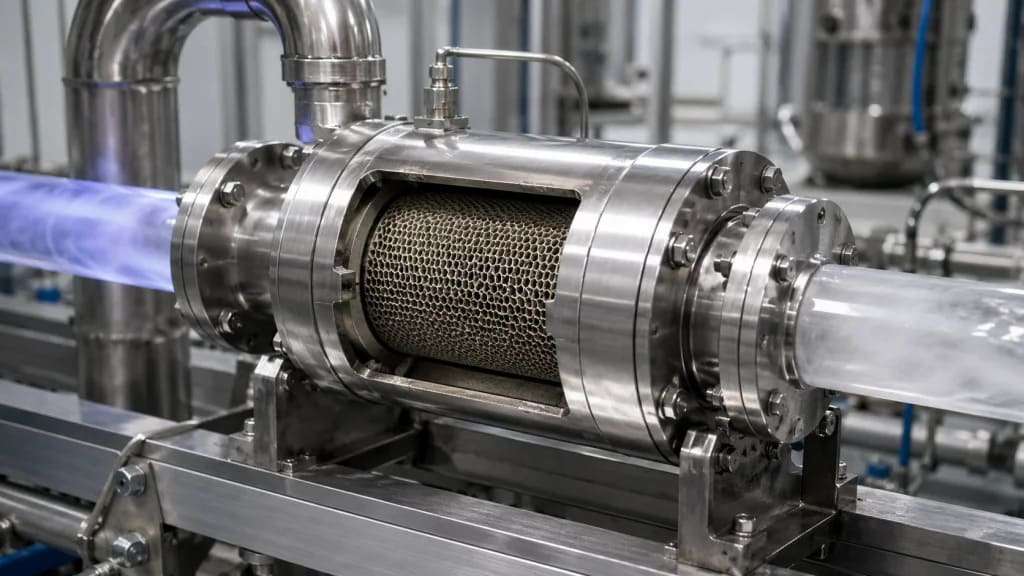

Manganese dioxide (MnO₂) – the industry standard: Manganese dioxide is the most widely used ozone decomposition catalyst due to its high activity, low cost, and ambient-temperature operation. The catalytic activity originates from variable valence states (Mn³⁺/Mn⁴⁺) and surface oxygen vacancies that adsorb and dissociate ozone. Commercial MnO₂ catalysts achieve >99% decomposition efficiency at room temperature with typical space velocities of 10,000-50,000 hr⁻¹.
Noble metal catalysts (Pt, Pd, Au on alumina): Platinum and palladium offer excellent activity and superior moisture resistance but at higher cost. Typically used in aerospace (cabin air purification) and specialty applications where absolute reliability is required.
Mixed metal oxides: Hopcalite (MnO₂/CuO mixture) – historically used in gas masks for carbon monoxide and ozone protection. Cobalt oxide (Co₃O₄), nickel oxide (NiO), and iron oxide (Fe₂O₃) provide moderate activity. Binary and ternary formulations (Mn-Cu, Mn-Fe, Mn-Co) often outperform single oxides through synergistic redox coupling.
Supported catalyst architectures: High-surface-area supports (activated carbon, alumina, silica gel, zeolites, titania) disperse the active phase and provide additional ozone adsorption sites.
Catalyst selection guide:
Catalyst Type | Active Material | Operating Temp | Relative Cost | Primary Application |
MnO₂ granular | Manganese dioxide | Ambient-100°C | Low | Industrial off-gas, copiers |
Hopcalite | MnO₂/CuO mixture | Ambient-150°C | Low | Gas masks, respirators |
Pt/Al₂O₃ | Platinum on alumina | Ambient-200°C | High | Aerospace cabin air |
MnO₂/zeolite | Manganese on zeolite | Ambient-80°C | Medium | High-humidity applications |
Packed bed design (most common): Catalyst particles (typically 1-5 mm diameter for granules, 3-6 mm for pellets) are packed into a cylindrical or rectangular chamber. Bed depth typically ranges from 25-200 mm depending on inlet concentration, flow rate, and desired outlet concentration. Key design parameter: space velocity (volumetric gas flow rate ÷ catalyst volume, typical 5,000-50,000 hr⁻¹). Higher space velocity = smaller bed = lower pressure drop but shorter residence time.
Monolithic honeycomb design (low pressure drop applications): Ceramic or metallic honeycomb substrates (200-600 cpsi) coated with MnO₂ washcoat. Advantages: very low pressure drop (1/5 to 1/10 of packed bed), no particle attrition, compact radial dimensions. Disadvantages: lower active material loading per volume, higher manufacturing cost. Preferred for high-flow applications (>1,000 m³/hr).
Key design equations:
Overall reaction: 2O₃ → 3O₂ (exothermic, ΔH = -144 kJ/mol)
Mechanism on MnO₂ (proposed, well-supported):
Kinetic model (Langmuir-Hinshelwood): Rate = k × K_O₃ × C_O₃ ÷ (1 + K_O₃ × C_O₃ + K_H2O × C_H2O). At low ozone concentrations (<100 ppm), simplifies to first-order: Rate = k_obs × C_O₃.
Temperature effects: Unlike most catalytic reactions, ozone decomposition activity decreases with increasing temperature above 50-80°C due to lower ozone adsorption. The optimum temperature for MnO₂ catalysts is typically 20-50°C (ambient to warm).
Activation energy (MnO₂): Approximately 20-40 kJ/mol – very low, reflecting the facile room-temperature reaction.
Water vapor poisoning (primary deactivation cause): Water molecules compete with ozone for active sites (surface oxygen vacancies). At relative humidity >50%, activity can drop by 50-80%. Reversible – activity recovers when dry gas flows.
Prevention strategies:
Sulfur dioxide (SO₂) poisoning (irreversible): SO₂ reacts with MnO₂ to form MnSO₄ (manganese sulfate). Irreversible – sulfate blocks active sites and cannot be regenerated at practical temperatures. For high-SO₂ applications (>10 ppm), use noble metal catalysts (Pt, Pd) or replace catalyst periodically.
Dust and particulate fouling: Physical blockage of pores and active sites. Prevention: upstream filtration (5-10 µm pre-filter).
Catalyst regeneration:
Industrial off-gas (ozone generators, corona discharge equipment): Ozone is used for wastewater disinfection, pulp bleaching, and chemical synthesis – residual ozone must be destroyed before venting. Typical inlet: 100-1,000 ppm O₃, flow 100-10,000 m³/hr. Outlet target: <0.1 ppm. Packed bed MnO₂ catalyst, SV = 10,000-20,000 hr⁻¹, bed depth 100-200 mm.
Air purification (HVAC, office copiers, laser printers): Copy machines and laser printers generate ozone from corona wires. Small granular or honeycomb MnO₂ cartridges (pencil-eraser to soda-can size). Inlet: 1-10 ppm O₃ (localized), outlet: <0.05 ppm. Room-temperature operation, life 1-3 years.
Aerospace cabin air purification: Aircraft cabins recirculate air through ozone converters to remove ozone (present at 0.1-0.5 ppm at cruising altitude). Requirements: absolute reliability, low pressure drop, long life (20,000+ hours). Pt/Al₂O₃ honeycomb or MnO₂/zeolite monolithic catalysts.
Gas masks and respirators (military/civilian): Hopcalite or MnO₂/CuO granular layers in combination with particulate filters and activated carbon. Ambient operation, high humidity tolerance required (breath moisture). Service life: hours to days depending on ozone concentration.
Ozone destruct for water treatment off-gas: Ozone contactor off-gas contains 1-100 ppm O₃ plus humidity (saturated). Requires heated catalyst (40-60°C) to prevent water poisoning, or hydrophobic catalyst.
Performance requirements by application:
Application | Inlet O₃ (ppm) | Outlet Target (ppm) | SV (hr⁻¹) | Key Constraint |
Industrial off-gas | 100-1,000 | <0.1 | 10,000-20,000 | Pressure drop |
Copier/printer | 1-10 | <0.05 | 30,000-50,000 | Compact size |
Aircraft cabin | 0.1-0.5 | <0.05 | 20,000-40,000 | Long life |
Water treatment | 1-100 | <0.1 | 5,000-15,000 | Humidity |
Step 1: Determine required destruction efficiency: η = (C_in – C_out)/C_in. Example: C_in=200 ppm, C_out=0.1 ppm → η=99.95%.
Step 2: Select catalyst and obtain kinetic constant (k). For MnO₂, first-order rate constant k = 2-10 sec⁻¹ at room temperature.
Step 3: Calculate required residence time: τ = -ln(1-η)/k. Example: η=99.95%, k=5 sec⁻¹ → τ = -ln(0.0005)/5 = 7.6/5 = 1.52 seconds.
Step 4: Calculate catalyst volume: V_cat = Q × τ. Example: Q=1,000 m³/hr = 0.278 m³/s → V_cat = 0.278 × 1.52 = 0.42 m³.
Step 5: Determine bed dimensions: For packed bed, select bed depth (L) to balance ΔP and diameter. Typical L/D = 1-5.
Step 6: Verify space velocity: SV = Q/V_cat = 1/τ = 1/1.52 = 0.658 sec⁻¹ = 2,370 hr⁻¹ (check against typical range; if too low, select higher activity catalyst).
We engineer ozone destruction solutions across the full application spectrum. Whether you require a high-activity, low-cost MnO₂ granular packed bed for an industrial ozone generator off-gas stream (1,000 ppm inlet, 0.1 ppm outlet), a hydrophobic MnO₂/zeolite honeycomb for a high-humidity water treatment application, or a long-life Pt/Al₂O₃ monolithic converter for aircraft cabin air, our team tailors the catalyst composition, support architecture, bed geometry, and optional pre-treatment to your specific ozone concentration, flow rate, humidity level, and outlet compliance target.
Partner with us to define your path to compliance – decompose and breathe safely.
Hydrophobic MnO₂ formulations: Fluorinated or silane-modified MnO₂ surfaces resist water adsorption while maintaining ozone activity. Extends effective catalyst life in high-humidity applications without pre-drying.
Low-temperature plasma-regenerable catalysts: Catalysts that can be regenerated in-situ by dielectric barrier discharge (DBD) plasma – oxidizes surface sulfates and organics, restoring activity without removing the catalyst bed.
Transparent thin-film catalysts (indoor air quality): MnO₂ or cobalt oxide coatings on glass, plastic, or HVAC surfaces – ozone decomposition integrated into building materials.
Room-temperature catalysts for low-concentration ozone (<10 ppb): Emerging formulations with extremely high low-concentration activity – targeted at indoor air quality where even 10-20 ppb ozone has documented health effects.
The ozone decomposition catalyst is a mature, reliable, highly efficient technology operating at ambient temperature with no energy input. A well-engineered system achieves >99.9% destruction efficiency, resists water poisoning through proper design, and provides years of service life. Whether you are treating industrial off-gas, purifying aircraft cabin air, or removing ozone from a copier exhaust, catalytic ozone decomposition will define your workplace safety and regulatory compliance – and we are ready to engineer the solution.