|

HENTEK CAT Catalyst & Catalytic Converter Solutions

Non-Road (Machinery Emission Control) – Marine Power

Complete Emission Control Solutions for Marine Diesel Engines

Marine diesel engines power a vast fleet – from small fishing boats and pleasure craft to inland waterway vessels (tugboats, ferries, barges) and large ocean-going ships. International and regional regulations have become increasingly stringent: IMO Tier III (2016+, NOx control in Emission Control Areas), EPA Tier 4 (2014+, US waterways), and EU Stage V (2019+, inland waterway). Marine engines face unique challenges: high-sulfur fuel (up to 3.5% globally, 0.1% in ECAs), saltwater corrosion, wet exhaust systems, and very long service lives (20,000-50,000+ hours). We provide complete, validated aftertreatment solutions for marine diesel engines from 100 kW to 10+ MW.

The Marine Power Challenge

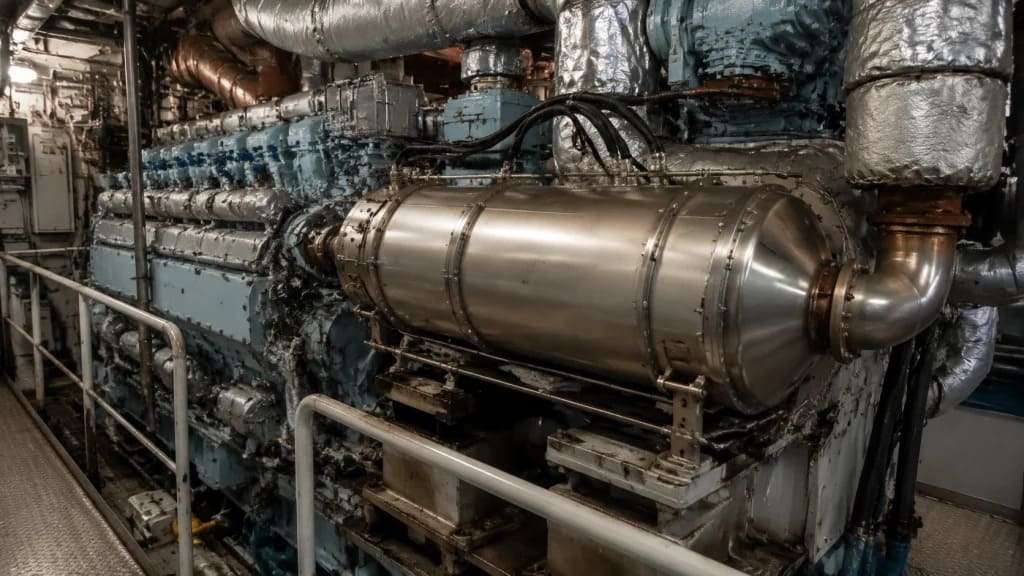
Marine engines operate in corrosive saltwater environments with high fuel sulfur. Exhaust may be wet for cooling or spark arresting, requiring corrosion-resistant materials. Vibration and motion (pitch, roll) demand ruggedized packaging. Systems use sulfur-tolerant vanadia SCR, high-grade stainless (316L, duplex), and seawater-resistant components.

Our Marine Aftertreatment Architecture

Application

Configuration

IMO Tier III / EPA Tier 4 (low-sulfur ECA, 0.1% S)

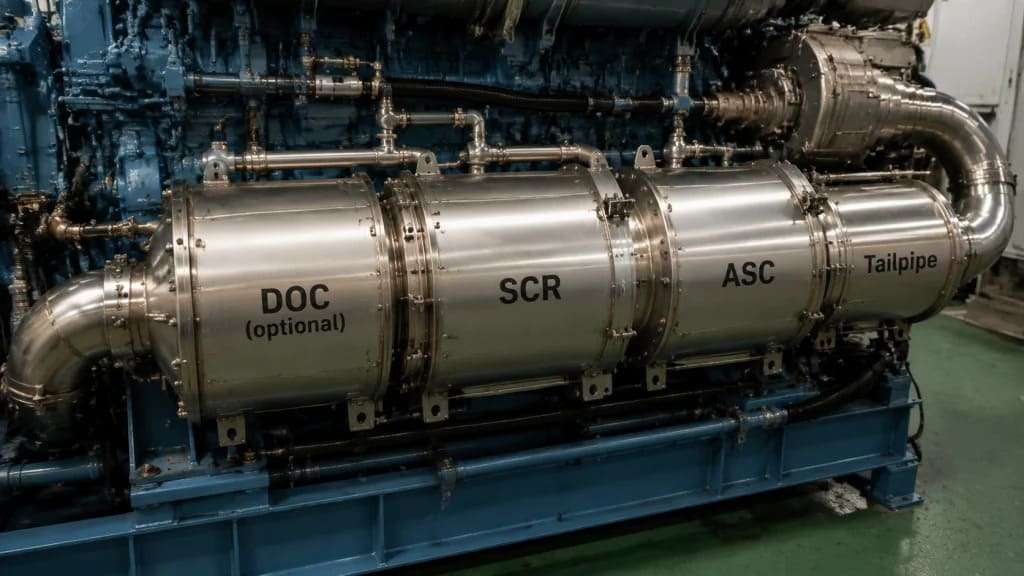
Engine → DOC (optional) → SCR → ASC → Tailpipe

Global / high-sulfur fuel (3.5% S, non-ECA)

Engine → SCR (vanadia) → Tailpipe

Small marine / pleasure craft (50–500 kW)

Engine → DOC → SCR → ASC → Tailpipe

Core Component Technologies

Selective Catalytic Reduction (SCR)

Vanadia-based (V₂O₅/WO₃/TiO₂), sulfur-tolerant, 300–450°C. Honeycomb or plate catalyst. NOx reduction: 80–95% (IMO Tier III). Service life: 10,000–25,000 hrs.

Diesel Oxidation Catalyst (DOC)

For smaller engines (<1 MW) with low-sulfur fuel. Converts CO/HC, generates NO₂ for SCR. Optional on large engines to avoid fouling.

Ammonia Slip Catalyst (ASC)

Pt on alumina. Reduces NH₃ slip <10 ppm in enclosed engine rooms.

Urea Dosing System

Marine-grade DEF or aqueous ammonia. Corrosion-resistant injectors, heated lines, redundant pumps for reliability, automatic purge to prevent crystallization.

Wet Exhaust Compatibility

SCR mounted upstream of water injection. Corrosion-resistant housing (316L, duplex, Inconel). Condensate drains prevent acid pooling.

Performance Benchmarks

Engine Type

Fuel Sulfur

Aftertreatment

NOx Outlet

IMO Tier III Limit

Medium-speed (ferry, tug)

0.1% (ECA)

SCR (vanadia)

2.5–3.0 g/kWh

3.4 g/kWh

Medium-speed (global)

3.5%

SCR (vanadia)

3.0–3.4 g/kWh

N/A

High-speed (yacht, fishing)

0.1%

DOC + SCR

2.0–2.5 g/kWh

3.4 g/kWh

Low-speed (ocean-going)

3.5%

SCR (plate)

3.0–3.5 g/kWh

N/A

Application Coverage

Vessel Type

Power Range

Fuel

Aftertreatment

Key Requirements

Ferry (inland/coastal, ECA)

500 kW–5 MW

0.1% S diesel

SCR + ASC

Continuous duty, enclosed engine room

Tugboat / workboat

1–5 MW

0.1–3.5% S

Vanadia SCR

High load, extreme vibration, salt spray

Cruise ship auxiliary

2–10+ MW

0.1% S

SCR (or EGR + SCR)

Hotel load, NH₃ slip control

Fishing vessel

200–2,000 kW

0.1–3.5% S

DOC + SCR

Unattended operation, remote monitoring

Pleasure yacht

500–5 MW

0.1% S

DOC + SCR + ASC

Silent operation, zero odor

Inland barge / tanker

300–2,000 kW

0.1% S

SCR + ASC

Limited engine room space, low-load idle

Passenger HSC

1–10+ MW

0.1% S

SCR (plate)

High exhaust flow, compact packaging

Naval / coast guard

1–20+ MW

0.1–3.5% S

SCR (redundant)

Shock resistance, silent mode

Key Advantages

Sulfur-tolerant vanadia SCR

Maintains >80% NOx reduction with 3.5% fuel S. Operates globally (low- or high-sulfur). Service life 10,000–25,000 hrs.

Corrosion-resistant construction

316L stainless, duplex 2205, Inconel. Salt-spray tested >2,000 hrs. Condensate drains.

Ruggedized for marine vibration

ISO 10816 compliant, reinforced catalyst supports, braided stainless urea lines, sealed connectors (IP67).

Wet exhaust compatible

SCR upstream of water injection, thermal shock protection, backflow prevention.

Low-temperature operation

Electric pre-heater for SCR, exhaust bypass for cold start, insulated catalyst housing.

Reliable urea dosing

Marine-grade injectors, heated lines, redundant pumps, automatic purge, fail-safe derate mode.

IMO Tier III certified

Onboard monitoring (NOx, NH₃ slip, exhaust flow, temperature), data logging, remote telematics.

Our Integration Services

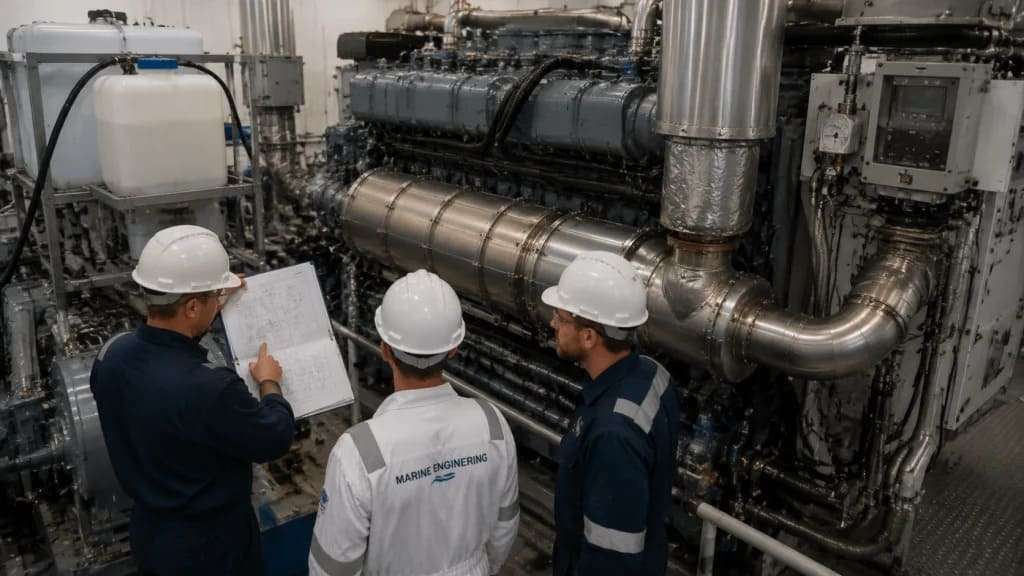
  • Application assessment – Vessel type, engine speed, fuel type, operating area, engine room layout
  • Technology selection – Vanadia SCR vs. Cu-zeolite, plate vs. honeycomb, ASC for enclosed spaces
  • Mechanical packaging – Engine room integration, urea storage/dosing, exhaust bypass for cold-start and low load
  • Corrosion protection – Material selection, condensate management, saltwater ingress prevention
  • Controls integration – Engine control system, NOx feedback, onboard data logging
  • Installation & commissioning – Shipyard supervision, sea trials, crew training

Why Choose Us

Marine expertise

Hundreds of marine SCR systems in operation, validated to IMO Tier III, EPA Tier 4, EU Stage V.

Sulfur-tolerant vanadia technology

Works globally with 0.1–3.5% sulfur fuel. Maintains Tier III compliance in ECAs.

Corrosion engineering

2,000+ hour salt-spray certified, wet exhaust integration, condensate-free designs.

Global support network

Marine service engineers at major ports, emergency response, remote telematics.

From a 200 kW fishing vessel in the North Sea to a 10 MW ferry in US ECAs or a superyacht in the Mediterranean, our marine aftertreatment solutions deliver IMO Tier III compliance, corrosion resistance, and operational reliability in the harshest saltwater environments.