|

HENTEK CAT Catalyst & Catalytic Converter Solutions

Non-Road (Machinery Emission Control) – Construction Machinery

 Complete Emission Control Solutions for Construction Equipment

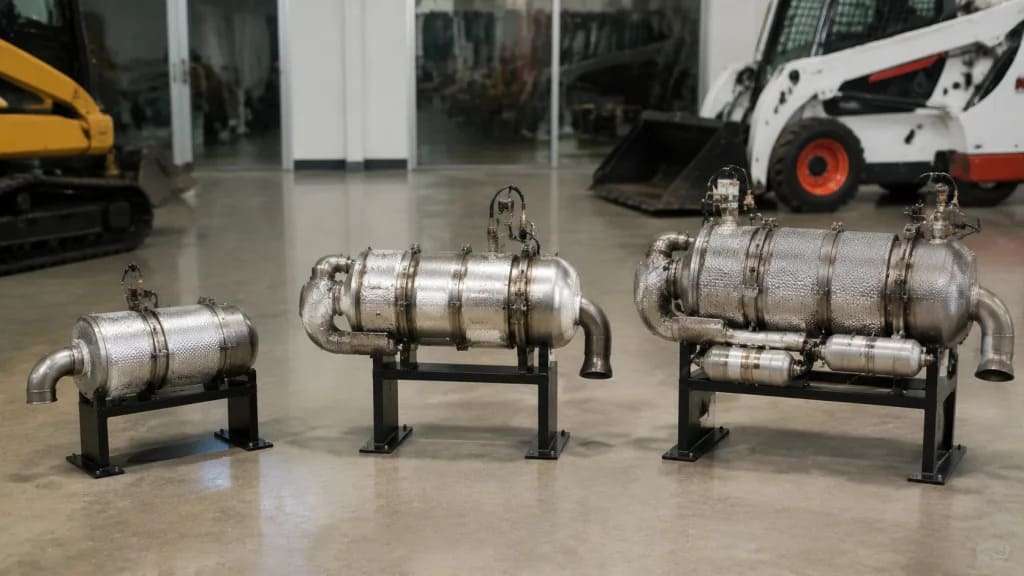
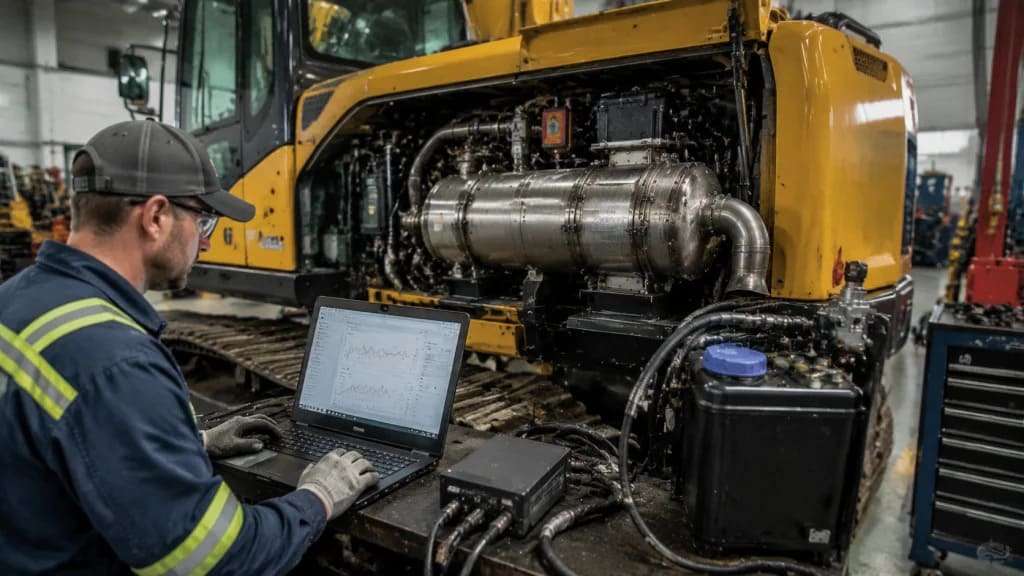
Construction machinery – excavators, bulldozers, wheel loaders, backhoes, motor graders, and compact track loaders – operates in demanding environments: extreme vibration, dust, moisture, and tight urban job sites. Regulations: EU Stage V, EPA Tier 4 Final, China Stage IV. Required reductions: PM 90–99%, NOx 80–95%. Our DOC, DPF, and SCR aftertreatment systems are rugged, space-efficient, and serviceable.

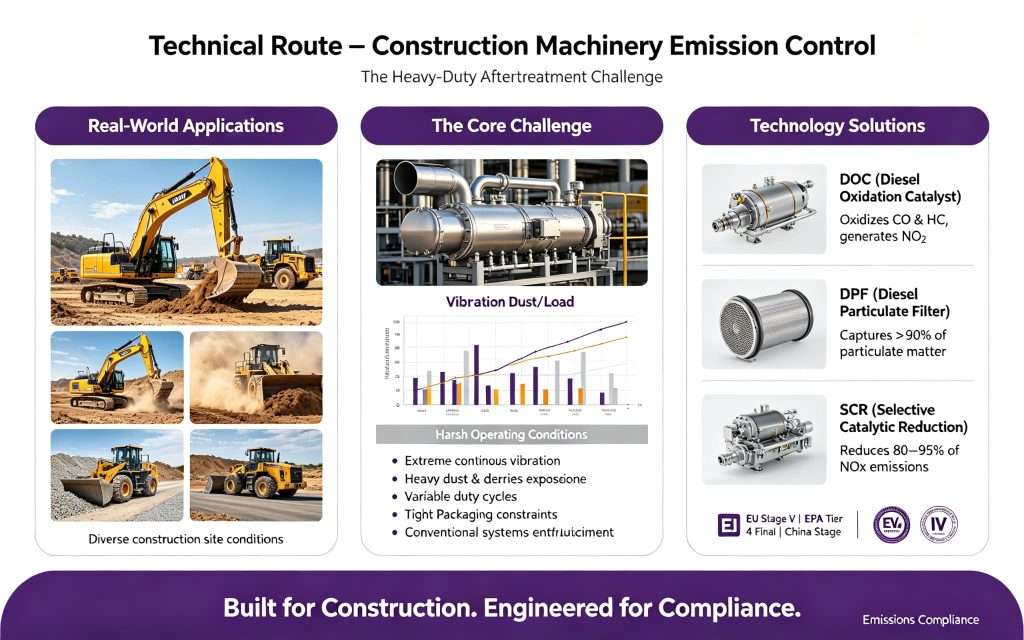
The Construction Machinery Challenge

Equipment operates under continuous vibration, extreme dust, tight packaging, and variable duty cycles. Unlike agricultural machinery, construction machines work in confined spaces (urban sites, tunnels, indoor demolition), requiring safe exhaust heat and emissions management.

Our Construction Aftertreatment Architecture

Power Range

Typical Machinery

Aftertreatment Configuration

<56 kW (75 hp)

Compact equipment, skid steers, mini excavators

DOC or DOC+DPF

56–130 kW (75–174 hp)

Midi excavators, compact loaders, backhoes

DOC → DPF → SCR (ASC optional)

130–560 kW (174–750 hp)

Large excavators, bulldozers, wheel loaders

DOC → DPF → SCR → ASC → Tailpipe

Core Component Technologies

Diesel Oxidation Catalyst (DOC)

Converts CO and HC, generates NO₂ for DPF regeneration. Must tolerate extreme vibration (10–20g, 50–200 Hz). Compact packaging and oversized volume (20–30% larger) for extended service intervals.

Diesel Particulate Filter (DPF)

Traps soot and ash. It uses a wall-flow cordierite or SiC substrate with more than 99% filtration efficiency. Passive regeneration happens during normal driving using NO₂. Active regeneration uses fuel post-injection and DOC exotherm when soot load exceeds the threshold, typically 4–6 g/L. Service life is 300,000+ km with proper ash cleaning.

Selective Catalytic Reduction (SCR)

The primary NOx removal system. It uses Cu-zeolite at 175–500°C or Fe-zeolite at 250–550°C on a cordierite honeycomb. DEF, also known as AdBlue, contains 32.5% urea and is injected upstream. It decomposes into NH₃, which reduces NOx into N₂ and H₂O. Conversion efficiency is 90–99%. Closed-loop control is managed with upstream and downstream NOx sensors.

Ammonia Slip Catalyst (ASC)

Reduces NH₃ slip to <10 ppm for enclosed cabs and underground construction.

Performance Benchmarks

Pollutant

Engine Out

After Aftertreatment (Stage V / Tier 4)

Efficiency

NOx

300–1,000+ ppm

<0.4 g/kWh (56–560 kW)

85–95%

PM

0.1–0.8 g/kWh

<0.015 g/kWh

>98%

CO

100–500 ppm

<10 ppm

>95%

HC

50–200 ppm

<10 ppm

>95%

Application Coverage

Machinery

Power Range

Aftertreatment

Key Challenges

Mini excavator

<56 kW

DOC + DPF

Tight packaging, indoor regen inhibit

Midi excavator

56–130 kW

DOC + DPF + SCR

Vibration, urban job sites

Large excavator

130–560 kW

DOC + DPF + SCR + ASC

Long hours, high load, operator comfort

Skid steer / compact track loader

<75 kW

DOC + DPF

Low load, frequent starts, dust

Wheel loader

100–500 kW

DOC + DPF + SCR + ASC

Extreme dust, reversing fans

Bulldozer

200–560 kW

DOC + DPF + SCR + ASC

High load, remote operation

Backhoe loader

50–100 kW

DOC + DPF + SCR

Mixed duty cycle, public roads

Motor grader

100–300 kW

DOC + DPF + SCR

Variable load, precision grading

Compactor / roller

50–150 kW

DOC + DPF

Extreme vibration, low-speed operation

Demolition excavator

200–500 kW

DOC + DPF + SCR + ASC

Extreme dust, fire risk

Key Advantages

Vibration-tolerant design

Rubber-isolated mounts, braided stainless DEF lines, sealed IP67/IP69K connections, thick-wall canning (3–4 mm stainless).

Low-load regeneration management

Active regen controlled by soot load, regen inhibit for hazardous areas, parked regeneration on job site.

Tight packaging solutions

Vertical or side-mounted configurations, SCRoF for compact space, heat shields protect hydraulic lines and fuel tanks.

Urban job site safety

Regeneration inhibit, high-temperature warning decals, insulated/double-wall cans (<200°C surface).

Indoor / underground capability

Electric pre-heater and eSCR maintain catalyst temperature during low-load or indoor operation. Battery-powered DEF heater and line heater. MSHA/ATEX certified.

Remote telematics

Real-time monitoring of soot load, regeneration status, DEF level, fault codes. Predictive alerts for maintenance.

Our Integration Services

  • Application assessment – Power category, duty cycle, environment, chassis space
  • Technology selection – DOC+DPF or +SCR, SCRoF for space-constrained equipment
  • Mechanical packaging – Vertical/side-mounted, vibration isolation, heat management
  • Regeneration management – Inhibit logic, parked regen, indoor/tunnel mode
  • DEF system design – Heated tank/lines, crystallization-resistant injector, compact frame integration
  • Telematics integration – Remote monitoring, predictive maintenance, job site regen planning

Why Choose Us

Proven in construction

Thousands of systems worldwide. Validated to Stage V, Tier 4 Final, China Stage IV.

Rugged packaging expertise

Vibration-tested, dust/water ingress tested, thermal cycling (-40°C to +800°C, 1,000 cycles).

Indoor/underground certified

eSCR for zero-emission operation, low surface temperature packages (<180°C).

Global field support

Dealer network and field service engineers available during critical project windows.

From 20 kW aerial lifts to 300 kW air compressors, our industrial diesel aftertreatment solutions deliver worker-safe emissions, indoor-compatible regeneration, and regulatory compliance without productivity compromise. Partner with us to engineer your path to cleaner factory operations.