Step 1: The Hybrid Cold-Start Problem
- Conventional vehicles: one cold start per trip, engine keeps catalyst above light-off
- HEVs/PHEVs: engine may start multiple times:
- Initial cold start: warms catalyst
- Electric-only driving: catalyst cools
- Engine restart: cold catalyst, high emissions
- Catalyst temperature can drop from 400°C → 100°C in 5–10 minutes of electric driving
- Engine restart produces 60–80% of cold-start emissions
Step 2: Electrically Heated Catalyst (eHC) – Core Technology
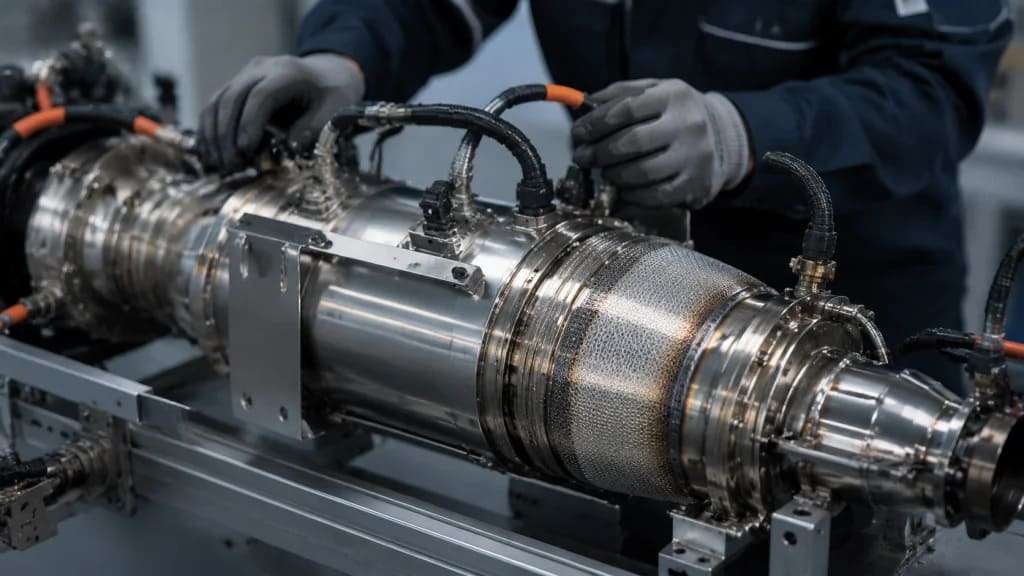
- Resistive heating element integrated into or upstream of TWC substrate
- Maintains catalyst above light-off when engine is off
- Rapidly reheats catalyst 300°C in <10 s when engine restarts
Construction:
- Metallic foil substrate (FeCrAlloy) with printed resistive tracks
- Ceramic substrate with embedded conductive grid (emergent)
- 48V power supply (from hybrid battery)
- Heater power: 1–4 kW depending on catalyst volume and target temperature
Operating modes:
- Standby heating (200–400 W): maintains 150–200°C, minimal battery drain
- Rapid reheat (2–4 kW): 150°C → 300°C in 5–10 s before engine restart
- Cold-start assist (2–4 kW, 10–30 s): accelerates initial light-off from ambient → 300°C
Energy consumption:
- Standby: 50–100 Wh per hour (acceptable for 10–20 kWh PHEV battery)
- Rapid reheat: 5–10 Wh per restart
- Cold-start assist: 15–30 Wh per trip
- Total energy: <3% of typical PHEV battery capacity
Step 3: Thermal Management Strategy
Active control:
- Sensors at eHC outlet and TWC inlet
- PID-modulated eHC power maintains 300–350°C during engine-off
- ECU predicts restart (accelerator, SOC, navigation) and pre-heats catalyst
Passive retention:
- Insulation: ceramic fiber wrap, aerogel blanket
- Heat storage: phase-change materials, high-specific-heat ceramics
- Extends cool-down from 5–10 → 15–30 min
- Close-coupled mounting minimizes heat loss
Engine calibration:
- Delayed intake valve closing (Miller cycle) raises exhaust temp
- Increased idle speed: 900–1,200 rpm during cold start
- Reduced EGR to raise combustion temperature
Step 4: Three-Way Catalyst (TWC) for Hybrids
- Low-temperature optimized: ceria-zirconia 40–50% of washcoat (vs 20–30%)
- Lower PGM loading possible (eHC maintains temperature)
- Faster light-off formulation: Pd-rich top layer, reduced diffusion barriers
Substrate:
- Thin-wall metallic preferred for eHC integration
- Lower thermal mass than ceramic: 300°C in 5–10 s
- Cell density: 400–600 cpsi, wall thickness 2–3 mil
Volume optimization: engine displacement × 0.8–1.0 (vs 1.0–1.5 for conventional)
Step 5: GPF Integration for GDI Hybrids
- Catalyzed GPF (cGPF / Four-Way Catalyst): TWC washcoat on wall-flow filter
- Single brick saves space and weight
- Passive regeneration sufficient (500–700°C)
- Electric pre-heating of GPF ensures catalyst activity before engine restart
Step 6: Control Strategy – Predictive Thermal Management
Rule-based (current generation):
- eHC activates if SOC >30% and engine-off >2 min
- Catalyst temperature monitored; eHC engages if <200°C
- Engine restarts if catalyst ≥150°C and driver power demand low
Predictive (next generation):
- GPS & navigation predict electric-only range and engine restarts
- ML learns driver behavior
- Cloud-based route optimization maintains catalyst temperature
- Pre-heating triggered before high power demands