
Industrial flue gas streams present a dual threat: hazardous carbon monoxide (CO) gas and fine particulate matter (PM10, PM2.5, coal dust). Unlike conventional systems that treat each pollutant separately, the integrated CO adsorption + dust control technical route removes both contaminants in a single, energy-efficient process. This approach is critical for steel mills, coal mines, sponge iron plants, and cement kilns where carbonaceous gases and dust co-exist. By combining physical filtration for particulates with selective chemisorption for CO, this route achieves >99% dust removal and >85-90% CO capture while minimizing equipment footprint and operating costs.
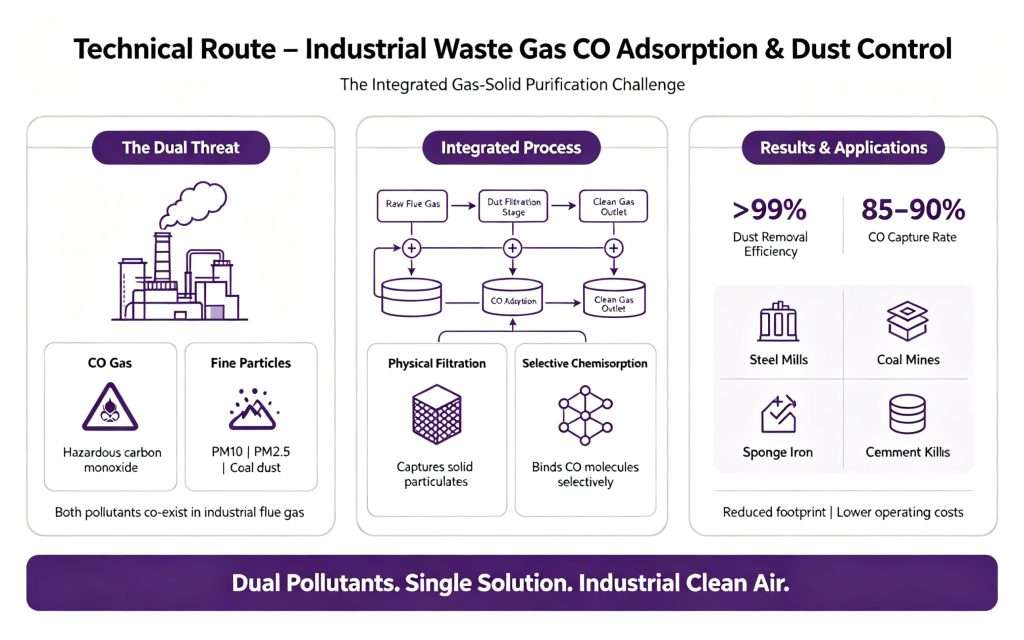

Complete system architecture:
Industrial flue gas → Pre-treatment (cooling/quench) → Integrated adsorber-filter → Clean gas to stack
The fully submerged self-primed venturi scrubber is the core technology for simultaneous removal. The system operates by creating a high-velocity gas-liquid interaction zone where both particulate matter and soluble gases are captured.
Operating principle:
Flue gas enters the venturi throat (60-80 m/s velocity). Scrubbing liquid (water or alkaline solution) is injected, creating intense atomization. Dust particles collide with liquid droplets (inertial impaction, direct interception). CO and other gases are absorbed into the liquid phase (mass transfer). Cleaned gas exits through a demister.
Performance benchmarks:
Advantages:
For higher CO removal efficiency (>95%), a packed tower follows the venturi scrubber. The tower contains random packing (Pall rings, Raschig rings, or structured packing) that increases gas-liquid contact area.
Absorption chemistry:
CO is relatively insoluble in water, requiring chemical enhancement. Alkaline solutions (NaOH, KOH, or amine-based) react with CO:
CO + OH⁻ → HCO₂⁻ (formate)
Operating parameters:
Pressure drop: 50-200 mm H₂O per meter of packing
For applications requiring sub-ppm CO outlet (<10 ppm), a fixed-bed adsorber provides final polishing. Activated carbon is widely used due to its internal pore structure and high surface area (800-1,500 m²/g).
Modified activated carbon formulations:
Regeneration:
Pressure swing adsorption (PSA) enables rapid cycling for continuous operation
When wet scrubbing is unsuitable (e.g., water-sensitive processes, cold climates), dry baghouse filters provide >99% dust removal efficiency. Pulse-jet cleaned bags extend service life by 20% over standard designs. EN 15021 certified, suitable for fine particulate capture down to 0.5 µm.
Technology | CO Removal Efficiency | Dust Removal Efficiency | Operating Temp | Key Advantage |
Self-primed venturi scrubber | 85-97.5% | 99.9% (coal dust) | Ambient-80°C | Simultaneous removal, no bag replacement |
Packed bed absorber (MEA) | 86% (instantaneous) | N/A | 20-60°C | High CO loading, low cost |
AC/PPy nanocomposite filter | 88.5% | N/A | Ambient-200°C | High capacity 478 mg/g |
Baghouse filter | N/A | >99% | Up to 200°C (Nomex) | Dry process, heat-resistant media |
Steel mills / sponge iron plants: Flue gas contains CO (1,000-5,000 ppm) and fine iron oxide dust. Recommended: Venturi scrubber + packed bed absorber. Achieves <50 ppm CO and <10 mg/m³ dust.
Coal mines / coal preparation plants: Coal dust (explosion hazard) and CO from conveyors/crushers. Recommended: Wet scrubber (fully submerged) + baghouse. Achieves 99.9% dust removal, 97.5% CO capture.
Cement kilns: CO from incomplete combustion, high-temperature dust. Recommended: Baghouse (Nomex fabric, 200°C rating) + AC adsorber. Achieves <10 mg/m³ dust, <100 ppm CO.
Chemical plants (acid gas streams): Venturi scrubber with alkaline solution neutralizes HCl, HF, H₂S while capturing CO.
Enclosed space air supply: CO monitors activate audible alarm at 10 ppm (OSHA/NIOSH). AC/PPy filters remove CO to <10 ppm for breathing air panels.
One integrated unit removes both gas and solid pollutants. Reduced equipment footprint (30-50% smaller). Lower capital and operating costs. Simplified permitting and compliance monitoring.
Self-primed venturi design uses liquid recirculation (no external pumps for priming). Low pressure drop compared to conventional venturi (30-50% reduction). Reusable adsorbents (thermal or pressure swing regeneration).
Industrial solid wastes (coal ash, slag) can be modified as low-cost adsorbents for CO and other gaseous pollutants. Supports circular economy principles.
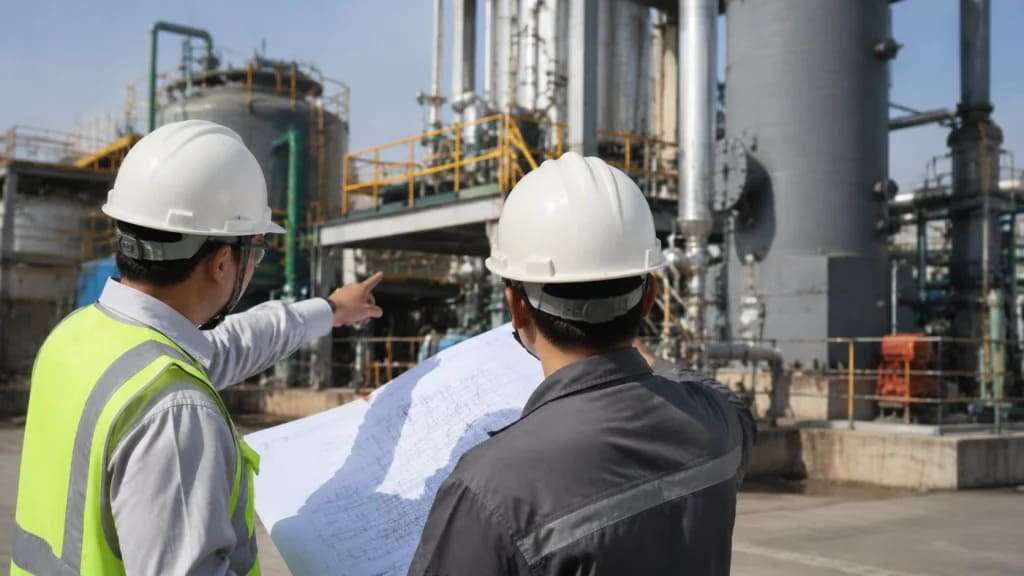
We engineer complete CO adsorption + dust control systems for any industrial application. Whether you require a high-velocity self-primed venturi scrubber for coal dust and CO (99.9% PM / 97.5% CO removal), a MEA-loaded packed tower for chemical plant off-gas, or an AC/PPy nanocomposite filter for breathing air CO polishing, our team tailors:
All customized to your specific gas composition, particulate loading, flow rate, and outlet compliance target.
Partner with us to define your path to compliance – integrated CO and dust control, cleaner industrial emissions.