
Exploring the engineering behind catalytic decomposition systems that convert residual hydrogen peroxide into harmless water and oxygen – essential for aerospace propulsion, industrial sterilization, and wastewater treatment.
Hydrogen peroxide (H₂O₂) is a powerful oxidizer used as a green propellant, a sterilizing agent (vaporized H₂O₂ for medical and space decontamination), and an oxidant in wastewater treatment. However, residual high-concentration H₂O₂ poses explosion risks, severe burns, and health hazards. While H₂O₂ spontaneously decomposes into H₂O and O₂ (2H₂O₂ → 2H₂O + O₂), this self-decomposition is extremely slow. The H₂O₂ destruction catalytic converter accelerates decomposition by orders of magnitude, reducing concentrations from thousands of ppm to below 1 ppm – the safe long-term exposure limit.
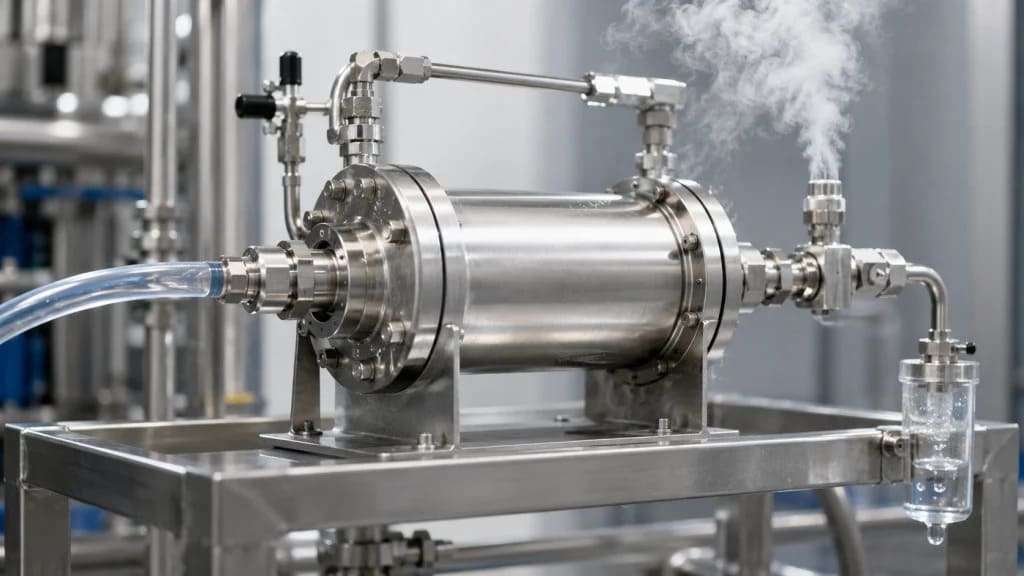

Noble metal catalysts (Pt, Pd, Au): Platinum (Pt) is the most effective active component. Trace Pt-loading (as low as 0.57 wt%) on transition metal hydroxide supports achieves excellent performance – catalytic activity approximately twice that of transition metal catalysts alone.
Transition metal-based catalysts: Manganese dioxide (MnO₂), silver screens, iron oxides (Fe³⁺), cobalt (Co²⁺), and nickel (Ni²⁺) offer lower-cost alternatives. MnO₂/PbO/Al₂O₃ catalysts are established in H₂O₂ monopropellant thrusters with catalyst capacity of approximately 3.75 g/cm³•s. Layered double hydroxides (LDHs) – particularly NiAlCrFe-based multinary hydroxides – exhibit active VHP decomposition properties.
Supported catalyst architectures: Nickel foam (NF) provides an ideal 3D porous substrate due to large surface area, low pressure drop, and mechanical robustness. Carbon nanotubes (CNTs) and modified PAN fibers serve in wastewater treatment.
Catalyst selection guide:
Catalyst Type | Active Material | Operating Temp | Primary Application |
MnO₂/PbO/Al₂O₃ | Manganese-lead-alumina | 500-900°C | Rocket thrusters |
Pt@NiAlCrFe-LDHs/NF | Trace Pt + layered hydroxides | Ambient-200°C | VHP sterilization |
Fe³⁺-PAN fibers | Iron on polyacrylonitrile | 50-90°C | Wastewater CWPO |
Packed bed design (most common): Catalyst particles (0.5–3 mm diameter) packed into a cylindrical chamber. Bed depth ranges from 1/2 to 6 inches. Chambers approximately twice the volume of the catalyst bed are preferred – the space above reduces injector heating, permits better distribution, and prevents bed channeling.
Multi-tray support systems: Several trays lock catalyst in place, preventing unpacking from pressure surges. Trays made from 1/4-inch or thicker material are structurally adequate.
Radial-inflow bed design: For large gas generators, radial-inflow cylindrical beds offer large flow area in small volume, cooled walls, and ability to wind screen catalyst into a one-piece bed.
Overall reaction: 2H₂O₂ → 2H₂O + O₂ (exothermic, ΔH = -98.2 kJ/mol)
Mechanism: On Pt-based catalysts, O-O bond splitting and consecutive hydrogen-transfer reactions occur. Synergistic effects of trace Pt and transition metal hydroxides lead to larger amounts of surface O* and HO* species.
Kinetics: Decomposition follows pseudo-first-order kinetics. Different catalysts exhibit different mechanisms:
Temperature effects: Higher temperatures accelerate decomposition. Lower H₂O₂ concentrations require greater bed depths.
H₂O₂ decomposition is highly exothermic. For high-concentration H₂O₂ (85-98%), exhaust temperatures reach 800-900°C (1,472-1,652°F). The catalyst bed must withstand these temperatures without sintering.
Heat control challenges: When catalyst packs chill, starting is seriously delayed or prevented. Starting surges following delayed starts sometimes have been catastrophic. Silver-screen catalysts are particularly easy to chill due to high bed conductivity – both manifold and valve explosions have occurred.
Thermal isolation: A canister provides contact resistance or a cooled-gas boundary between canister and chamber walls, thermally isolating the catalyst.
High-temperature materials: Stainless steel walls suit small systems with very heavy walls. For large systems, high-nickel-cobalt alloys (e.g., Haynes 25) are successful. Nickel and cobalt are catalytically active and self-protecting.
Catalyst capacity: Mass flow rate of fully decomposed propellant per unit catalyst bed volume (ṁ_fully-decomposed / V_bed). Determined empirically but can be inaccurate.
Scaling methodology: One-dimensional catalytic decomposition modeling (temperature, pressure, species concentration profiles) enables precise scaling. Pressure drop can be expressed as a constant, allowing optimum catalyst bed size determination through parametric analysis.
Model validation: Static firing tests on 100-N H₂O₂ monopropellant thrusters (MnO₂/PbO/Al₂O₃ catalyst) validate model accuracy – temperature estimations concur with experimental data.
Scaling parameters:
Aerospace monopropellant thrusters: Complete decomposition of rocket-grade H₂O₂ (85-98%). Catalyst bed sized for >99.99% decomposition.
Vaporized H₂O₂ (VHP) sterilization (spacecraft, medical): Residual VHP must be removed to <1 ppm for long-term human exposure. AlCrFePt₀.₆₄/NF reduces VHP from 250 ppm to 1 ppm in 59 minutes. After 10 recycling tests, no significant deterioration.
Wastewater treatment (CWPO): H₂O₂ generates hydroxyl radicals (•OH) that oxidize organic pollutants (pharmaceuticals, dyes, isopropyl alcohol). Complete conversion within 24 hours; 70% mineralization achieved.
Performance requirements:
Application | Target Concentration | Required Efficiency | Key Constraint |
Spacecraft VHP removal | <1 ppm | >99.9% | Low temp, durability |
Rocket thrusters | 100% decomposition | >99.99% | High temp, ΔP |
Wastewater CWPO | Complete pollutant removal | >90% | •OH generation |
We engineer H₂O₂ decomposition solutions across the full application spectrum. Whether you require a high-temperature MnO₂/PbO/Al₂O₃ packed bed for a 100-N green propellant thruster, a trace Pt-loaded transition metal hydroxide catalyst for spacecraft VHP sterilization, or an Fe³⁺-PAN fibrous catalyst for industrial wastewater CWPO treatment, our team tailors the catalyst composition, support architecture, bed geometry, and thermal management to your specific H₂O₂ concentration, flow rate, temperature window, and destruction efficiency target.
Partner with us to define your path to compliance – decompose, detoxify, deliver.
Multi-component synergistic catalysts: AlCrFePt/NF nanocomposites with 3D porous frameworks provide large specific surface area and rapid gas flow. Synergistic effects of noble-metal Pt and transition metals are the key origin of high catalytic performance.
Low-PGM and PGM-free catalysts: Trace Pt-loading (0.57 wt%) achieves performance approaching full Pt catalysts at dramatically reduced cost. Transition metal hydroxides continue to improve.
Catalytic decomposition modeling: One-dimensional models incorporating temperature, pressure, species concentration, and catalyst particle size enable precise scaling without extensive experimental campaigns.
Self-cleaning and poison-resistant formulations: Materials resistant to sulfur, phosphorus, and silicon poisoning – critical for wastewater and industrial applications with contaminated feedstocks.
The H₂O₂ destruction catalytic converter is not a simple decomposition device – it is a precision chemical reactor operating from ambient sterilization to 900°C rocket thrust. A well-engineered system achieves >99.99% decomposition efficiency, withstands thermal shock and pressure surges, and maintains activity across thousands of cycles. Whether you are sterilizing a spacecraft, propelling a launch vehicle, or treating industrial wastewater, H₂O₂ catalytic decomposition will define your operational safety and environmental compliance – and we are ready to engineer the solution.