
Hopcalite powder is a finely divided black or dark brown catalytic material composed of mixed copper and manganese oxides (CuMnOx). As the precursor or active component for formed catalysts (pellets, granules, honeycombs), this powder form serves respirator canisters, catalytic filter coatings, and industrial gas purification systems. Since its discovery around 1920, Hopcalite has remained the industry standard for ambient-temperature carbon monoxide (CO) oxidation, converting lethal CO into harmless CO₂ without external heating. The synergy between copper and manganese oxides—through an oxygen spillover mechanism where MnO₂ acts as the oxygen donor and CuO as the acceptor—creates a redox system that dramatically lowers the activation energy for CO oxidation, enabling room-temperature operation.
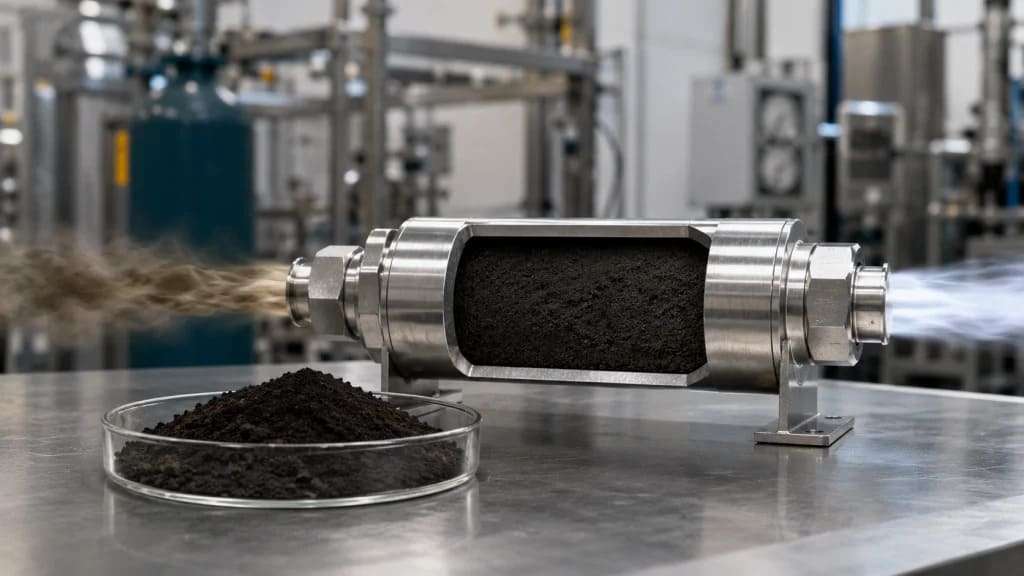

Classic Hopcalite consists of a mixture of manganese dioxide (MnO₂) and copper oxide (CuO). The Mn:Cu mole ratio typically ranges from 2.2:1 to 3:1, with combined effective constituents of 80% minimum. The powder appears black or dark brown and is hygroscopic—moisture content is strictly controlled at 3-5% maximum.
The synergy mechanism—copper oxide alone and manganese oxide alone exhibit only moderate catalytic activity. However, when combined, they form a cooperative redox couple: Cu²⁺ + Mn³⁺ ⇆ Cu⁺ + Mn⁴⁺. This electron transfer enables a spillover effect where manganese oxide donates oxygen species to copper oxide, which serves as the primary active site for CO adsorption and oxidation. The reaction proceeds as: 2CO + O₂ → 2CO₂, catalyzed at temperatures from -20°C to 50°C.
The spinel question—earlier research attributed Hopcalite’s high activity to the copper manganese spinel (CuMn₂O₄). However, subsequent studies demonstrated that the synergy arises from physical cooperation between distinct CuO and Mn₂O₃ phases rather than a single spinel phase. The most active Hopcalite contains approximately 40% Mn₂O₃, 20% CuO, and 40% spinel when calcined at 550°C. High crystallinity correlates with activity loss—amorphous or poorly crystalline structures exhibit superior performance.
Gold-modified Hopcalite—the addition of 1-6% gold during coprecipitation enhances catalytic activity for propane and VOC total oxidation. Gold-containing Hopcalite demonstrates stable activity through cycling and increased stability compared to conventional Hopcalite, though the light-off temperature is not significantly lowered.
The preparation method profoundly influences powder properties. Co-precipitation is the industry standard, producing the most active Hopcalite due to lower crystallinity and higher surface area.
Co-precipitation procedure:
Critical preparation parameters:
Parameter | Optimal Range | Impact on Performance |
Mn:Cu mole ratio | 2:1 to 3:1 | Lower ratios decrease activity; higher ratios waste Mn |
Precipitation pH | 8-9 | Affects particle size and phase composition |
Drying temperature | 80-120°C | Higher temperatures cause cracking |
Calcination temperature | 300-550°C | >600°C causes sintering and irreversible deactivation |
Calcination atmosphere | Flowing air | Ensures complete oxidation to MnO₂/CuO |
Flame spray pyrolysis (alternative)—for moisture-resistant applications, flame spray pyrolysis produces nanoparticles (180 m²/g) with hydrophobic carbonaceous surface layers, reducing deactivation at up to 75% relative humidity. This method avoids alkali metal contamination from sodium carbonate used in co-precipitation.
Commercial Hopcalite powder is classified as particles finer than 80 mesh (177 µm) to over 200 mesh (74 µm).
Key specification table:
Parameter | Typical Value | Test Method |
Appearance | Black/dark brown powder | Visual |
Mn:Cu mole ratio | 2.2:1 – 3:1 | ICP or XRF |
Effective constituents (Mn+Cu) | ≥80% | Gravimetric |
Specific surface area (BET) | 170-320 m²/g | N₂ adsorption |
Bulk density | 0.65-0.80 g/ml | Tapped density |
Moisture content | ≤5% | Loss on drying |
Particle size | <74-177 µm (80-200 mesh) | Sieve analysis |
Mechanical strength (formed) | 18-60 N/cm | Crush strength |
Higher surface area (≥240 m²/g) correlates directly with greater catalytic activity, as more active sites are available for CO adsorption.
Water vapor poisoning (primary cause)—water molecules compete with CO for active sites on the catalyst surface. At relative humidity exceeding 50%, conversion efficiency drops rapidly, and prolonged exposure can cause irreversible deactivation. This is why Hopcalite powder must be stored in sealed, dry containers and is typically used with upstream desiccant layers in respirator canisters.
Thermal degradation (sintering)—above 600-700°C, Hopcalite undergoes irreversible activity loss due to:
During CO oxidation, the exothermic reaction (ΔH = -283 kJ/mol CO) can raise bed temperatures above 600°C when inlet CO exceeds 2.5 volume percent, causing catastrophic deactivation.
Sulfur and alkali poisoning—sulfur dioxide (SO₂) and alkali metals (sodium, potassium) permanently poison Hopcalite. Flame spray pyrolysis synthesis produces contaminant-free powder by avoiding alkali-containing precursors.
Regeneration limitations—once deactivated by water or thermal sintering, Hopcalite cannot be practically regenerated in field conditions. This restricts its use to short-duration, controlled-humidity applications.
Respiratory protection (primary application)—Hopcalite powder is loaded into canisters for firefighter escape masks, mine rescue equipment, and military gas masks. It removes CO from breathing air at room temperature without external power. The powder is typically layered with desiccants (silica gel or molecular sieves) to maintain low humidity around the catalyst.
High-purity gas production—Hopcalite is used in air separation units to remove CO and hydrogen impurities from feed air before cryogenic distillation, producing ultra-high purity nitrogen for electronics manufacturing. For hydrogen removal, higher Cu:Mn ratios (0.8-7) are preferred to optimize hydrogen capacity.
Industrial off-gas treatment—powdered or granulated Hopcalite treats exhaust streams containing CO, volatile organic compounds (VOCs), and ozone (O₃) from printing, coating, and chemical processes.
Catalytic filter coating—fine Hopcalite powder is suspended in binders and spray-coated onto honeycomb monoliths, metal meshes, or ceramic foam supports to create structured catalysts with lower pressure drop than packed beds.
Storage requirements—Hopcalite powder is highly hygroscopic and must be stored in airtight containers with desiccants. Exposure to ambient humidity for extended periods reduces activity. Sealed iron drums with inner liners are standard.
Health precautions—copper and manganese compounds are toxic if inhaled. Powder handling requires dust masks or fume extraction. Wash thoroughly after contact.
Packaging—commercial packaging: 35 kg in iron drums with polyethylene liners; 500 kg in supersacks for industrial quantities.
We engineer Hopcalite powder across the full application spectrum. Whether you require a high-surface-area (≥240 m²/g) co-precipitated powder for respirator canisters, a moisture-resistant flame-spray-pyrolysis formulation for humid industrial off-gas, or a gold-modified composition for VOC total oxidation, our team tailors the Mn:Cu ratio, particle size distribution, calcination conditions, and surface chemistry to your specific catalytic application.
Partner with us to define your path to compliance – Hopcalite powder, foundational protection.
Gold-promoted formulations—addition of 1-3% gold during co-precipitation enhances propane oxidation activity and improves stability. Gold-containing Hopcalite shows higher activity than palladium-based catalysts for VOC removal.
High Cu:Mn ratio compositions—for hydrogen removal applications, increasing the Cu:Mn molar ratio to 0.8-7 optimizes hydrogen capacity, with peak performance at ratios around 3.
Nano-Hopcalite—nanoparticle formulations (specific surface area ≥240 m²/g) provide higher activity through increased active site density. These are produced via flame spray pyrolysis or controlled co-precipitation with surfactants.
Hydrophobic surface treatments—silane or fluorocarbon coatings impart water resistance, extending service life in humid environments without pre-drying.
Hopcalite powder is not merely a raw material—it is the foundational technology enabling ambient-temperature CO oxidation across respirators, gas purification, and industrial catalysis. A well-engineered Hopcalite powder achieves >99% CO conversion at room temperature, maintains activity across thousands of cycles, and provides cost-effective protection where noble metals are uneconomical. Whether you are filling respirator canisters for firefighters, producing ultra-pure nitrogen for semiconductor fabs, or treating industrial off-gas, Hopcalite powder defines the state of the art and we are ready to engineer your solution.