
Diesel engines have long been the workhorses of heavy-duty transportation, agriculture, construction, and marine applications. Their efficiency and durability are unmatched – but their lean-burn combustion produces two pollutants that are particularly challenging to control: particulate matter (soot) and nitrogen oxides (NOx). Unlike gasoline engines, which can use a single three-way catalyst to convert all three major pollutants, diesel engines require a multi-stage aftertreatment system.
The DOC+DPF+SCR architecture is the industry standard for modern diesel vehicles, achieving >99% particulate filtration and 90-99% NOx conversion.
The DOC is the first active device after the engine. It performs three critical functions:
CO and HC Oxidation: The DOC converts >90% of CO and HC into CO₂ and H₂O using platinum and palladium catalysts. This is the same chemistry as a gasoline TWC’s oxidation reactions, but without NOx reduction.
NO to NO₂ Conversion: The DOC oxidizes a portion of the NO produced by the engine to NO₂. This is critical for downstream processes because:
Exotherm Generation: During active DPF regeneration, the ECU injects fuel late in the cylinder or via a post-injection. This fuel burns on the DOC, raising exhaust temperature to 550-650°C for soot combustion.
DOC construction: Cordierite honeycomb (200-400 cpsi, 5-8 mil wall) with Pt/Pd washcoat (0.5-3 g/L total PGM). Volume typically 1.5-3L for passenger diesel, 5-15L for heavy-duty.
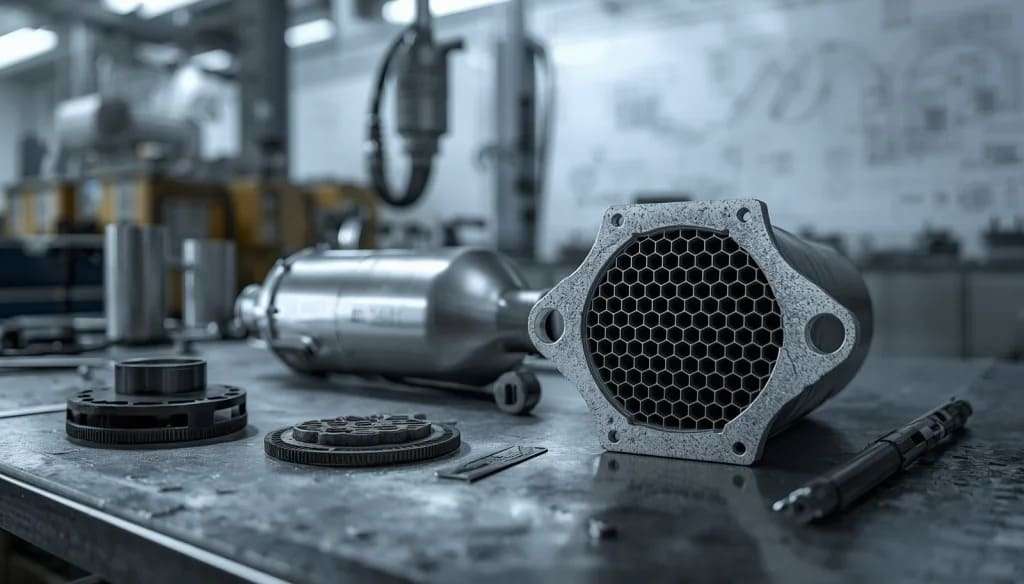
The DPF physically traps soot particles using a wall-flow substrate. Channels are alternately plugged – exhaust enters open channels and is forced through porous ceramic walls, depositing soot on the inlet side.
Filtration Efficiency: >99% for all particle sizes, including sub-23nm nanoparticles. The soot cake that forms on the channel walls actually enhances filtration efficiency – a phenomenon called “cake filtration.”
Regeneration: Accumulated soot must be periodically burned off to prevent excessive backpressure. Three regeneration modes exist:
Ash Accumulation: Metallic ash from engine oil (calcium, zinc, magnesium, phosphorus) is non-combustible and remains in the DPF after regeneration. Ash cleaning is required at 150,000-300,000 km (passenger) or 200,000-500,000 km (heavy-duty).
SCR is the primary NOx reduction device. DEF (diesel exhaust fluid, 32.5% urea) is injected upstream and decomposes to ammonia (NH₃), which reacts with NOx on the SCR catalyst.
Chemical Reactions:
Catalyst Types:
NH₃ Storage: Zeolite catalysts store ammonia on their high surface area at lower temperatures (150-250°C). This “NH₃ tank” allows SCR to function during transients when the DEF doser cannot respond instantly.
NH₃ Slip Control: Excess NH₃ is oxidized by the ASC (Ammonia Slip Catalyst) – a Pt-based catalyst downstream of SCR – to prevent ammonia odor and toxicity.
At HENTEKCAT, we engineer complete DOC+DPF+SCR+ASC systems for any diesel application:
Maximize emission reduction efficiency and eliminate process bottlenecks with HENTEKCAT's compact, high-performance catalytic converters and aftertreatment systems. Designed for targeted gas purification in automotive, non-road, marine, and industrial applications, our solutions deliver reliable and efficient emissions control directly within your exhaust stream or process line. Connect with our engineers to discuss seamless integration and specific system requirements.